The Beautiful Writers Workshop #21: The Keeper Shelf

Happy Thursday, writers! Today we’re jumping right into the craft of writing and, more to the point, how the books we read influence and inspire us. Many of us know that to be a better* writer, we must spend a lot of time reading good books.

 *I’ve heard it said many times that if you want to write well, you must devote an equal if not greater time reading, especially within your genre. I have mixed feelings on this. Yes, reading good work in your genre can be important to how you formulate story, find inspiration, and learn. But if you are doing it solely from the perspective as a writer, it can also cause you to lose a bit of that magic we call your ‘voice’. And, don’t misunderstand, I LOVE TO READ. But I will often lose myself in a good book (Thanks a bunch Chuck Wendig, you beautiful beast of a writer) to the extent that I use up most of my ‘free time’ and close the cover in a self-made brain fog, where in I can’t find my laptop let alone write something coherent. So I guess what I’m saying is: Balance.

Today, I want to talk about what you read and in particular your “Keeper Shelf”.
Ladies and Gentleman Hectic Eclectic (Part 1)

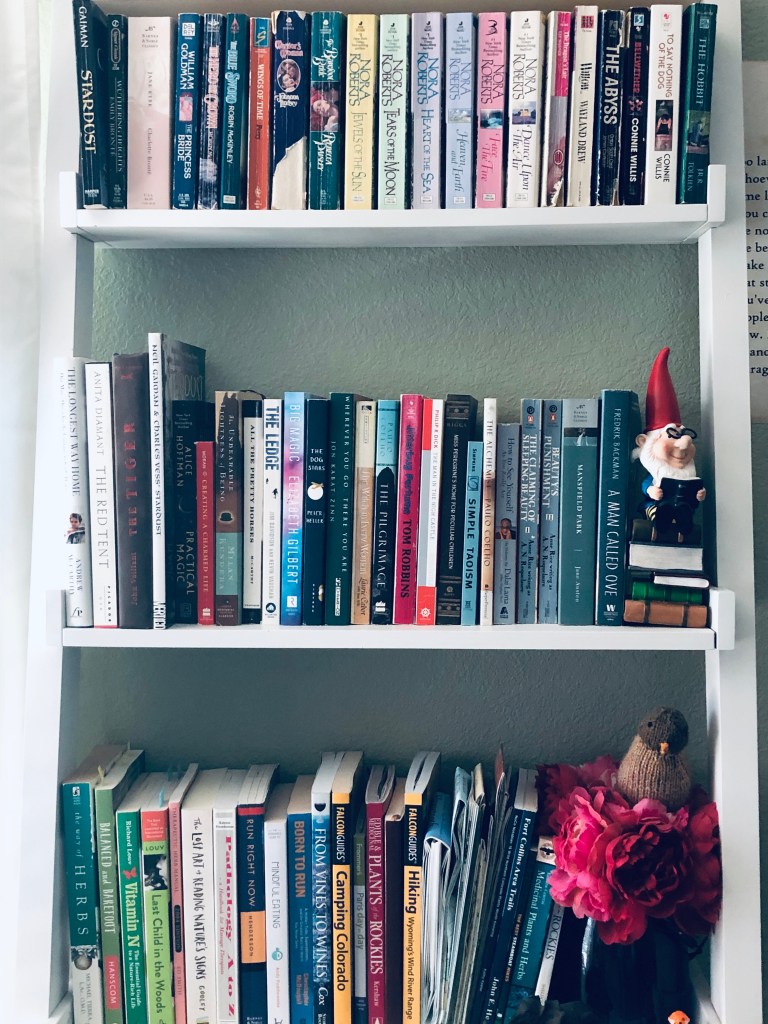
All of us have a “Keeper Shelf”, I’m sure of it. These are the books and stories that we love so much we can’t bear to part with them. They have somehow touched us, shaped us, hit that chord deep inside that makes us want to read them over and over again. This shelf is unique for each person and what’s lovely about your Keeper Shelf is that you’ve chosen these books because something about them worked so intrinsically well that you keep coming back, even when you know how it ends. These are the best ‘how to’ manuals we have as writers.

Hectic Eclectic (Part Deux). Ballerinas next to Deadpool (thanks April Kramer), a dash of Xian Terra cotta warrior and an empty bottle of what my father said was part of his worst college experience. Oh…and some of my all time favorite books. High brow.

This week, I want you to take an introspective look at an area you are struggling with in your own novel/work. For some of us, that might be dialogue. It might be story arc, it might be how best to show (not tell) emotion, character quirks, climax, scene setting, you name it. At least one of those authors on your keeper shelf has nailed a concept that you are struggling with. Once you identify what you’re trying to accomplish with a story, scene, or character, I would love you to take another look at one of your ‘faves’ that did it right.

Read, re-read, dissect it, pull it apart and diagram it on post-it notes…

“Ah, she doesn’t say Mel is sad…she makes the sky cloud over—even the setting turns dark—and  Mel misses breakfast for the third time because she can’t pull herself out of bed, and her eyes hurt, and her mom won’t stop asking her if she’s all right.”

“Ah—I can see these characters care about each other because they can pick on tender parts in their banter and only love each other more for it.”

“She leaves every chapter with a tiny cliffhanger…that’s why I can’t put it down.”

“He’s made Nessie so human and imperfect, by all the things she does despite of her internal dialogue, he makes her a hero that feels personal.”

You get the idea. It is the sincerest form of flattery and honor to use someone’s work to make yours better. Obviously, I’m not advocating for plagiarism; you will and should write your own story, but if another author’s work helps you see the difference between what works and what doesn’t, then utilize their book as a tool to get you there.

You have shelve(s) of Master’s Classes right in your own home so go through some of your old favorites and pull out the things those writers are doing to connect with you as a reader so you can do the same with your own readers.

Constant and continual improvement in our writing craft is essential to success. Because someday, we all hope that a reader gets to the last page of our book, closes the cover, puts it up on that top shelf in their library, and says, “That’s a keeper.”

The Beautiful Writers Workshop #20: Finding Romance in a Time of Disconnect

The world is a tense place right now and I know I’m not the only one who’s been suffering with a busy and worried mind. These days, these times, these overcrowded houses, and insecurities about the future don’t make for good bedfellows and it’s not just artists who are suffering.

A recent study revealed that fewer people are having sex. Especially in the younger age groups. A combination of the world’s current crises, economic disparity, job loss, women’s fears of sexual violence, and a general unease about the current “hook up” culture have left a great many of us feeling as though sex just isn’t worth all the hullabaloo. (Clear sign that people aren’t getting enough play time between the sheets is the uptake in old-timey language like “hullabaloo”, “horse feathers”, “fiddle faddle”, wisenheimer”, “canoodling” and “shenanigans”)

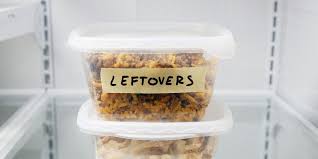
So, what better time for yours truly to have signed up for an online Romance Writers Conference this weekend, brought to us by the lovely folks at The Wordsmith Institute. Despite feeling a little ‘meh’ about love in general, my hope is that it will ignite some latent ideas that will help me finish the two or three novels that have just been sitting like cold leftovers in my fridge.

 (I should eat that before it goes bad, but I’m just not feeling like all that fiddle-faddle. I’ll make a quesadilla.)

I’m not sure how many of my writing clan out there dabbles in romance or what your current feelings are on the matter, but I think that when we are faced with a world in such serious and important chaos, the idea of a little escapism should not be dismissed too lightly. Passion comes in many forms, and when we stoke the fires of one form, we help to ignite the others. A passionate life is not just in the pursuit of justice, it is in the pursuit of love and happiness as well. And a good romance novel will follow this pursuit.

So, for today’s exercise, whether or not you write romance, I would like you to try your hand at a touch of eroticism (there’s a double meaning in there). I’m not suggesting you sit down and write your tawdriest letter to Penthouse. I don’t want to know about girth or the overused metaphors of trembling phalluses or ‘moist’ orifices. (Yuck, I think I just grossed myself out).

I want you to find the eroticism in the small details, objects, places, memories. Eroticism is more than just what you think of when you see an eggplant emoji.

Awe, they’re canoodling! (Photo by Dainis Graveris on Pexels.com)

Take your time, focus on the minute details of moments. The way a finger plucks a grape from the vine, or how a callus feels against the small of your back. Focus on the path of a rain droplet down a leaf, the low blood-warming rumble of thunder, the smell of skin warmed by sunshine. The juice of a mango running down your wrist.

Write about those moments and observations, as if it were the world teasing you.

What makes them sensual? What makes your breath quicken?

If you need more direct inspiration, here are some great suggestions from Natalie Goldberg’s “Writing Down the Bones”:

  1. What makes you hot?
  2. Name all the sexual fruits you know? What makes them so?
  3. What do you crave when you are in love?
  4. What is the most erotic part of your body? (and please, be creative, we all know the obvious ones—reach for something more interesting—well, not literally…or yes literally–what do I care what you do in the privacy of your own home? I support however you process).
  5. Write the body as a landscape.
  6. What do you connect with? (physicality, music, touch, words: think of this similarly as how you learn. Visually, orally, auditory, by doing, by reading?)
  7. Do you remember the very first time you felt desire? When was the first time you felt erotic?

Okay! There you go, something fun to get out of the world for a minute. I hope it helps to boost your writing if not your mood. Maybe your cohabiter will even benefit from these shenanigans. As Monty Python so eloquently said: “wink, wink, nudge, nudge”.

The Beautiful Writers Workshop #8: I Made You a Mixed Tape

Hello beautiful writers, how are we wordsmithing this week? (heck yes wordsmithing is a verb). Were you able to come up with some inspiration from the well of words that is Merriam-Webster?

On this installment of the workshop we’re going to shift our focus from the power of words to the power of music and what it means for our creativity.

Now, I think I’ve written on this topic before so I may be borrowing from some past inspiration, but I think it bears repeating that music has a very influential role on all of us as humans and how we make neurological connections in the process of creativity.

As a writer, I’ve met the broad spectrum of those who couldn’t possibly have the distraction of sound and voice beside them while composing their stories to those who couldn’t bear to have the room silent. You know your own style and needs best and you aren’t required to practice any of these methods I give you, but I encourage you to try a few things to see if it affects your ability to create.

If you write to music, what do you prefer? 

In my experience, it depends greatly on what I’m writing. Sometimes I chose the music based on the scene I’m trying to create, or the mood that I want to convey. Sometimes the music is based solely on the character whose perspective I’m writing from, and what I think the soundtrack of their life looks like.

(ahem, in case you weren’t aware: we all have a soundtrack of our life, it’s what plays in our heads as the day progresses and during those times of elation or sadness…don’t believe me? Sit still with your thoughts for a couple of hours and see what little dittys pop up.)

When I write poetry I listen to something more instrumental and flowing, because the words in my head can’t be confused with any other words outside of it, When I write essays for my classes, classical music is fine but I have to stay away from rock because it breaks my focus and makes me randomly use my highlighter for a mic while I stand on my desk and belt out “My Sharona”. I once spent a few months embroiled in the genre of country, waist deep in Kenny Chesney and George Strait tracks, writing a romance novel about a country star trying to start his life over. This certainly helped: Tip of my tongue

Remember, singers and songwriters are creatives, people who understand emotion and the depth of lyrical effect. They are poets and expansive to our own work.

So this week’s assignment is to explore music as a way to get in touch with the mood of your scenes, the background and feelings of your characters, and inspire you to create more flowing and free works of art. I’ve listed a few of my favorite albums, artists and songs to write by lately, and remember I’m a romance novelist so…these aren’t going to be everyone’s jam.

The Pride and Prejudice Soundtrack: Pride and Prejudice

Brandi Carlile’s Bear Creek Album

Hozier (anything by that beautiful Irish, nature-jesus is golden by me)

The Head and the Heart “Down in the Valley” and “Rivers and Roads”

A Fine Frenzy

Ray LaMontagne

Jason Isbell (former front singer of The Drive By Truckers)

The Civil Wars

First Aid Kit

Kina Grannis’ cover of “Iris” Iris

Ruston Kelly

Anderson East

This one from Ashley Monroe is a favorite ‘mood’ song: Hands on You

Ruth B.

Wow, I could go on all day, but I DO have other things to get to. I hope you have a musically inspired day.

Good luck out there, and let me know what you prefer to write to. Even if it’s silence.


The Beautiful Writers Workshop: Week #6 Character Development


Good Morning! Quick announcement for those of you following such things. The Beautiful Stuff Poetry Anthology of 2019-2020, “No Small Things” will be released this coming Monday the 17th of February! Appropriately just past Valentine’s Day. That means you can buy it for a belated gift, because everyone knows the actual day is just a commercial driven, chocolate and sex-fest. (if it were just a chocolate and sex-fest, without the commercialism, I’d be totally for it.)

But a stunning book of poetry is the gift that keeps on giving.

Stay tuned for pictures, samples, and book giveaways happening this month and thru March. Also, be on the lookout for a book signing to happen this Spring in Fort Collins. I will let you know the date and place as it solidifies.

AND NOW THIS:

First off, where in the hell are your haiku’s?

None? Psh…cowards.

Okay, here’s a few from some brave souls out there.

Miss. Elliana Byrne from Boulder, Colorado sent me this lovely and thought worthy collaboration of five.

He said, I can’t help

With all your mental raving

You’ll have to sort it


He said, I was sweet

A juicy peach to bite, hard

But I talk too much


He said, breathe deeply

When I’m not so insecure,

He might give a fuck.


He said, I wouldn’t

Not with you, and your baggage

Stacked higher than sin.


They all want to taste

But none want to swallow me.

Jagged edge sweetness


Here are a few of my own in “honor” of the upcoming holiday.


1.

Silence stole my heart

You are gone, and I am lost

You were my constant.


2.

February lies

In drifts of heart-shaped candy

All love is false hope.


3.

Mechanical heart

Pumping without feeling love

Empty valves digress.


4.

She carried it well

Cancer of melancholy

consumed heart tissue.


There’s no time limit on these exercises and no order so if you want to send me anything from The Beautiful Writer Workshop, feel free.


NOW, ON TO THIS WEEK’S BEAUTIFUL STUFF:

This week’s exercise is short and sweet (not 17 syllables short, you’ll need some time on this one.)

Take ten to thirty minutes (together or in pieces) and pick either one of your favorite characters from a work in progress OR a favorite character from an already published book.

Write their backstory.

Where were they born? What was the name of the hospital? What time of day was it? What were they like in kindergarten? Did they run track or dole out drugs in high school? What’s their most defining internal characteristic? What strange thing do they do when they think they’re alone? What’s the worst thing about them, external or internal? What’s the best?

If you’ve already done this, then kudos to you. The writer that knows their character will have a much easier time telling their story. If you haven’t done it, get on it!

If you don’t have a character of your own, pick one of your favorite characters from literature (or dime-store novels, it doesn’t matter) and rewrite them as the anti-hero/opposite and be sure to have the backstory of why they turned out that way.

What defining moment in their life changed it all?

Okay. Go. You don’t have to send anything in on this one, but keep in it your file for your WIP. If you like it and find it helpful, do a similar exercise with the other characters in your book/novel/short story. Even the “sidekicks”. Everybody’s got a story.

Until next week, Happy Writing.


The Beautiful Writers Workshop: Week 2- Mission Possible: Drafting A Writing Statement

Read that title, again would you?


I know, right?! SNOOZEFEST!!!

I promise, this isn’t going to be as painful as it sounds and it might be one of the most useful tools you have when it comes to guiding your writing. A writing mission statement turns vague hopes for an outcome into solid ideas and language.

So what is it that you want your writing to do?

Last week I asked you to compose some answers to questions about your writing in hopes that you can expand on those answers in the coming weeks and use them in addition to our exercises to flesh out your writing career.

From those answers, you should have written down aspirations for what you wanted to accomplish in a year, month, week, etc, and the small manageable goals that can get you there.

This is a little different.

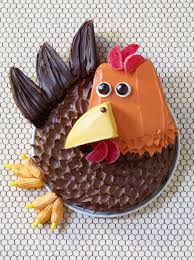
Thinking about the work in progress you’re embroiled in (be it a novel, an article, an essay, or directions on how to make a giant rooster shaped cake)

rooster cake2
Join me next time when I explain how writers are masters of procrastination. Like, looking up images for rooster cake.

I want you to write down what you hope to accomplish with this particular work. We’re talking end game stuff here. What do you want the people reading your work to walk away with afterwards?

Example 1:

Say you’re working on an article about the wage disparity in large corporations.

Take ten to fifteen minutes and write what outcome you want to see as a result of your article. How do you want people to see your subject of the story? How can you make them identify with the people involved? Is it to educate? To change policy? Do you want to give them the tools to make changes, or just to think about it in a new light and in a way that encourages discussion?

Once you know the end goal, it will affect how you write the story.


For novelists a mission statement is integral to developing a relationship with your reader via your characters.

Example 2:

I want my readers to identify with a cranky, semi-violent spirit, haunting an old seaside house and fall in love with him. I want my readers to feel the sting of being trapped, and the power of love to soften hurt.


Writing about what you want to write will actually help you know what you need to learn in order to accomplish this mission statement.


So here’s your job this week:

  • Write a short mission statement for your work in progress or your next work.
  • Share it with someone (accountability bitches)
  • Where is the next, imagined destination of this work?
  • If you have time—study some of your old work, and see if you can write a mission statement for them—what did you learn from each?
  • If you have time—think of your favorite articles, books, masterpieces and see if you can decipher what the mission statement was for them.

Oye, so much work. Don’t make me crack a whip.

Again, feel free to share. I love hearing about your purpose in writing and remember that sharing that will help to manifest your goals!

Next week we’re dipping into some heavy creative work to balance out all of this business side.


Take care!

Em-Dash It All: The Changing and Fluid Nature of Grammar

Hello my little writer friends. It’s not often I jump of the creative train to offer you some solid advice on the science of writing, but I thought I’d give your philosophical pathways a break. Hopefully, unlike your sophomore English teacher, this won’t put you to sleep.

I’m a creative; a bit of a butterfly girl if you will, and my concern and study of the correct comma or punctuation usage is akin to my concern and study of the HOA Regulations. And while my garden grows amuck and wild like fairies planted it, it also makes for some unsightly overgrowth.

Some forms of writing can take more license. Poetry is a perfect example of this. There is also a funky new emergence of non-traditional work coming out of some literary journals that plays with time, space, language and form like Shyamalan played with screenwriting. So for those forms not all the rules will apply.

For the rest of us, who’s audience doesn’t want the jolt of unexpected grammar holes, it’s important that we keep up on the latest grammatical trends in the business.

“Wait! Grammar trends? But grammar doesn’t change! I memorized all of those rules from Mr. Cloyd, I KNOW how to use proper form!”

I hate to be the one to break it to you, but we’re friends and I have only your best interests at heart, so here it goes.

Some grammatical rules always apply. I had started a list but it was getting too long so  I’m doing a total cop out and referring you to the ignanamous Daniel Scocco and his blog: Grammar 101. 

Even with this base, writers and editors have started to understand the importance of language as a living being. As time and modes of communication change and flow, so do the ways in which writers share their stories. I’m not here to judge whether or not the Oxford Comma is valid (totally valid), I’m here to let you know that writing well and clearly without the distraction of poor sentence structure remains your goal.

I tend to think of changes in grammar as happening like a Paris fashion show. All of these bigwig editors get together at giant conferences and spend hours drooling over the next newest trends in the industry. Whether it be hyphenation changes or comma usage, there’s always something that top-selling writers (oof, was I supposed to hyphen that?) or literary savants are playing with that make it more acceptable (even standard) for the rest of us to do as well.

Sometimes these changes are a direct result of what’s happening in the English language in it’s spoken form. After all, your modern-day hero isn’t going to yell out, “I shan’t do it!” or “Have you a moment?”. Jane Austen didn’t have the word “bromance” to describe Mr. Darcy’s and Mr. Bingly’s long standing friendship. We are experiencing a trend towards more passive voice as well as a heavier usage of the progressive form of verbs (‘they speak’ vs. ‘they are speaking’).

The changes I most want you to pay attention to are those that the industry is accepting as standard. Such as the single-space after a period vs. double space (as Chicago crooned, it’s a hard habit to break).

Lucky for us, in this world of mobile grammar, tools have arisen to help. Grammar checking software is like having an on call editor, standing by as you write to alert you of any mishaps. They’re getting reasonable in price and better with each year. Most are updated to reflect industry standards. Check out Grammarly, WhiteSmoke, ProWritingAid, Ginger Online, and LanguageTool just to name a few.

If you aren’t ready to download something yet, here are a few more resources that I’ve bookmarked on my own laptop.

The Punctuation Guide

The Blue Book of Grammar and Punctuation

The Chicago Manual of Style

I know it’s a vast, ever-changing sea out there, but stay strong little writer.

You ought not worry.


Kats n’ Dogs: The Importance of Conflict In Writing

I live in a veritable menagerie of animal and child chaos. Now, we’re down by one basset just this last year and it’s been more quiet without our Bailey girl, but her brother still manages a good ugly face when the cat garners more attention than he thinks she should. Yet she keeps insisting that he enjoys her arching-cat rub beneath his saggy jowls, calico tail flicking into his cataract plagued eyes.

He secretly does.

Until he sees us watching.

Then he’s all bark and tiny overbite snaps at the air above her.

“Knock it off, I don’t like it. I don’t like you.”

But we know better.

It got me thinking about conflict and what makes it work in our novels and stories.

We all know the basics of conflict as it pertains to our writing. That it needs to be between our main character and some other source (i.e. a person, technology, the weather, the government, their past etc.). That it drives the character to escape, succeed, fail, run (to or from) all important story climax points that keep the reader engaged.

But when I think of this kind of conflict, I think about writing romance.

Ok, look away and or stop reading if you think this has nothing to do with your historical fiction on the Prussian War…but I’ve only got a few more words left and it may give you a little insight.

Sometimes the conflict comes in the not wanting to want what we want. It comes when two characters rub each other the wrong way, precisely because it’s kind of the right way and they both hate admitting it. Two characters (leads in your story, no matter what their gender or sexual orientation) who get riled up by the other are usually, in some way, riled up about how much they don’t hate them despite knowing they should.

patrick and kat2

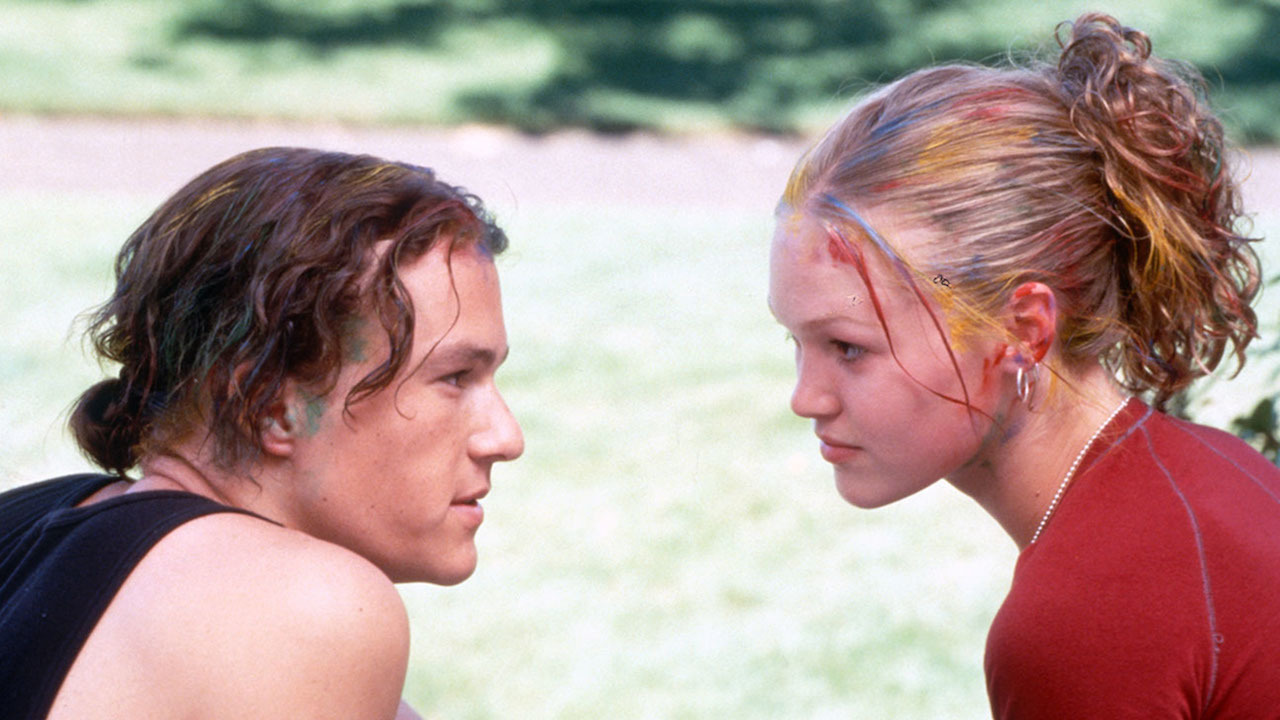
One of the best examples of this is Kat’s final speech in 10 Things I Hate About You. (I GET that its from a teenage snippy version of ‘Taming The Shrew’ but bear with me because that movie is actually quite brilliant and the principal is a romance novelist who spends a great deal of the movie looking for synonyms to the word “penis”).

It is a play on the beloved Shakespearean 141st Sonnet, beginning with “In faith, I do not love thee with mine eyes…” and underscores this principle of why not wanting to love someone can be the most powerful motivator of behavior and conflict.

“I hate the way you talk to me
And the way you cut your hair
I hate the way you drive my car
I hate it when you stare

I hate your big dumb combat boots
And the way you read my mind
I hate you so much that it makes me sick
It even makes me rhyme

I hate the way you’re always right
I hate it when you lie
I hate it when you make me laugh
Even worse when you make me cry

I hate the way you’re not around
And the fact that you didn’t call
But mostly I hate the way I don’t hate you
Not even close, not even a little bit, not even at all.”

It’s in the breaching of walls, the naked vulnerability, and the human exposition that binds us as readers to the character, and makes us fall just as hard as they do.

You may not have swooning shirtless people with wind machines in the background, mussing their perfectly golden locks, while they embrace ecstatically, but I bet that you have a character that you want your reader to root for. And that means creating conflict that resonates with the deeper tendrils of human emotion hidden beneath the layers of caustic comebacks and snide remarks.

Your conflict doesn’t have to drive your character into the arms of their reluctant beloved, it just has to drive them into the hungry hands of your readers.

Happy Writing!

The Power of A Flat Character

Hey kids! Today’s blog is all about writing, specifically pinpointing a very prevalent problem novelists face.

Flat characters.

Now, most of my novels are character driven. That is to say, I begin with a person. A beautifully flawed and imperfect hero who has a problem. Hopefully a big problem. (If they don’t have a reason to cry, by God, I’ll give them one!) And normally, not to pat myself on the back, I can write a pretty interesting character. Someone readers want to follow through the ups and downs of plot arcs.

And yet…

When I found myself mired in yet another round of editing my latest novel, wondering why nothing was working and everything seemed so boring and flat in nearly all of my scenes, I realized the story was trying to support dead weight. That is…my character was not providing any sort of flame to heat the story. They were just being pulled along by their circumstances. She was the equivalent of a wet blanket draped across a closeline, pulling both ends of it down in the middle.

I started this novel many years ago around a situation. And the situation was driving the plot. Instead of my character driving the story, she was just a passenger. Not only does that make everything in writing your novel a struggle, it also makes it less interesting for your readers. No one wants to know about the girl sitting complacently in the back seat. They want to know who in the hell is driving the car and how close it is to the cliff.

All the rounds of editing were wasted in trying to make the scenes and plot more vibrant but it never seemed to be enough. Because it couldn’t carry itself and her lazy ass too. A flat character, lacking depth, quirks, a solid core of values or lack thereof, is like an empty billboard in the middle of a field. Taking up the view without contributing to it.

So I’m back to the drawing board and today, I’m going to start it right. I’m starting with a detailed account of just who this girl is and what drives her. If it’s not interesting enough then I’m going to try out some weird shit until that awe inspiring ‘ah-ha’ hits me between the eyes. And then I’ll re examine every page of her story to see if she’s behaving the way she would and saying the things she should. The story will change, scenes will change, her interaction with others and the direction they head will change. I’ve got a ton of work ahead of me.

It’s going to be like starting over and I’m a little disheartened by that. But if something is worth doing, it’s worth doing right and I’m not ready to give up on her just yet.

After all, she does know how to shoot, bakes the best biscuits in the county, and can shear an angora goat in under a minute-thirty.

(By the way, the world record for sheep shearing is 37.9 seconds. Goats take longer, because they’re feisty and require a more careful ‘clipping’ technique.)

more you know

Don’t be lazy. In the same way certain Robin Hood actors wouldn’t learn a British accent (ooo, Kevin Costner BURN!) don’t half-ass your main character. They should carry the story, not drag it down.

What are some of your favorite character development tools?