Flash Fic: Weekly Prompt

Hello writers and readers.

Today, I’m stepping out of my normal routine of poetry and serial romancing to bring you a couple of exercises on writing flash fiction and some prompts to help get you started. (Think 1-800 word count, 1000 tops)

Now, I’ve talked in length about the fine art of flash fiction and what its doing in the field of literary wonder these days. Many a journal, website, and anthology are accepting these tiny powerhouses of storytelling as submissions. Their growing popularity, I believe, has to do with our shortened attention spans as well as our lack of free time. (Well, I mean we’d have more free time if we weren’t captivated by tiny screens most of our waking hours, but that’s a soap box for a different day).

A flash fic piece will tell the reader a whole story in a few hundred words and usually pack some kind of emotional, suspenseful, or humorous punch (‘humorous punch’ feels strange to write. Like slapstick?). For more on the logistics and down and dirty of them here’s a great blog on the topic… https://thebeautifulstuff.blog/2020/08/06/the-beautiful-writers-workshop-26-flashing-for-fun-and-profit/

So, if you are interested in trying it out, or if you’re an ‘old hat’ in the flash arena, I’m offering up some fun prompts to work with this week, to help boost your submission pool and get you used to the art of brevity. If you find one you like, let me know and I’ll give it a shout out and a bump on the site (AHEM–you could also submit it to my Anthology due out at the end of the year: https://thebeautifulstuff.blog/2022/01/27/call-for-submissions-2022-anthology-a-beautiful-twist/

I will also post one of mine next week to show solidarity for all of our creative endeavors. You aren’t in this alone, after all. OK–here’s a bullet list because I know how much we like that kind of thing.

  • A man/woman/nonbinary person goes about their normal day, not realizing that they died three years ago.
  • A dog comes back to its owner after a rousing game of fetch, but instead of the ball, it’s carrying a human skull.
  • A dinner party, a raccoon, an affair (don’t ask me, it’s your job to make it work)
  • A parent’s first night in an empty nest
  • Time freezes at a traffic light, for everyone but the man in the third car
  • After kissing a stranger at a party, a woman finds she can no longer lie
  • Maybe it’s puberty, maybe they’re a werewolf
  • A demon finds a portal out of hell, but it empties into the ball pit at a fast-food playplace.
  • A man who can smell colors. And he’s a chef.
  • A lake, a toad, the agony of getting what you ask for

Okay–get writing. Go make something beautiful and strange.
Spring Cleaning and The Writer’s Mind

Sometimes, at the beginning of the year when I’m trying to plan out my blog posts, I will randomly insert a brainstormed title with no idea where it will lead. The above is a case in point. I love the concept of brainstorming but it often makes me look back at past Sarah with a scowl (‘whatdafuq does spring cleaning have to do with the writer’s mind, Sarah? Whatwereyouthinking?)

So now, I’m going to attempt to free-style on the topic of “Spring Cleaning”.

Photo by Taryn Elliott on Pexels.com

To be fair to past Sarah, she knew this blog would come around the time of the spring equinox which is a brilliant time to clean out homes, old clothes, ancient ideas…anything that’s not serving you, from your too-tight college jeans to the ideal that says you still should fit into those. Throw that baggage out.

At first I considered telling you to do the very practical, literal cleaning out of your laptop, files, and paperwork. Grouping together like-minded topics, removing old or already published notes that are no longer needed, and generally getting yourself a clean slate for the year ahead. But as I started to look through my own little chaos, the temper of the idea changed.

No one’s desk is probably more a mess than mine. It looks fairly ordered but the truth is, it’s a jumble of post-its, three-word ‘grand ideas’ scribbled in crayon on lunch napkins or old receipts, and seven different rewrites of the same novel that I have absolutely no reason to still hang on to. I have letters from old high school friends, squirmy notes about boys we liked and the bittersweet ones after our subsequent heartbreaks. I’ve got writing notes from conferences, random journals of poetry, thank you cards with mismatched envelopes, and the last letter my grandmother Emma sent me before she passed away. I’ve got pictures of the two friends I lost after high school and the tiny pamphlets from their funeral services. I have the fuel receipt from my first solo flight. And a certificate from my training as an early childhood educator.

I have my winning poetry from 8th grade Young Writers competitions, and the short story that lost magnificently about star crossed lovers on either side of the Berlin Wall (fuck yeah, I’m that old). And its jumbled and slung into folders like a field of wildflowers, contained in manila.

Nothing is in order, but everything has its place.

Perhaps I should go through. Let go of some of this history. Let go of the girl I used to be and the dreams she used to dream. I should stop looking to the past and wondering what I could have done, or been. How brightly I used to burn, when I was young and half-wild. Maybe we should all, let go. Clean out the things in our life that no longer look like our current state.

And in some ways, I suppose it is good. Sometimes we use these things to look back, to regret or be stuck in a cycle of ‘what if’…in some ways that can hold us back. But somethings also remind us of who we are. Sounds silly but–if you’re anything like me, and you’ve spent most of your life, trying to fit into boxes, shrink down, be smaller, be ‘easier’ to love, or be what you think people want…it can get so easy to become lost.

So maybe you read your grandma’s last letter. And your best friend’s note about her no good boyfriend, or that first draft you kept for no reason, and you let them all take you back for a moment. To the person you were, the person who was just a bit more trusting. A bit more bright. Before the world sanded down your edges and made you behave. Maybe you remember that these are pieces of you that are still in there. That cannot be fully swept away.

That you are still, even in small ways, young and half-wild.

Maybe I’ll toss the other six drafts. Maybe I’ll get rid of any napkins and three-word ideas that I can’t connect to. Maybe I’ll donate the books I know I won’t read, and let go of the thank you notes with no matching envelopes.

Photo by Anastasiya Lobanovskaya on Pexels.com

But I’ll keep everything else that makes up the story of me. So on days when I feel like I belong too much to the world and the other people around me, I can return to that girl, that wildling burning bright, and remember who I am. The girl who’s been a poet since she was 12. The girl who believed love could tear down walls on a grand, societal level. The girl who misses her friends, who promised to fill her days with the life they never got to finish. The girl who refused to shrink.

Clean up your space, but leave the layers of your soul intact. They are the story of you, and no one else can tell that story.

Call For Submissions 2022 Anthology: “A Beautiful Twist”

Good morning, readers and writers. I can’t believe we’re already one trip around the sun from last year’s submissions call! The previous years have resulted in two wonderful poetry anthologies with a variety of contributors across the globe. This year, I’m changing things up.

The theme for this year is “A Beautiful Twist”. I will be looking for work that surprises and delights, causes a reader to pause and do a double take if you will. For instance, some of my own work will be myths retold in modern times (what if Bacchus was a recovering alcoholic, or Snow White was a dominatrix?) For poetry, think about a split between how it begins and how it ends. You start out thinking its about love but turns out to be about laundry. Twist a fairytale, turn over old paradigms and genre expectations, dust off any speculative fiction because that’s a goldmine for twists. Surprise me. Surprise yourself. Give yourself freedom to dabble in the ridiculous.

Photo by rikka ameboshi on Pexels.com

Below you’ll find the details for the anthology, submission guidelines, and publishing dates. Please follow the guidelines. They exist for a reason…mostly to make sure I don’t pull my hair out whilst trying to read and format them. You are always more than welcome to contact me via this website with questions (Please use subject line: QUESTION ANTHOLOGY 2022). Some changes this year will include the length and type of content I’m accepting, and a monetary prize for the top three entries, as well as publication. Good skill to all of the writers out there, newbies and old hats.

SUBMISSION GUIDELINES

  • Dates: Submission will open January 28th and will run until September 16th
  • Winners will be notified September 19th 2022
  • Publication Date: TBA Early November
  • Submission guidelines: The Beautiful Stuff will be accepting, short stories (2000-5000 words), Flash Fiction (200-1000 words), Poetry (up to 5 poems allowed per submission), novel excerpts (up to 3000 words), Personal Essays (up to 2000 words) all centered around the theme. I’m pretty lenient as far as genre. I will accept non fiction, fiction, speculative fic, western, sci-fi, fantasy, romance, erotica, historical, hysterical, time jumping primates, talking frogs, brains in jars, and ANY combination thereof. Submissions translated to English are preferred. Contest is open to domestic and international writers but awards will be paid in US dollars. Please submit your work as an attachment to your email which will be a lovely cover letter about you (name, email, job, what you write, what you love to do, your submission’s title, and the secret of life–haha, just kidding we all know its 42). Email subject line should read BEAUTIFUL TWIST SUBMISSION_name (not just ‘name’–use your name). The submission file (please use .doc, .docx, or another Word friendly format) should be the title of your submission and your last name i.e. “Merry Krampus-Reichert”
  • Top 3 submissions will earn prizes as follows: 1st–$30, 2nd–$20, 3rd–$10 paid via PayPal or Venmo (or check if need be). Runners up will be published in the anthology with a chance to compete in the Colorado Book Awards.
  • You may submit in multiple formats, multiple times (ie poems and flash, or novel excerpt and essay) but each submission must be in a separate email. You can copy and paste your cover letter…I’m not going to make you rewrite that thing, they’re a pain in the ass.
  • PLEASE DO NOT submit anything that has been previously published or that you no longer own the rights to. I can’t even begin to process the legalities, so just don’t. Don’t double dip. Simultaneous submissions are absolutely fine but LET ME KNOW if your work gets accepted elsewhere as soon as possible.
  • Prohibited subject matter includes: overtly violent or gruesome content that does not further the story, non consensual sexual acts, racist/homophobic/misogynistic/hate filled writing, violent or hurtful actions against children or animals, and anything that judges, stereotypes, or seeks to harm another human being based on their human being-ness. I’m cool with erotica done tastefully and along the lines of the theme. I’m also cool with expletives if they fit the character and scene and you’re not just using them like a 7th grade boy to look cool. Cool?

Well, that’s it! Start writing! Hopefully this will provide you the experience and drive to get some submitting done. Let me know if you have any questions. I will contact you to let you know your submission has been received and as we get near to September 16th I will keep you in the loop about your submission’s place in the anthology.

I’m so flippin’ excited to read your stuff. Truly. Don’t leave me hanging.

Photo by Suzy Hazelwood on Pexels.com

Diversity in Fiction: Crafting Characters Respectfully

I’m not one to go seeking out hot-button issues, but the truth is when we don’t address underlying, systemic problems of all the ‘isms’ in our culture (from government programs, to housing applications, to writing fiction–) they continue to hold power over and harm other human beings. So, I’m discussing today how we, as writers, can be not only sensitive to the characters we create but the effects of their existence on our world. After all, stereotypes exist because we fail to see them in all the subtle ways they permeate our lives. As ethical and compassionate people, we should work towards burning down those untruths as much as possible, even in our own work.

I’m not going to stand on a soap box and preach without starting with myself. I’ve probably, in my ignorant and un-learned past, created characters that simplified the complexities of a human into certain traits. I’ve tried not to. I tried to craft my characters as strong, independent and powerful, more tuned to their personalities than their physical traits. But there were still subtle things, I wasn’t even aware of at the time, that filtered from my limited white experience. As I look into rewriting this character, I am constantly questioning how I can do better.

We all should. We owe it to the character, to the reader (and to the world) to examine our writing and go forward with an eye to our own hidden (and not so hidden) biases or ideas.

The best advice I can give you is to strip yourself of any cloak of magnanimous “equality”. Start by reading some real, hard to stomach, but necessary soul-exploring books on the complexities of race and gender equality, the reason systemic problems exist, and how we can best eradicate them. Talk to people from every background, attend classes, lectures, and forums, open discussions of others’ experiences. Do it with an open heart, and a willingness to accept your part in the system. Have the dedication to do something about it.

When we are invested in writing characters different from ourselves (race, gender, religion, sexuality, age etc) one of the best things we can do is RESEARCH. In the expansiveness of the Internet, so much good information, written by diverse voices, can be found. The ones most important (and really the only viable ones) are those written in their own voice, about their own experience.

I also encourage you to talk to as many other people of all walks of life as you can. (And not just to research for your work…do it for the benefit of your humanity and compassion.) While I DO NOT advocate for you turning your ‘one black friend’ into your go-to for all questions about a diverse, varied and culturally rich part of our world (it’s not their job or duty to educate you), don’t shy away from respectful and honest conversations that come up, especially when they happen from immersing yourself in different situations and events from a standpoint of open mindedness and learning.

Above all, when you are writing diverse characters DON’T, for the love of god, assume that by describing their skin color/religion/orientation that you’ve described their character in total. DON’T stereotype them. DON’T include diverse characters just for the sake of checking off a box.

DO make them unique to their upbringing, their experience, and their situation. DO describe all of your characters equally and in rich and expansive ways.

I’ve always believed that good storytelling is universal. And in our connected and dynamic world, it would be a shame to only write one kind of person. But care for your characters and the people they may or may not represent. Here are some good resources that may help:

Good luck and don’t be afraid. Just be respectful, compassionate, and educated.

Begin Again

So here we are, at the precipice of a new year and probably, in some part, still reeling from the last two. I recall, vaguely, that at this time last year I was filled with hope that things were about to get better. Then, events in the first week of the year reminded me that the calendar rolling over didn’t wipe the slate clean on the world’s troubles. It’s just a date. Not a miracle.

The only comfort I had, and still have, as we again sit at the top of 2022, is that I have control over at least one thing in the world, and that’s how I live in it. So no matter where you are, in physical or mental space, take an opportunity to day to think about what you would do if you could begin again. The date may be arbitrary, but the idea is sound.

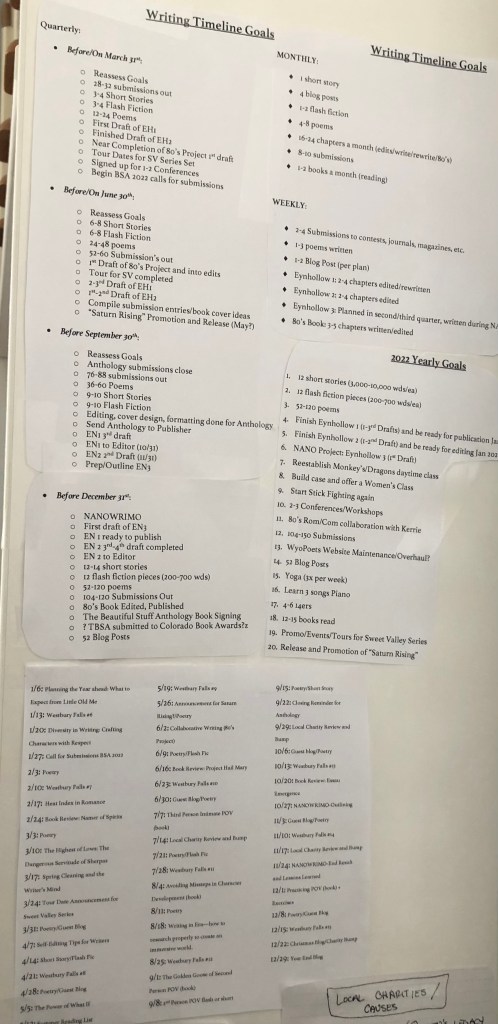
Everything you’ve lived through up to this point has prepared you for the challenges ahead. Everything that you’ve seen, learned, failed at, succeeded at, has built in you a resilience for the journey ahead. So while we shouldn’t dwell on our pasts (whether it be to regret–terrible thing, or to relive glory days–also unhelpful) we should remember the value they have given us. Every experience, hardship, joy, failure, and triumph has added to your soul-resume and will give you what you need for this next year. I believe that whatever it is you set your sights on, whether its finishing a book, starting a new job, getting out of an abusive relationship, or giving yourself more grace, you will find success. But don’t just throw vague intentions out. Make a map.

Now how detailed you want to get depends on your level of focus, your own acknowledgement for order, and what works for you. I like to start with a general goal list, break it down by quarter, month, and week, and hang it up where I can see it. So when I find myself caught up in pitbull puppy videos, its looming over me, reminding me to focus.

That’s a shit-ton of bullets…*sigh*

At the beginning of the year, it looks daunting. So I have to remind myself, even if it’s on paper, it’s still fluid. Just because it’s all there, listed out, doesn’t mean it all gets done today. Like any journey, goals are a series of steps, one after another.

This year, I’ll be trying a few different things, and I only squawk about them here as a measure of accountability.

In the spring (March-ish) I’ll be releasing my Western Romance Series and planning some tour dates in my home state of Wyoming to promote it. This will include book signings, readings, and Q and A sessions. I’m aspiring to submit short stories, poetry, and flash fiction to at least 100 different publications (aiming for 100 rejections but my hope is they aren’t ALL rejected). In May, I’m hoping to finish up a collaboration with a local press for my Sci/Fi novella “Saturn Rising”. The blog will continue with weekly writing advice, poetry, guest blogs, and a special series on local charities, the work they’re doing, and how we can help keep them running. This year’s Anthology is not yet themed but I’m shifting over to include short stories, essays, and excerpts. Stay tuned for more details. This year, winning entries will be published and receive a monetary prize.

I’ve got my first co-authoring project in the works (a fun romp and homage to my love of 80’s pop culture) and will be working on my next series (I’m getting all Urban fantasy this time).

Outside of writing, I’ll be teaching a few more classes, continue advancing towards my next degree (Sensei Sarah has a nice ring to it), reading more, I’ll climb a few more 14ers, and work this old body into more flexibility through yoga. It all feels like a lot, but days are made of minutes and you can do a lot in those minutes….once you choose to begin.

Good luck out there. Come back and visit to keep updated on the anthology submissions and so we can check in with each other on our new starts. Above all, let’s just be better people this year. The best versions of ourselves we can be.

NANOWRIMO Week Four: The Final Countdown

Good morning!

For those of you who’ve been following me through the month of November, this marks the final installment of surviving NANOWRIMO (National Novel Writing Month). I’ve been flowing with a life-stages theme, and had intended to title this week “Retirement” but the thing with NANO is that only some of us will spend the last week resting and reaping the rewards of a month packed with hours of dedication to your project. A lot of us will find this final week to be the last, desperate attempt to finish.

So this brief post is for those who are struggling through the last four to five days to make up those words, or at least push to do what they can.

I hope, more than anything, and even above the lofty goal of 50,000 words, that you are still trying. That you haven’t given up. That you have built a habit of writing so that you don’t feel complete in your day unless you’ve spent at least some time on your work.

Because, that’s the whole point. This month is more about teaching us to prioritize our lives to include our writing first (or at least at the top of the to-do list) and to know that we CAN accomplish great things when we give it the time and love it needs. It’s more about building the habit of writing than it is about reaching the specific goal.

So often in our lives we self-limit. So often we are told it can’t be done, we can’t, the work is too great, the effort pointless. So often we are told that struggle won’t be worth the outcome. But those voices and those opinions fail to factor in that it is not just the outcome that is rewarding. The end result is not all we are working for. Its the journey in getting there.

When we challenge ourselves, the bigger reward lies in the struggle. New ventures, hard and thankless work, and lofty goals teach us how to plan, how to plot, how to push ahead when we simply don’t feel like it or when others around us question or scoff at the ideas before us. Challenges shine a light on how amazing and resilient we are so that, no matter the outcome, we learn what we are capable of. And once we know what we are capable of, the bonds of doubt weaken and we begin to believe that if we can write a novel in a month, we can edit it, publish it, write another, and another, and another. And if we can write a book we can take a class, or teach a class. We can climb a mountain, we can travel across the world. We can do anything we set our minds to.

We can.

You can.

You’ve only got a few days left in this month and I BELIEVE THAT YOU CAN do anything you’ve set out to do. You are amazing. You are imperfectly perfect and there’s no one in the world who can finish this month the way you will.

Deep breath, writer. Don’t let the home stretch scare you. Let the struggle instead be your gift and one which you are grateful to work through. You can. You will.

NANOWRIMO Week Three: The Midlife Crisis

Hey there writer.

I know I don’t have to thank you for being here with me because if you are akin to me, you’re looking for any excuse to change up the monotony of this novel-writing month and escape that mad-dash. Perhaps you’re feeling like this story you’ve been pouring your heart and soul into for what seems like years is starting to stale. Things are getting drab. The plot line is petering out. The characters have run out of things to say.

This is the dreaded, dead-ended doldrum, (say that one a few times fast) of week 3. And it can often feel like middle age in its sunken sails, stagnant air, and the questioning of the choices that brought you here.

Photo by Johannes Plenio on Pexels.com

With only days left in this crazy adventure, you may feel like you just don’t want to go on. That perhaps it would be easier to abandon your project all together and take a hot little novella out for a spin. Maybe start seeing some poetry on the side. Perhaps dabble in a little erotica?

While I encourage some dabbling (especially in erotica) I would argue that all of those exploratory practices can be done right in your own work in progress. So you’re bored, so you don’t know what the characters will say to one another…I urge you to start a new chapter, in the same document, where your characters take a jump off of the tracks and do something completely unexpected. Put them in a different time, put them in a different dynamic…hell, switch their genders and see what happens. Write a poem that serves as a synopsis to the story, first from one character’s perspective, and then from another’s. All of this play might help unlock the paths your novel needs to get going again. Think of it as putting some wind in those sails. A little spice in between the pages.

And all of those words you put down, even if they may be edited out later, still count as words towards your 50,000. Let’s be honest, at this point in the process, any word count is better than none.

It’s normal to feel a bit discouraged and bogged down in week 3, but what you’re building is worth hanging on to. It’s worth the investment of time and thought in this, the darkest, dreaded, dead-ended doldrums.

Hang in there kid. Go get freaky with your WIP and spice things up to see you through to the end.

Next week, look for the final, and highly inspirational installment of my NANOWRIMO survival guide.

NANOWRIMO Week Two: Here Comes a Writer With a Baby Carriage

Hello! Thanks for taking the time to catch up with the blog in the middle of one of your (hopefully) busiest writing months. At this point your mind set is probably so swayed to creating that reading outside of your work in progress is a lot like talking to another adult after being seeped in toddler-speak non-stop all week.

I know that your time is precious so I’ll keep it short and sweet. (Like me, ya’ll)

The second week of NANOWRIMO is all about elaborating on, fleshing out, and developing your baby. Last week we talked about the excitement of new love, the honeymoon stage of writing, if you will. This week is about the baby you’ve made and what that means for not just your writing, but your life for the next seven to ten days.

I know a lot of you are parents, and though it may have been awhile since you’ve spent the midnight hours rocking teary-eyed cherub back to sleep, chances are you remember the sacrifice of time and autonomy for the good of the future. This week is not much different for the NANOWRIMO process. You are starting to see the commitment involved and how the expectations you may have had in the beginning are often dashed by the realities.

Because children don’t always behave the way you think they will. Characters show unexpected traits and say things that throw your dynamic out of whack like dropping the f-bomb at Christmas dinner with Grandma, or asking you for “boob!” loudly in a store.

Settings and plot lines stall with the same debilitating frustration as trying to get a two-year-old into shoes because you’re late for the doctor appointment and you haven’t showered in three days, and you ate cold, leftover mac n cheese for breakfast and you’re not sure if that’s their diaper that smells or the dog…

Keeping on top of the little fires that come up isn’t easy but I encourage you to set a flexible schedule (it works with kids; it works with writing). Give yourself two hours ideally but really whatever you have is fine. Leave half for just writing. Leave the other half to fix plot holes, develop your character’s personalities and backgrounds, build on your story arc, and brainstorm solutions for things that are cropping up as you pour ever more work into the novel. Look at it like doing the groundwork of, feeding, changing, and burping for half of it, and the other half cuddling, coloring, singing, and playing.

A well rounded “story” is equal parts meeting the basic needs and getting to play in the creation of it.

Good luck out there. Nap when it naps, grab a shower while your computer backs up. Drink some coffee and prep for the long nights. Remember the bigger picture. Novels and babies are investments in the future. The work, and love, and committed care you invest now will lead to rewarding results in both your story, your characters, and your craft.

Oh…and get a decent meal. You can’t run on PB&J crusts and half eaten apples forever.

NANOWRIMO Week One: The Honeymoon

Ah, yes, the glorious stage of excitement and foreplay. The thrill of fleshing out your characters, and having them say clever things to one another, and building beautiful worlds with soft hues and brilliant sunsets. It’s champagne and butterflies, it’s rainbows and 3 hour love-making sessions with your laptop (please, God, not literally…the keys are hard enough to keep clean with just my coffee and pastry habit).

The words come easy, the beginning is new and exciting, the chemistry is just right. Possibly you’ve been planning this novel for awhile, maybe you even used October to plan it out and things are running smoothly and in great gushes of inspiration and excitement. (I think ‘gushes’ might be just as bad as ‘moist’ for cringe-worthy words).

OR

You’re stuck in front of your blank page and wondering why in God’s name you agreed to this. The stress of completing such a herculean task is causing every neuron to march around your addled brain with tiny little picket signs protesting the ridiculous workload before they even endure it.

You’re thinking of giving up. It feels as though you agreed to do this on a brash weekend in Vegas and you might have done so under the influence of alcohol and you really don’t know this book that well and what will your parents say and… is it too late for an annulment?

In the first case: Congratulations, keep going! If you have the stamina and inspiration to do so, front load these first couple of weeks so you can have a few days to ride if you need to recover. (I can’t help but hear Sheriff Bart’s voice in my head “Man, them schnitzengrubens will wipe you out!” Come on, people…Blazing Saddles)

In the second case: Don’t give up just yet. So she/he’s a gamble and you may have rushed into things. It’s normal to be nervous. It’s normal to feel like there’s nowhere to go. But you’re a writer. And writer’s do best when they stop questioning the end product and just write. See where that impromptu spouse will lead you, let it play out for a few days and enjoy the crazy weird ride that you’re on.

The secret to NANOWRIMO is to not overthink it. Because that’s when you start looking for all the imperfections and plot holes that send you into editing mode and canceling out any forward movement you have.

If you’re having trouble with getting your word count every day here’s some tips that have helped me:

  1. Break it up into smaller sections. A little in the morning, a little at lunch, some at night. Carry the laptop or notebook with you and write a few lines whenever you have a chance
  2. Keep your characters in your head with you at all times. How would they react to what you’re doing? What would they say to each other in the grocery store line? Let them talk to each other while you’re doing the dishes or in that third useless meeting of the day (come on, we all know at least 2/3rds of all meetings are just wastes of time that allow one person to hear themselves talk).
  3. Strike when the fire is hot. If you are on a roll, do everything in your power to keep writing…then in the middle of a paragraph or even a sentence–stop. Yeah, you read that right. Stop. It will frustrate you and keep your mind on what will happen next until you pick it back up. Foreplay people…there’s nothing like a little flirtatious teasing to make the next interlude all the more passionate.
  4. DO NOT be discouraged if you have a short day. Every word counts and a 400 word day is still 400 words. Like running or training, or anything really–great things are accomplished not always in leaps and bounds but by small progressive steps forward.
  5. Rest your fingers and your brain. Take breaks, sleep well, eat well, exercise, and get away from it throughout the day. Burnout probably happens most in the first couple of weeks when our inspiration gets ahead of our ability to keep at it with the same frantic pace.

Okay. That’s all I’ve got for this week.

Remember, comment below with how it’s going or send me quick email with any frustrations or elations you have and I’ll enter you to win a goodie basket with some books and writer self-care stuff that will help keep you going into this crazy month.

Good skill, Writer.

Writing to Frighten: The Art of Suspense and Tension

Photo by Monstera on Pexels.com

Good morning, writer. As we approach Samhain and the dark, twisty corners of the season I thought it would be a great time to bring up suspense in your writing. I’m not a horror writer and I’m not going to pretend to be just to fit in to the theme of the month but I do believe that being able to create suspense in any genre is key to keeping your readers engaged and turning the pages.

Suspense can help build emotion in your reader up to your critical moments of change (the top of your acts–the big doors–crisis of faith moments—etc.) And that helps them become more invested in your character and the outcome of the scene. Because it’s been awhile, I’m going to give you a good-ol’ bullet list. Everybody likes a bullet list. Here are some top tips to factor in while working the element of suspense into your novel/Work-In-Progress. Keep in mind, these are general so they can be applied to most genres, but within each tip, there are a hundred different directions you can go–from the benign to the macabre.

  • Tap Into Universal Fears: We all have some pretty basic fears that drive us. They are usually based in survival. Fear of death, loss of child/loved one, fear of physical pain, starvation, exposure–anything that can take away the basic needs for survival. Fear of the unknown–can mean anything from not knowing what’s making that bumping noise in the closet, to not have existential knowledge of where you’ll end up after death. Fear of emotional pain, fear of social stigma. We’re scared little apes, so there’s an endless well to tap into here.
  • Create the Right Atmosphere: Depending on your genre and the style you like to write in, you could use your scenes to strike psychological terror (inner thoughts, rampant and illogical emotions, mind-games, gaslighting, etc) physical/gross terror (think limbs stripped of their muscle fibers, blood spurting, eyeballs popped out, or any other gory, pain-inducing action), or subtle/unseen terror (the ever present feeling of dread–small sounds getting closer, lights flickering down long hallways, those two notes on the piano when Jaws was nearby)
  • Make The Stakes High: It’s not going to ruffle your readers feathers if your character meets the friendly neighborhood cat at night if they love cats and brought yum-yums to share. Make it ten mange-riddled cats with broken, sharp teeth, stalking down a feline-hater, from all directions on a deserted city street and then you have a show. Losing a job sucks–but make it the job with the benefits that her sick daughter needs the insurance for, and its a different game (let us pause for a moment when discussing terror and how the American medical system has actually become something that induces terror…think about that for a moment)
  • Consider Your Point of View: There isn’t a wrong POV for horror, it just depends on how you want the reader to feel. Are you aiming to put them in a shed with the axe murderer outside, holding their dying cell phone? (FIRST PERSON)Or are you sitting beside them in the shed with eyes on how close the bloodied axe is to the door, yelling out in the middle of the library “Make the call, you idiot!!! He’s coming for you!!” (THIRD PERSON)
  • Don’t Forget the Character: Listen, it all comes down to the basics, if the reader isn’t invested in your character, they aren’t going to feel the empathy needed to induce terror no matter what horrifying situation you put them into. Make your character someone worth following into the dark and twisted. If your character is the dark and twisted, give it/them the solid justification that makes the reader question who the bad guy really is.

OK! Well, that’s all you get today. Good luck out there creating some suspense. Use it as you need to in your own work and if you feel the Hallow’s Eve vibe, try your hand at a little horror. I always encourage dabbling outside your genre to help make your work stronger.

Happy Writing!