Begin Again

So here we are, at the precipice of a new year and probably, in some part, still reeling from the last two. I recall, vaguely, that at this time last year I was filled with hope that things were about to get better. Then, events in the first week of the year reminded me that the calendar rolling over didn’t wipe the slate clean on the world’s troubles. It’s just a date. Not a miracle.

The only comfort I had, and still have, as we again sit at the top of 2022, is that I have control over at least one thing in the world, and that’s how I live in it. So no matter where you are, in physical or mental space, take an opportunity to day to think about what you would do if you could begin again. The date may be arbitrary, but the idea is sound.

Everything you’ve lived through up to this point has prepared you for the challenges ahead. Everything that you’ve seen, learned, failed at, succeeded at, has built in you a resilience for the journey ahead. So while we shouldn’t dwell on our pasts (whether it be to regret–terrible thing, or to relive glory days–also unhelpful) we should remember the value they have given us. Every experience, hardship, joy, failure, and triumph has added to your soul-resume and will give you what you need for this next year. I believe that whatever it is you set your sights on, whether its finishing a book, starting a new job, getting out of an abusive relationship, or giving yourself more grace, you will find success. But don’t just throw vague intentions out. Make a map.

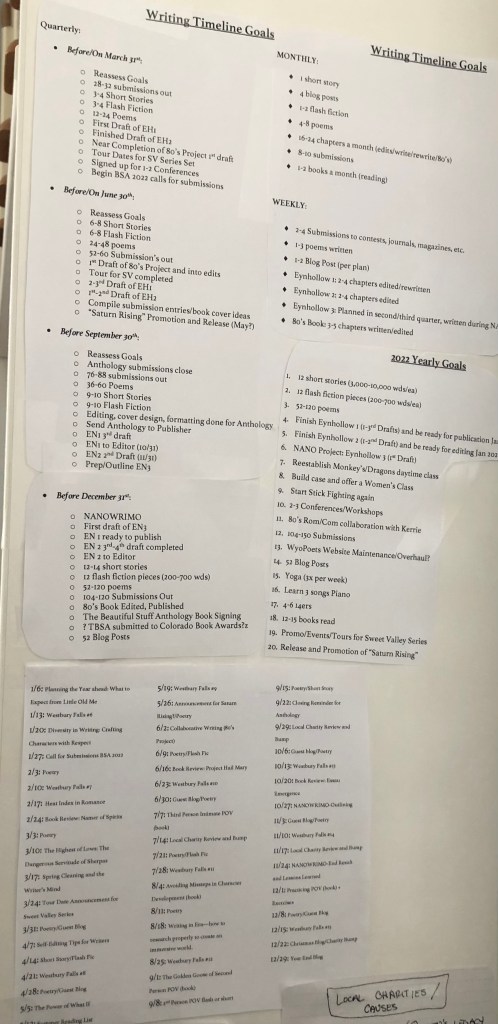
Now how detailed you want to get depends on your level of focus, your own acknowledgement for order, and what works for you. I like to start with a general goal list, break it down by quarter, month, and week, and hang it up where I can see it. So when I find myself caught up in pitbull puppy videos, its looming over me, reminding me to focus.

That’s a shit-ton of bullets…*sigh*

At the beginning of the year, it looks daunting. So I have to remind myself, even if it’s on paper, it’s still fluid. Just because it’s all there, listed out, doesn’t mean it all gets done today. Like any journey, goals are a series of steps, one after another.

This year, I’ll be trying a few different things, and I only squawk about them here as a measure of accountability.

In the spring (March-ish) I’ll be releasing my Western Romance Series and planning some tour dates in my home state of Wyoming to promote it. This will include book signings, readings, and Q and A sessions. I’m aspiring to submit short stories, poetry, and flash fiction to at least 100 different publications (aiming for 100 rejections but my hope is they aren’t ALL rejected). In May, I’m hoping to finish up a collaboration with a local press for my Sci/Fi novella “Saturn Rising”. The blog will continue with weekly writing advice, poetry, guest blogs, and a special series on local charities, the work they’re doing, and how we can help keep them running. This year’s Anthology is not yet themed but I’m shifting over to include short stories, essays, and excerpts. Stay tuned for more details. This year, winning entries will be published and receive a monetary prize.

I’ve got my first co-authoring project in the works (a fun romp and homage to my love of 80’s pop culture) and will be working on my next series (I’m getting all Urban fantasy this time).

Outside of writing, I’ll be teaching a few more classes, continue advancing towards my next degree (Sensei Sarah has a nice ring to it), reading more, I’ll climb a few more 14ers, and work this old body into more flexibility through yoga. It all feels like a lot, but days are made of minutes and you can do a lot in those minutes….once you choose to begin.

Good luck out there. Come back and visit to keep updated on the anthology submissions and so we can check in with each other on our new starts. Above all, let’s just be better people this year. The best versions of ourselves we can be.

NANOWRIMO Week Four: The Final Countdown

Good morning!

For those of you who’ve been following me through the month of November, this marks the final installment of surviving NANOWRIMO (National Novel Writing Month). I’ve been flowing with a life-stages theme, and had intended to title this week “Retirement” but the thing with NANO is that only some of us will spend the last week resting and reaping the rewards of a month packed with hours of dedication to your project. A lot of us will find this final week to be the last, desperate attempt to finish.

So this brief post is for those who are struggling through the last four to five days to make up those words, or at least push to do what they can.

I hope, more than anything, and even above the lofty goal of 50,000 words, that you are still trying. That you haven’t given up. That you have built a habit of writing so that you don’t feel complete in your day unless you’ve spent at least some time on your work.

Because, that’s the whole point. This month is more about teaching us to prioritize our lives to include our writing first (or at least at the top of the to-do list) and to know that we CAN accomplish great things when we give it the time and love it needs. It’s more about building the habit of writing than it is about reaching the specific goal.

So often in our lives we self-limit. So often we are told it can’t be done, we can’t, the work is too great, the effort pointless. So often we are told that struggle won’t be worth the outcome. But those voices and those opinions fail to factor in that it is not just the outcome that is rewarding. The end result is not all we are working for. Its the journey in getting there.

When we challenge ourselves, the bigger reward lies in the struggle. New ventures, hard and thankless work, and lofty goals teach us how to plan, how to plot, how to push ahead when we simply don’t feel like it or when others around us question or scoff at the ideas before us. Challenges shine a light on how amazing and resilient we are so that, no matter the outcome, we learn what we are capable of. And once we know what we are capable of, the bonds of doubt weaken and we begin to believe that if we can write a novel in a month, we can edit it, publish it, write another, and another, and another. And if we can write a book we can take a class, or teach a class. We can climb a mountain, we can travel across the world. We can do anything we set our minds to.

We can.

You can.

You’ve only got a few days left in this month and I BELIEVE THAT YOU CAN do anything you’ve set out to do. You are amazing. You are imperfectly perfect and there’s no one in the world who can finish this month the way you will.

Deep breath, writer. Don’t let the home stretch scare you. Let the struggle instead be your gift and one which you are grateful to work through. You can. You will.

NANOWRIMO Week Three: The Midlife Crisis

Hey there writer.

I know I don’t have to thank you for being here with me because if you are akin to me, you’re looking for any excuse to change up the monotony of this novel-writing month and escape that mad-dash. Perhaps you’re feeling like this story you’ve been pouring your heart and soul into for what seems like years is starting to stale. Things are getting drab. The plot line is petering out. The characters have run out of things to say.

This is the dreaded, dead-ended doldrum, (say that one a few times fast) of week 3. And it can often feel like middle age in its sunken sails, stagnant air, and the questioning of the choices that brought you here.

Photo by Johannes Plenio on Pexels.com

With only days left in this crazy adventure, you may feel like you just don’t want to go on. That perhaps it would be easier to abandon your project all together and take a hot little novella out for a spin. Maybe start seeing some poetry on the side. Perhaps dabble in a little erotica?

While I encourage some dabbling (especially in erotica) I would argue that all of those exploratory practices can be done right in your own work in progress. So you’re bored, so you don’t know what the characters will say to one another…I urge you to start a new chapter, in the same document, where your characters take a jump off of the tracks and do something completely unexpected. Put them in a different time, put them in a different dynamic…hell, switch their genders and see what happens. Write a poem that serves as a synopsis to the story, first from one character’s perspective, and then from another’s. All of this play might help unlock the paths your novel needs to get going again. Think of it as putting some wind in those sails. A little spice in between the pages.

And all of those words you put down, even if they may be edited out later, still count as words towards your 50,000. Let’s be honest, at this point in the process, any word count is better than none.

It’s normal to feel a bit discouraged and bogged down in week 3, but what you’re building is worth hanging on to. It’s worth the investment of time and thought in this, the darkest, dreaded, dead-ended doldrums.

Hang in there kid. Go get freaky with your WIP and spice things up to see you through to the end.

Next week, look for the final, and highly inspirational installment of my NANOWRIMO survival guide.

NANOWRIMO Week Two: Here Comes a Writer With a Baby Carriage

Hello! Thanks for taking the time to catch up with the blog in the middle of one of your (hopefully) busiest writing months. At this point your mind set is probably so swayed to creating that reading outside of your work in progress is a lot like talking to another adult after being seeped in toddler-speak non-stop all week.

I know that your time is precious so I’ll keep it short and sweet. (Like me, ya’ll)

The second week of NANOWRIMO is all about elaborating on, fleshing out, and developing your baby. Last week we talked about the excitement of new love, the honeymoon stage of writing, if you will. This week is about the baby you’ve made and what that means for not just your writing, but your life for the next seven to ten days.

I know a lot of you are parents, and though it may have been awhile since you’ve spent the midnight hours rocking teary-eyed cherub back to sleep, chances are you remember the sacrifice of time and autonomy for the good of the future. This week is not much different for the NANOWRIMO process. You are starting to see the commitment involved and how the expectations you may have had in the beginning are often dashed by the realities.

Because children don’t always behave the way you think they will. Characters show unexpected traits and say things that throw your dynamic out of whack like dropping the f-bomb at Christmas dinner with Grandma, or asking you for “boob!” loudly in a store.

Settings and plot lines stall with the same debilitating frustration as trying to get a two-year-old into shoes because you’re late for the doctor appointment and you haven’t showered in three days, and you ate cold, leftover mac n cheese for breakfast and you’re not sure if that’s their diaper that smells or the dog…

Keeping on top of the little fires that come up isn’t easy but I encourage you to set a flexible schedule (it works with kids; it works with writing). Give yourself two hours ideally but really whatever you have is fine. Leave half for just writing. Leave the other half to fix plot holes, develop your character’s personalities and backgrounds, build on your story arc, and brainstorm solutions for things that are cropping up as you pour ever more work into the novel. Look at it like doing the groundwork of, feeding, changing, and burping for half of it, and the other half cuddling, coloring, singing, and playing.

A well rounded “story” is equal parts meeting the basic needs and getting to play in the creation of it.

Good luck out there. Nap when it naps, grab a shower while your computer backs up. Drink some coffee and prep for the long nights. Remember the bigger picture. Novels and babies are investments in the future. The work, and love, and committed care you invest now will lead to rewarding results in both your story, your characters, and your craft.

Oh…and get a decent meal. You can’t run on PB&J crusts and half eaten apples forever.

NANOWRIMO Week One: The Honeymoon

Ah, yes, the glorious stage of excitement and foreplay. The thrill of fleshing out your characters, and having them say clever things to one another, and building beautiful worlds with soft hues and brilliant sunsets. It’s champagne and butterflies, it’s rainbows and 3 hour love-making sessions with your laptop (please, God, not literally…the keys are hard enough to keep clean with just my coffee and pastry habit).

The words come easy, the beginning is new and exciting, the chemistry is just right. Possibly you’ve been planning this novel for awhile, maybe you even used October to plan it out and things are running smoothly and in great gushes of inspiration and excitement. (I think ‘gushes’ might be just as bad as ‘moist’ for cringe-worthy words).

OR

You’re stuck in front of your blank page and wondering why in God’s name you agreed to this. The stress of completing such a herculean task is causing every neuron to march around your addled brain with tiny little picket signs protesting the ridiculous workload before they even endure it.

You’re thinking of giving up. It feels as though you agreed to do this on a brash weekend in Vegas and you might have done so under the influence of alcohol and you really don’t know this book that well and what will your parents say and… is it too late for an annulment?

In the first case: Congratulations, keep going! If you have the stamina and inspiration to do so, front load these first couple of weeks so you can have a few days to ride if you need to recover. (I can’t help but hear Sheriff Bart’s voice in my head “Man, them schnitzengrubens will wipe you out!” Come on, people…Blazing Saddles)

In the second case: Don’t give up just yet. So she/he’s a gamble and you may have rushed into things. It’s normal to be nervous. It’s normal to feel like there’s nowhere to go. But you’re a writer. And writer’s do best when they stop questioning the end product and just write. See where that impromptu spouse will lead you, let it play out for a few days and enjoy the crazy weird ride that you’re on.

The secret to NANOWRIMO is to not overthink it. Because that’s when you start looking for all the imperfections and plot holes that send you into editing mode and canceling out any forward movement you have.

If you’re having trouble with getting your word count every day here’s some tips that have helped me:

  1. Break it up into smaller sections. A little in the morning, a little at lunch, some at night. Carry the laptop or notebook with you and write a few lines whenever you have a chance
  2. Keep your characters in your head with you at all times. How would they react to what you’re doing? What would they say to each other in the grocery store line? Let them talk to each other while you’re doing the dishes or in that third useless meeting of the day (come on, we all know at least 2/3rds of all meetings are just wastes of time that allow one person to hear themselves talk).
  3. Strike when the fire is hot. If you are on a roll, do everything in your power to keep writing…then in the middle of a paragraph or even a sentence–stop. Yeah, you read that right. Stop. It will frustrate you and keep your mind on what will happen next until you pick it back up. Foreplay people…there’s nothing like a little flirtatious teasing to make the next interlude all the more passionate.
  4. DO NOT be discouraged if you have a short day. Every word counts and a 400 word day is still 400 words. Like running or training, or anything really–great things are accomplished not always in leaps and bounds but by small progressive steps forward.
  5. Rest your fingers and your brain. Take breaks, sleep well, eat well, exercise, and get away from it throughout the day. Burnout probably happens most in the first couple of weeks when our inspiration gets ahead of our ability to keep at it with the same frantic pace.

Okay. That’s all I’ve got for this week.

Remember, comment below with how it’s going or send me quick email with any frustrations or elations you have and I’ll enter you to win a goodie basket with some books and writer self-care stuff that will help keep you going into this crazy month.

Good skill, Writer.

Writing to Frighten: The Art of Suspense and Tension

Photo by Monstera on Pexels.com

Good morning, writer. As we approach Samhain and the dark, twisty corners of the season I thought it would be a great time to bring up suspense in your writing. I’m not a horror writer and I’m not going to pretend to be just to fit in to the theme of the month but I do believe that being able to create suspense in any genre is key to keeping your readers engaged and turning the pages.

Suspense can help build emotion in your reader up to your critical moments of change (the top of your acts–the big doors–crisis of faith moments—etc.) And that helps them become more invested in your character and the outcome of the scene. Because it’s been awhile, I’m going to give you a good-ol’ bullet list. Everybody likes a bullet list. Here are some top tips to factor in while working the element of suspense into your novel/Work-In-Progress. Keep in mind, these are general so they can be applied to most genres, but within each tip, there are a hundred different directions you can go–from the benign to the macabre.

  • Tap Into Universal Fears: We all have some pretty basic fears that drive us. They are usually based in survival. Fear of death, loss of child/loved one, fear of physical pain, starvation, exposure–anything that can take away the basic needs for survival. Fear of the unknown–can mean anything from not knowing what’s making that bumping noise in the closet, to not have existential knowledge of where you’ll end up after death. Fear of emotional pain, fear of social stigma. We’re scared little apes, so there’s an endless well to tap into here.
  • Create the Right Atmosphere: Depending on your genre and the style you like to write in, you could use your scenes to strike psychological terror (inner thoughts, rampant and illogical emotions, mind-games, gaslighting, etc) physical/gross terror (think limbs stripped of their muscle fibers, blood spurting, eyeballs popped out, or any other gory, pain-inducing action), or subtle/unseen terror (the ever present feeling of dread–small sounds getting closer, lights flickering down long hallways, those two notes on the piano when Jaws was nearby)
  • Make The Stakes High: It’s not going to ruffle your readers feathers if your character meets the friendly neighborhood cat at night if they love cats and brought yum-yums to share. Make it ten mange-riddled cats with broken, sharp teeth, stalking down a feline-hater, from all directions on a deserted city street and then you have a show. Losing a job sucks–but make it the job with the benefits that her sick daughter needs the insurance for, and its a different game (let us pause for a moment when discussing terror and how the American medical system has actually become something that induces terror…think about that for a moment)
  • Consider Your Point of View: There isn’t a wrong POV for horror, it just depends on how you want the reader to feel. Are you aiming to put them in a shed with the axe murderer outside, holding their dying cell phone? (FIRST PERSON)Or are you sitting beside them in the shed with eyes on how close the bloodied axe is to the door, yelling out in the middle of the library “Make the call, you idiot!!! He’s coming for you!!” (THIRD PERSON)
  • Don’t Forget the Character: Listen, it all comes down to the basics, if the reader isn’t invested in your character, they aren’t going to feel the empathy needed to induce terror no matter what horrifying situation you put them into. Make your character someone worth following into the dark and twisted. If your character is the dark and twisted, give it/them the solid justification that makes the reader question who the bad guy really is.

OK! Well, that’s all you get today. Good luck out there creating some suspense. Use it as you need to in your own work and if you feel the Hallow’s Eve vibe, try your hand at a little horror. I always encourage dabbling outside your genre to help make your work stronger.

Happy Writing!

In the Dark and Light

So, last week, I hit a rough patch, and I appreciate all of the kind comments and voices of concern that were raised for my well being and in defense of the human. I wanted to take a moment, before I launch into today’s poetry (brought to you by the amazing NCW Writing Retreat I was able to attend) to reach out and say a few words.

I know all humans aren’t assholes. I also know it’s our job (each human) to try and do our best not to be assholes. To not raise assholes. To forgive those who are being assholes. I know these things. But just like holding a weight constantly can fatigue a muscle and cause injury, holding on to this dark while trying to be light can be draining, so it behooves us all to drop the weight once in a while and call out the asshole-ness when we see it. After all, our job as humans is to try to make it a better world and that sometimes means calling on others to do better by one another.

And now: Poetry:

Photo by Darius Krause on Pexels.com
Breakdown
When we break apart
to find the core of iron-will within
or the soft underbelly of a soul
too long denied air
Then we will understand the
driving nature of our force
Lies not in what covers us
but what centers us

When we give in to the churning
burn of a life outside our control
the masticating masses of teeth bared 
in anger and fear
Then we will understand that
we only control the product 
of our own mind
And we are the owners of
sanctuaries or hells
within our own creation

When we let go
of the idea that its our job
to dictate the perfections of others
to drive their engines
to direct the film of their lives
and focus instead on 
what beauty we can leave behind
Then we will find the only
fragile, and faltering peace
a human can own.

Write What You Love

Today I’m talking about two pitfalls many writers fall into. First, the desperate search for the holy grail of what’s on fleek (do they say that anymore?) or ‘trending’. And secondly, the pursuit of higher literary fiction as the only respectable way to claim ‘writer’ status.

It’s no secret that trends play a big role in what kinds of books get produced and published. Like some kind of secret surfing spot, the waves that peak are often unpredictable and by the time you get your board out into the fray, the ride has already passed.

In the same manner, when writers take it upon themselves to invest in their education with an MFA program or something similar, they are put into a strange and high-walled box of what constitutes ‘worthwhile’ literary fiction.

When, as writers, we are so desperate for that publishing contract, agent, representation, royalty check—or whatever your goal may be—we often forgo our ‘pet projects’ to work on something that will sell or is more ‘meaningful’ aka digestible by a higher caliber of reader.

These are pitfalls and I’m going to tell you why.

  1. No one can predict trends. No one. In an excellent class, taught by Todd Mitchell, he talked about a controlled experiment wherein three groups were kept isolated (online) and given the same songs to listen to, vote on, dissect, and judge. In every group, a different song was chosen to be ‘best’. In every group, when one song started to get more votes, strange herd-like mentality propelled it further. Bottom line, people will choose at random and marketing departments of publishing companies don’t represent the whole palette of readers in the world. Writing to trends, especially if it’s not something you love or are invested in, is a waste of your talent and time.
  2. MFA programs are great at exposing you to a range of writers, styles, perspectives and technique. I highly recommend if you have the money and time, to pursue one. But you don’t need a higher degree to become a better writer. Also, having an advanced degree will not guarantee you will be published. The main focus of an MFA program is to get you to finish a novel, a whole project. In the process, it will look down its nose at genre fiction, light-reads, and non-literary fluff. Which may lead you to believe that kind of writing is not worth your time. Even if you enjoy it. Even if most readers prefer a lighter, easier book for at least some (if not all) of their reading time.

So what do we do? Well…I’m going to offer you the best advice I’ve ever gotten.

Write what YOU love.Trends can’t be trusted and you won’t write with heart and fire if the subject doesn’t drive you. The world only needed one Hemingway. What the world is severely lacking is your book. Written your way. I’m not saying you can throw out good writing, grammar, decent editing and the one-two punch of great plot and snappy characters. I’m saying if you love your pet project about ghosts on a mission to save their grandchildren from mutated vampire bats, but you try to write a theory-deep mind fuck about 21st century American Existentialism, because you think it will be more impressive—nothing will go well.

Writing without heart, without passion, will feel empty to readers. AND it will discourage and squelch your flame…and a writer without fire inside will sputter to ash.

So write what you love.

When it’s done, you’ll be excited about it, you will nurture it…it will be easier to promote and share because you believe in it. And it won’t matter who else picks it up or loves it, because it’s already loved. Even if it doesn’t ‘make it’ by industry standards, you win because you have created something that brought you joy. Approaching your project with love puts positivity into the universe and it tends to circle back around. With every project you do with maniacal joy and persistent love, you’ll build the confidence in your work and your purpose as a writer, which is the beauty of creating as a whole. And it leads to miraculous things.

So get out there…without worrying about the current trend or if you’ll hit the sweet spot of American capitalistic consumption. Create what you love to create. That’s success.

Finding Sanctuary in Times of Change

Photo by Andrew Beatson on Pexels.com

Times of transition are like hurricanes. Confusing, loud, messy and intense. There is uncertainty and a sense of powerlessness that directly affects our peace and sanctuary. Some of us deal with the changes with decidedly more grace than others. Some are rocked off their foundations, never to be the same again.

The point is that no one is safe from change. And why the hell would you want to be?

Change is the great motivator. It is the one unequivocal trait of the progression of human life. Without it we are stagnant lumps. Change breeds invention and new ideas, it sparks, hopefully, encompassing understanding and empathy. Compassion even.

What happens though, when we have too much change? When we are in a constant state of upheaval. When everything in life is a transition?

It is proven that children who suffer chronic instability (experiencing transitions so often that instability becomes their norm) can suffer from toxic stress.  

Toxic stress increases the risks of several physical and social problems including but not limited to increased risk for cancer and diabetes, heart, lung, and liver disease, increased risk for smoking, drug abuse, suicide, teen pregnancy, sexually transmitted disease, domestic violence and depression.

While a normal amount of stress can be good (it stimulates healthy growth, promotes resilience, and helps us to learn coping mechanisms), constant stress and insecurity in our lives actually causes the body great physical and psychological harm.

The effects are more pronounced in children but adults are not immune. Just ask the millions of people living with high blood pressure, depression, cardiac disease etc. We are in over our heads.

So how do we balance the change and transition? How do we grow and push our boundaries without breaking apart our safety net?

Balance seems a cop-out idea. Of course balance (*eye roll*). That’s like asking “how do I write a novel” and some smart ass saying “Just sit down and write”.

True…but too general. Writing, like balance, is not a one size fits all idea. What is balanced for me is way too much for someone else. One woman’s six, 50,000 word romances a year is another’s one 38,0000 word novel every seven.

How do we find our balance? How do we find the right amount of change? I think the answer lies in retaining sanctuary in our lives. Now I’m not talking humpy-backed bell swingers walled up inside the cathedral, sanctuary. I’m speaking of it on a more personal and sometimes mental level.

Are you safe in your own mind? Do you have a place to go, in your brain, where you can let go, remember to breathe, where your shoulders can drop away from your ears and you can feel at peace? Or is it all hell-fire and disaster, 24/7 from the moment you wake from stress-induced nightmares to the moment you’re knocking yourself out with Melatonin just to escape?

We all need peace. We all need change. How much of each is dependent on who you are.

One person may be content taking 15 credit hours, while raising a family of six and working part time for the PTA. Another may be perfectly happy chiming into an online forum on bee-keeping once a week and counting her reading in hours not minutes. One person may be at home living from a suitcase, jet-setting to all parts of the world for a story and a perspective never gleaned. Another may never leave their childhood hometown and yet still maintain contentment in the smaller world around them.

I’m not here to tell you how much change to accept. I’m here to tell you to accept some change. Pursue some change. But if you find that all you do is change, and you can’t recognize yourself or the people you love anymore, then it’s time to come back home.

Use that one word…what is it? Shoot, I’m not very good at this word, though I’m learning to let my lips form it’s simple monosyllabic music…it’s… NO. The word is NO. If you’re genteel you may even tack on a “Thank You” at the end.

NO is a great place to start. No I do not want to go to that party. No, I do not want to volunteer sixteen hours a week when I’m barely getting my chapters written. No I don’t have time to bake seventy-two cupcakes for the basket-weaving club…would you take a donation instead?

Conversely…don’t forget your YES button in the gleeful mania of refusing. Yes, I would love to meet you for coffee, it’s been too long! YES I would love to take a weekend class in basket weaving. YES, it would be an honor to help out for five hours a week. YES, I’ll go to Italy with you, tall-dark-and-handsome stranger…(*guffaw* still waiting for that one to come around).

You know you best. If you aren’t sleeping. if you’ve bitten your nails to the nubs and can feel the bonds of your family life deteriorating. If you’ve sacrificed what you’ve loved to do what you “should” for too long, then its time to take a long hard look at your hurricane and find a graceful exit from the storm.

If you’re still in a dead end job because you’re too afraid to throw caution to the winds of the hurricane blowing outside, do yourself and everyone who loves you a favor and chase that storm. Live a little for goodness sake. We only go get so much time! Don’t waste it wishing for something better, when you are perfectly capable of hunting down the something better and taking it back to your sanctuary.

A Writer’s Summer Reading List

Photo by Element5 Digital on Pexels.com

Stephen King once mentioned that if you, as a writer, didn’t have time to read, then you didn’t have time to write. Even more recently, at the closing remarks of this year’s NCW writing conference (https://www.northerncoloradowriters.com/) I was reminded by the incomparable Teresa Funke (https://www.teresafunke.com/) that writers who read shouldn’t consider that time ‘wasted’ or a guilty pleasure. Every book we read teaches us something about the craft, our own voice as writers, and provides us with inspiration and information that will be useful in our own projects.

So, as the warmth of lazy days approaches (ha ha–just kidding, if you’re a parent, summers aren’t ever lazy), I’ve compiled a list of books that may be of interest to writers, as well as some good-ol-fashioned brain candy. Let’s be honest, no one wants to spend their summer vacation slogging through a MFA reading list–gag me. The books below should be helpful AND entertaining. Each has been selected because it offers insight to the craft of writing or has brilliant use of good writing…or it’s just plain fun to read.

  1. “On Writing: A Memoir of The Craft” Stephen King: I read this one every year. He’s down to earth, helpful, at times hard-assed, and others vulnerable. A beautiful book.
  2. “The Kick-Ass Writer: 1001 Ways to Write Great Fiction, Get Published, and Earn Your Audience” Chuck Wendig: Holy shit snacks… If you haven’t followed Chuck Wendig’s blog (http://terribleminds.com/ramble/blog/)or read ANY of his books, you need to rethink where your life is heading. Part heart-felt genius, part sacrilegious savant, “Kick-Ass” is a fun and mildly irreverent romp through the derelict world of writing and I can’t love the man’s sense of humor or talent more.
  3. “The Invisible Life of Addie LaRue” V.E. Schwab: I told you it wasn’t all about writing manuals. This book is poetically beautiful, curious and heart wrenching. It’s a little tragic, a little romantic, and has just enough magic realism to make you feel like you’re cheating on your homework by reading it. Schwab also does a beautiful job transitioning through time, space, and POV.
  4. “Zen in the Art of Writing: Releasing the Creative Genius Within You” Ray Bradbury: I’d like to think, because we share a birthday, some of his playful brilliance will soak into my brain by some sort of weird Zodiac osmosis…hasn’t happened yet. This book is full of good advice, and assurances that the writing mind is not meant to be ‘normal’ and also that writing what we love, even if it’s labeled as low-brow or ‘not literary’ is more important than trying to get our books into an MFA program. As Bradbury says: “I have never listened to anyone who criticized my taste in space travel, sideshows or gorillas. When this occurs, I pack up my dinosaurs and leave the room.”
  5. “Save The Cat: The Last Book on Screenwriting You’ll Ever Need” Blake Snyder. Is it the last book on screenwriting I’ll ever need? Probably not. But even if you’re not a screenwriter this book has good information about story beats, plotting, character development and writing a story that audiences (your readers) will both love and be satisfied with. On a side note, if you’ve ever wanted to write a book that may someday transition to film, this is a great book to check out in understanding the process of writing a compelling story that live audiences will love.
  6. “Bursts of Brilliance for a Creative Life” Teresa R Funke. https://www.teresafunke.com/ This book is not just a boost of energy and inspiration, it’s a good ‘life skills’ book. We all need to know that our ideas matter, that it is possible to pursue our dreams and find the time to make them a reality, but this book offers helpful insights on how to do it and why it’s so imperative that we do. Teresa is not only a brilliant author but an amazing, down-to-earth, and kind human who has enough experience in the world of writing to know what she’s talking about.

Well, there you have it. I hope you get to read some of these this summer. If you don’t, I encourage you to pick up a few books in your genre and a few outside of it. See what you can learn. Even–try something out of your scope of practice (Non-fiction/Fiction) and see how the other half lives. Something is to be gained from every page we take in. Happy reading out there!