Pssst…Hey Kid, Do You…NaNo?

It’s that beautiful time of year again. When the leaves turn from green to brilliant oranges and bright yellows. The air turns crisp and the days beg us rest with the early setting of the sun. It means right around the corner of October will be the holidays, the hustle and bustle (and ensuing anxiety). But somewhere, wedged between this magical era of slowing into repose, and the mad dash to satisfy a ridiculous sense of commercialism, lies an opportunity. To sit down, carve out time, and *hopefully* write that novel that’s been tickling your gray matter for too long a time.

If you’ve never tried National Novel Writing Month, you’re not alone. I know brilliant writers who have shrugged it off as gimmicky or too much pressure. I know nervous neophyte writers who can’t even contemplate producing a novel in 30 days. Some don’t think they have the time. Some worry they will ‘fail’. Some might even worry that they’ll succeed (then what? I’ll have to edit it? Sell it? Pull my hair out over reviews? Who am I? Stephen Frickin King? no. you’re not.)

But if you’ve ever wondered what it would be like to sit down and face those fears and insecurities and test your wits as a writer, consider this your gentle push from someone who cares about your words and your voice in this world.

NaNoWriMo feels daunting in part, because many people think they need to produce a fully functioning, ready-to-read novel in 30 days. They know (as they should) that it will not be perfect and so why bother? But I’m here to tell you from over 10 years of experience in the process, that NaNo is actually about producing the hottest mess of a manuscript you can. The Absolute WORST. And that is why we bother.

Because a hot mess of a first draft…can be edited. A blank page, cannot.

You see, it’s not about a perfect draft, it’s just about words, strung together, that tell a story. It’s about taking off the binding of expectation and polish, and letting your creativity go braless. Free. Unrestrained. Bouncing all over the place. That’s what NaNo is. It’s permission to explore, play, and pretend. When do we get that as adults? Practically never.

So, if you’re thinking of trying out the challenge, I encourage you to sign up here. I’ll be offering a few more tips in the coming weeks AND I’ll be hosting a CRASH COURSE in NaNo on October 28th with the Writing Heights Writers Association. It’s running concurrent with a great class by Amy Rivers on Suspense (she knows, trust me). Here’s the link to register. You can attend in person or on-line from anywhere. I’ll be walking you through the basics, giving you inspiration and helpful tips, and resources for staying strong throughout the month.

Isn’t it about time you wrote that book? I mean really, we’re not promised another goddamn day…so don’t wait to do the things you’ve filed under “someday”. Worst case, you learn something about yourself, you get to write, and you find a community. Best case, you get all of that, and a first draft. What you do with it after is completely up to you. But to have it out, in the world? There’s no better feeling than that.

I’ll also be blogging about some things in the next coming weeks to help you prepare and posting weekly inspiration during November to keep your spirits up.

Go register. You’re not getting younger and the world needs your voice.
Listening to Our Characters

Good morning dear readers and writers. First, may I offer a huge thank you for all the comments and encouragement I received from the last post. Writer’s know what it is to get bogged down in the process, and no one is better at pulling you up from that dark, dusting off the weight of the little failures that cling to your shoulders, and giving you a gentle but determined shove back up on the road. So thank you for your advice and encouraging words. They mean a lot.

Between that last blog and this one, I was lucky enough to take Todd Mitchell’s workshop on Creativity. I’d been to a few of his classes but this one seemed serendipitous. I knew I needed to start writing again, a novel. A big project to immerse myself in, and I have a beautiful trio sort of dangling between first draft and not quite done currently on my computer. I love the second book, and that’s obvious by how close to done it is. The third, similarly has pulled me in and I’m enjoying working through the rough patches. But the first. Ah…the first. Kind of the keystone in a series…well…it’s a piece of shit.

And it took me a while to really figure out why during rewrites last year. The main character had somehow taken on the dreaded Susie Sunshine persona (probably because the concept of her was born many years ago.) So, I put her through a character-lift (like a facelift but for imaginary people without faces yet). She got a spanking new name and I roughed up her edges. But nothing in the story seemed to make sense and it felt like trying to force an incorrect puzzle piece into a million different holes that did not fit. What in the hell was wrong with her? I knew what she needed to do and the plot and arc of the book was solid.

But I didn’t believe she was the woman to live it. And I was stuck.

And then Todd said something about struggling with a novel for years until he finally sat down and wrote a letter to his main character and asked him “What is it you want me to know? What’s your story? What am I not seeing?”

For the average human reading this post, I’ve just solidified in your head what absolute insanity writers possess. What do you mean you ask your characters? You created them. You know them. That’s your brain.

But the brain is a tricky place, silly non-writer. It’s vast, and expansive and it has a million rooms we’ve never even found the doors to, let alone explored. And sometimes, characters and answers lay behind those doors. And the only way to access them is to stop trying to force the answer. (I’m planning a post on Alpha State writing so hanging in for that one). Answers com only when we calm the hell down, and sit quietly outside the door, letting go of our ego and our need to tell the story, and just listen to their story.

Sounds crazy. Absolutely, bat-shit, bonkers.

And it totally works.

I put on a meditative playlist, took some deep breaths and focused on her name. Her new name. Her newly rough edges. And I sat, with my back to her door and took some deep breaths. I closed my eyes and started typing. And I didn’t question or stop, or allow myself to think of what she was saying. I just listened to her.

Here’s what it looked like:

Hey Dani,

Hey Sarah.

So, I’ve been struggling with you.

Yeah, I know.

I want to create you

You can’t create me. I just am.

So who are you?

Wrong question

What is it you want me to know? What am I missing about you?

I’m dark.

You began so light and perfect

That’s not how the world works. Not for babies abandoned, babies with parents like mine.

What does that mean? Who are you?

I am Danika Brennen. I was left at a fire station as a baby. An orphan.

Who left you there?

A pregnant vagabond, disowned. My mom

Who was she?

An member of the High Guard,

kicked out

Are you ***’s daughter?

No, I’m Loki’s.

holy shit.

Now, I’m not going to give everything away, but that last thing she said…that was an answer I didn’t know until I let her talk to me. And it’s an answer that I can write a book from. That will help me, help her navigate through this story…to a better place. To a life she deserves. As dark as she thinks she is.

It’s crazy right? But talk to any fiction writer and I guarantee they’ve had some kind of experience with their characters talking to them, to each other, offering unwanted suggestions or criticism along the way. And yes, they’re all in our heads. But I think as humans we underestimate the expansive reach of our brains and neural capacity.

I mean what if they’re not just our consciousness, what if they’re wavelengths in a much bigger plane of existence that we’ve only just started to understand. The wavelengths and dimensions that only open to us, When we listen.

A Year in Review

Photo by u5f20u6210 on Pexels.com

Two days until we put to rest 2022, and I’m currently engaged in a battle with myself, whether or not this was a year of positive net.

It certainly was one of the most interesting ones I’ve survived.

On the bright and beautiful side, I pushed myself farther and to greater heights with my writing than I ever had before. I took chances and got out of my comfort zone, and thank goddess for that. Because those investments in myself and explorations into new experiences led me to some of the best connections I’ve made, the dearest of friends, more published pieces I’ve had in the last five years combined, and a publishing contract with a company I believe in. https://www.5princebooks.com/sarahreichert.html

Not only that, but when I put my fear of rejection aside, and made a deal with my writing bestie (Rebecca Cuthbert) I succeeded in my goal of 100 rejections for the year (along with about 15 acceptances that I’m so grateful for). My work was featured in awesome and quirky journals and sites and some even were accepted in more traditional venues. I co-wrote my first romance with my wonderful friend and mentor Kerrie Flanagan . I learned a lot about myself as a writer, how to manage my time in a busy world, how to write in different genres and formats, and how to shrug off the worry of failure. I learned that I can do things. Hard things. New things. Interesting things. Things I never even imagined. I learned that I can do whatever. I. Set. My. Mind. To.

On the darker side of things, I was, and still am engaging in a battle with my daughter’s worsening OCD. It is a constant in our lives and I am in a cyclical ride of refilling and emptying out my patience levels, trying to find and give to her compassion on the daily, reassurances to the virulent voices in her head that tell her on repeat horrible things will happen if she doesn’t follow its asinine rules. (More Info Here) I have to put aside my own anxieties and depression, I have to square my shoulders and tuck away my own mental strains so that I can be a solid rock for her during this ongoing storm. In turn, these pressures have left me very little space for other people’s bullshit, and maybe that’s a good thing.

I’ve become aware that I no longer tolerate the levels of injustice I used to. I no longer tolerate the levels of disrespect and flagrant wasting of my time that some people think is acceptable. That I’m not going to let assholes go on being assholes without telling them they’re being assholes. And I’ve come across some doozies in the last few months.

Not for the first time, I got a taste of gender imbalance and misogyny in my outside-of-writing-profession. It’s disheartening, especially, when it comes from men in a position of trust who have been my supposed ‘family’ for so long. It reminded me that the imbalance of power in our culture is always in play, no matter how safe you think a business or place is. I watched as a world that was once my sanctuary turned into a dark place where people I once trusted, threw dirt on the grave of my autonomy and denied my worth as a human being.

I’m still battling with if I should stay at my instructor position for the sake of the children and other females in the school. Is their instruction and safety worth more than having to put up with the culture that would allow and overlook frightening behavior and disrespect? Still battling over that one, and I guess if I give myself time to think (as I’m doing this week from social media) I will arrive at the solution that is the best for myself and the people I care about most.

But I have my writing, and I have my friends, and I have people who have stood by me and loved me and shook their fists for me when I just wanted to curl up and die. And that’s not nothing. Years like this teach you who your allies are. And who you should not put your faith or your respect in. They teach you who will stand by your side, and who will throw you under the bus, for their own personal gain. And that knowledge is not nothing either.

So as you look into the new year, I urge you to not forget the lessons you’ve learned. I urge you to write your own story. One worthy of you. I ask that you take leaps of faith, and do things outside of your comfort zone. I ask that you let yourself get rejected and keep moving forward. I ask that you let loose your imposter syndrome and know that you and your art are more than enough to be shared.

In this new year, surround yourself with people who put your safety in mind and value your worth. I urge you to stand up for the friend in need of some fist shaking. I urge you to not put up with anymore bullshit, especially the hateful, uneducated, dehumanizing kind. Use your heads, use your hearts. Build this year, 365 single days at a time, and find something at the end of it that has made you outgrow a little more of the old you.

Choose what to carry, and what to let go. Some things are too heavy, but more than their weight, they don’t belong to you. They are not yours; they serve no purpose to you or to the greater good of the world. They are merely weights that keep you from getting to where you’re meant to be. So know when to let them go, and don’t berate yourself for leaving them behind. Sometimes the absolutely strongest thing we can do, isn’t to keep holding on. It’s in the letting go. So you will have both hands open for the next, better opportunity.

Diversity in Fiction: Crafting Characters Respectfully

I’m not one to go seeking out hot-button issues, but the truth is when we don’t address underlying, systemic problems of all the ‘isms’ in our culture (from government programs, to housing applications, to writing fiction–) they continue to hold power over and harm other human beings. So, I’m discussing today how we, as writers, can be not only sensitive to the characters we create but the effects of their existence on our world. After all, stereotypes exist because we fail to see them in all the subtle ways they permeate our lives. As ethical and compassionate people, we should work towards burning down those untruths as much as possible, even in our own work.

I’m not going to stand on a soap box and preach without starting with myself. I’ve probably, in my ignorant and un-learned past, created characters that simplified the complexities of a human into certain traits. I’ve tried not to. I tried to craft my characters as strong, independent and powerful, more tuned to their personalities than their physical traits. But there were still subtle things, I wasn’t even aware of at the time, that filtered from my limited white experience. As I look into rewriting this character, I am constantly questioning how I can do better.

We all should. We owe it to the character, to the reader (and to the world) to examine our writing and go forward with an eye to our own hidden (and not so hidden) biases or ideas.

The best advice I can give you is to strip yourself of any cloak of magnanimous “equality”. Start by reading some real, hard to stomach, but necessary soul-exploring books on the complexities of race and gender equality, the reason systemic problems exist, and how we can best eradicate them. Talk to people from every background, attend classes, lectures, and forums, open discussions of others’ experiences. Do it with an open heart, and a willingness to accept your part in the system. Have the dedication to do something about it.

When we are invested in writing characters different from ourselves (race, gender, religion, sexuality, age etc) one of the best things we can do is RESEARCH. In the expansiveness of the Internet, so much good information, written by diverse voices, can be found. The ones most important (and really the only viable ones) are those written in their own voice, about their own experience.

I also encourage you to talk to as many other people of all walks of life as you can. (And not just to research for your work…do it for the benefit of your humanity and compassion.) While I DO NOT advocate for you turning your ‘one black friend’ into your go-to for all questions about a diverse, varied and culturally rich part of our world (it’s not their job or duty to educate you), don’t shy away from respectful and honest conversations that come up, especially when they happen from immersing yourself in different situations and events from a standpoint of open mindedness and learning.

Above all, when you are writing diverse characters DON’T, for the love of god, assume that by describing their skin color/religion/orientation that you’ve described their character in total. DON’T stereotype them. DON’T include diverse characters just for the sake of checking off a box.

DO make them unique to their upbringing, their experience, and their situation. DO describe all of your characters equally and in rich and expansive ways.

I’ve always believed that good storytelling is universal. And in our connected and dynamic world, it would be a shame to only write one kind of person. But care for your characters and the people they may or may not represent. Here are some good resources that may help:

Good luck and don’t be afraid. Just be respectful, compassionate, and educated.

NANOWRIMO Week Three: The Midlife Crisis

Hey there writer.

I know I don’t have to thank you for being here with me because if you are akin to me, you’re looking for any excuse to change up the monotony of this novel-writing month and escape that mad-dash. Perhaps you’re feeling like this story you’ve been pouring your heart and soul into for what seems like years is starting to stale. Things are getting drab. The plot line is petering out. The characters have run out of things to say.

This is the dreaded, dead-ended doldrum, (say that one a few times fast) of week 3. And it can often feel like middle age in its sunken sails, stagnant air, and the questioning of the choices that brought you here.

Photo by Johannes Plenio on Pexels.com

With only days left in this crazy adventure, you may feel like you just don’t want to go on. That perhaps it would be easier to abandon your project all together and take a hot little novella out for a spin. Maybe start seeing some poetry on the side. Perhaps dabble in a little erotica?

While I encourage some dabbling (especially in erotica) I would argue that all of those exploratory practices can be done right in your own work in progress. So you’re bored, so you don’t know what the characters will say to one another…I urge you to start a new chapter, in the same document, where your characters take a jump off of the tracks and do something completely unexpected. Put them in a different time, put them in a different dynamic…hell, switch their genders and see what happens. Write a poem that serves as a synopsis to the story, first from one character’s perspective, and then from another’s. All of this play might help unlock the paths your novel needs to get going again. Think of it as putting some wind in those sails. A little spice in between the pages.

And all of those words you put down, even if they may be edited out later, still count as words towards your 50,000. Let’s be honest, at this point in the process, any word count is better than none.

It’s normal to feel a bit discouraged and bogged down in week 3, but what you’re building is worth hanging on to. It’s worth the investment of time and thought in this, the darkest, dreaded, dead-ended doldrums.

Hang in there kid. Go get freaky with your WIP and spice things up to see you through to the end.

Next week, look for the final, and highly inspirational installment of my NANOWRIMO survival guide.

On Challenging Ourselves: National Novel Writing Month and Why It Matters

Good morning readers and writers. I’ve collaborated with the amazing folks at Masticadores to bring you a short series on what we affectionately call NaNoWriMo here in the States. National Novel Writing Month (NaNoWriMo) is a world-wide, month-long challenge to help writers of all ages, genres, and abilities finish the first draft of novel (50,000 words) in one month (30 days).

Looking at those numbers, especially as a beginning writer, feels daunting, I know. But, having participated for 8 years, including 6 novels published (and soon to be published) I can tell you; it is possible.

Now listen, I’m not a full-time writer. I’m a mom and a teacher. I’ve got a household, and pets, a garden, and other writerly obligations to fulfill, so I understand the idea of committing to this kind of word count can feel impossible. In this intro, I’ll break down the basics, and by the end I hope you’ll look at this challenge as something you can’t wait to start.

Breaking it down:

  1. If you want to get all math-y, 50,000 words in 30 days is only 1667 words a day and you don’t have to write them consecutively. 330 in the morning, 560 on a lunch break, 780 in the evening, and you’re there. OR, 5000 over the weekend and smatterings throughout the week as you have time. THE MOST IMPORTANT POINT IS TO KEEP WRITING. One of the purposes of this challenge is to make you realize how much available time you actually do have to write, when you make it a priority.
  • This isn’t about the final product, i.e. DON’T WASTE YOUR TIME EDITING! One of the major killers of first drafts and time is self-editing. JUST WRITE. Don’t worry if it’s not perfect, don’t worry if it’s down-right shit, just put the words on paper. Editing will come later, but you can’t edit what you haven’t written. So, write first…save the editing for December.
  • Use the resources at the website: National Novel Writing Month. You can set up your own dashboard, upload ideas, picture boards, short excerpts, possible titles and even inspirational playlists for each project. On the website you’ll find links to local events, helpful tips and blogs, ways to connect with other writers (buddies!), all kinds of support and help, and badges to keep you inspired along the way. ALSO: you can log your words per day and check on your progress (honestly one of the best tools for me. Nothing like a swanky bar graph to get a girl all excited to blow the curve, you know what I mean?)
  • If you don’t make the 50,000 words, there isn’t some Squid-Games pit that will open up and swallow you whole, but you will have made progress and learned a bit about your writing habits. If you do succeed in that word-count, you’ll receive free goodies to help in the next steps of editing, cover design, and self-publishing if you choose that route.
  • If you aren’t a novelist, don’t count this challenge out. At your author page/dashboard, you can select if you want to participate in the traditional challenge (50,000 words in 30 days) OR create a challenge of your own. It can be a collection of short stories or poetry. I’ve had friends and collogues use the challenge to get through final edits of their current novels or for drafting a complex series. The point is that you use the 30 days to build a habit of putting your writing first.
  • Lastly, as this blog is coming out in October, you will have plenty of time to prepare, especially if you’re a plotter/mapper. The weeks leading up to November 1st are a great time to outline your novel, create character boards, and get excited about telling your story.

For every week in November, I’ll be running one short blog (Wednesday or Saturday?) on this website to offer you inspiration for the week ahead. If you like the challenge, please support the cause by donating or picking up some sweet swag on their website. NaNoWriMo offers support and programs free for young writers to grow their skills, and for those disadvantaged or formally overlooked writers whose voices deserve to be heard.

I hope you’ll sign up. I hope you’ll find the time to invest in your book and yourself. I’m always open to any questions or thoughts on the matter, so hit me up at my website www.thebeautifulstuf.blog, through the contact page.

Thanks, and Happy Writing!

The Beautiful Writers Workshop: Novelty #8–Talk To Me Goose…or Dialogue

All right, listen. Top Gun did not have the best dialogue. At all. Like…not even remotely. BUT… I liked the headline so deal with it.

Today in the blog we’re talking about…well, your characters talk. Affectionally known as Dialogue. Writing dialogue like any aspect of your novel is an art, and one that will allow you to not only reveal character traits and all of those ‘shown’ details, it will also drive your plot. If you’re good at it, it will help your reader to know your character better and *gasp* if you have a flair for it, will provide extra entertainment. I’m a HUGE fan of witty banter when it’s appropriate. I’m a HUGE fan of letting dialogue tell the reader how two characters feel about each other.

Take this little gem from “Finding Destiny”: Hank and Daniel are two of my favorite characters to create a scene with. They’re brothers and love each other deeply. But they’re brothers, so that love is shown in obnoxious teasing. Take a gander–

“Everything OK?” Hank asked after an uncomfortable amount of silence.

“Yeah, I just… I just have this gala thing to go to for the university in a couple of days and, I… I’m supposed to bring someone.” Daniel paused and looked at Hank.

Hank took a moment to swallow. Then he batted his eyelashes and waved his hand in front of his face.

“Oh! I’m just so thrilled you’d ask!” he shrieked in a falsetto voice. “Oh! You’re so dreamy!”

Daniel threw a piece of bacon at him and laughed. “Not you, jackass.”

“What about Maggie?”

Daniel shook his head.  “Maggie and I don’t really—”

“Do anything that requires clothes and public places?” Hank raised his eyebrow.

“We sort of haven’t seen each other since the once…” Daniel’s voice trailed off. He still didn’t feel exactly right about what had happened between him and Maggie, or how Destiny had witnessed the start of their one-night stand.

“No wonder she’s been shooting nasty glances at me the last few weeks,” Hank chuckled into his coffee.

Daniel sighed in exasperation. “I was going to ask you…if you’d mind…if I took Destiny.”

Hank inhaled his biscuit and started coughing. His face turned red and his eyes welled up. He looked sideways at his brother as he pounded his chest with his fist.

“Destiny?” Hank wheezed.

“Yeah.”

“Destiny Harrison?”

“Yes,” Daniel said, annoyed.

“Red hair, tall, drawly, hates-your-guts Destiny Harrison?” Hank took a drink of coffee to clear his throat.

“Yes, Henry! That Destiny.”

Hank held up his hand.

“First of all, there’s no need to call me Henry. Second, I thought you hated her, too. But mostly, why in the hell do you think I’d mind? She and I aren’t…like that.”

“Well, I didn’t know! You spend a lot of time with her. And I don’t exactly hate her. I just—” Daniel sat forward in his frustration and loss for words and looked out the window.

“Well, we only spend so much time together because neither one of us has a life outside of the shop.” Hank stopped with his coffee halfway to his mouth. “How embarrassing is it that I just admitted that?”

“It was pretty pathetic.”

“Yeah.”

“So?  Do you think she’ll go with me?”

Hank shook his head in bewilderment. “I don’t know, Danny. What about that ‘hating you’ part?”

Daniel remained silent and watched out the window. What about that?  He thought of her warm body pressed to his in the fervent moment of thanks. He thought of her shapely breasts beneath the nightgown, and the smell of her. The shyness of her kiss. The way she had gotten snippy when Maggie had stayed over. Hank paused at the unusual look of self-doubt on his big brother’s face.

“I think if you could get her in a dress, she’d do all right. Assuming she did say yes,” Hank said.

“Yeah,” Daniel said, displaced.

“Maybe if you ask her nicely…you know, not like you?” Hank said.

“What the hell does that mean?”

“Well, you know…come down off of your high horse. Just a bit. And stop being such a surly son-of-a-bitch!”

“You sound like her now.”

“I’m just saying that a little honest humility and admiration goes a long way.”

Daniel stayed quiet. Humility wasn’t really his thing. He wasn’t very good at admiration, either.

Hank continued. “And if she says no, I can rock a strapless like you would not believe, girlfriend.” Hank snapped in the air and winked.

Daniel threw his biscuit at his brother with a laugh. “Shut up.”

So, we get to see some deeper dimension here, with Daniel’s secret insecurities, his blossoming interest in Destiny as well as Hank’s affection for them both. We set up for a minor climax (asking Destiny on the date) as well as establish the risk involved. All while doing it with a sense of humor.

The import aspects to remember in writing dialogue are below (been a while since I bullet listed for you)

  1. Dialogue needs to be real. By that I mean if it is forced (for the purpose of info-dumping), contrived (how convenient to drop that info into conversation even though they had no other reason to talk…), or sounds like an outside narrator suddenly taking over your character’s body (Hey! Where did their drawl and/or British accent go?) your reader is gonna know. So make it a conversation.
  2. As mentioned above, keep your character’s in their character. If they don’t normally say much, save the monologuing for others or some big reveal moment. Many a time I’ve had to edit a dialogue because I saw too much of me in there. Tricky me, trying to steal the conversation. This comes with knowing your character and what they would or would not say.
  3. If the dialogue doesn’t do any of the magical things listed, (furthering plot, character development, information snacks etc) and its just in there to fill space or act as a buffer don’t be afraid to cut it.
  4. Read your dialogues out loud! It’s the only way you’ll know for sure that they sound real and authentic to your characters and to the story. This is also a great way to catch mistakes and to ensure dialect and vernaculars are in place.
  5. Don’t be afraid to use abbreviations and slang if it’s true to how your character talks. Destiny Harrison said “ain’t” a lot. Spell check hates “ain’t”. Doesn’t matter what the spell checker wanted, she ain’t changing for it.
  6. I could give you a spiel here about dialogue tags (ie ‘he said’, ‘she yelled’) after your character’s speak. I’ve heard both sides. In my kids’ writing classes they are encouraged to use something other than ‘said’ to liven the action, express the tone, etc. In my adult-y writing classes, I’ve been told to cut the flowery bullshit and stick with ‘said’. The idea being that if your writing is good enough, the tone and character already established, the reader will read the dialogue in the feeling intended. My advice? I don’t like either of these approaches. Sometimes a simple ‘he said’ works, sometimes, I get bored as shit with that and when my characters talk in my head, they rarely just ‘say’ stuff. I may err more on the side of the flowery therefore, but I don’t do it so much that very ‘please pass the butter’ moment is fraught with tension.

Okay. That’s it for dialogue today.

I think…(she said with a gasp), that might even be the end of our writing series on the Novel! (she yelled?) I’ll check in on that and get back to you next week. Until then, go over your dialogues, check their authenticity and tone. How can you make them better? More real human-like? Read them aloud, don’t ALWAYS listen to your spell checker. Write. Write Write. Good luck out there. See you soon.

The Beautiful Writers Workshop: Novelty #7– Setting

Photo by James Wheeler on Pexels.com

Good morning! So, here we are. Working our way through the bulleted list on Novel Writing. Today is about setting, but before I build up that world, I would like to remind you:

Keep in mind, there are many intricacies to writing a novel. It can’t all be learned in 7 points. Or 25. Or even 100. Most novelists have one or two ‘starter’ novels that never see the light of day. Because the process of writing a complete novel is, in itself, the real lesson of what does and doesn’t work. Until you do it, write it, fight through it, you won’t truly grasp which elements are most important, and how to get through the problems that you will inevitably face.

Now–on to Setting.

Setting is the world where your characters live, where the plot takes place and what influences those major themes. Setting includes physical space (mountains, city, country, house, street, etc), time period (modern day, future, Elizabethan England), multiplied by fiction and non-fiction (3050 space opera set on a distant planet versus 1944 Italy during the Second World War).

Photo by Miriam Espacio on Pexels.com
Photo by Pixabay on Pexels.com

I am a firm and staunch believer that setting is, itself, integral as a character in your story. Setting will dictate so much of your novel. The physical and temporal surroundings of your characters limit or promote certain behaviors, patterns of speech, choices, and opportunities. The setting, say a creepy old house on the coast of Maine, can even be a character itself, lending an influential factor to the events that play out. (Wouldn’t be the same if Destiny Harrison had moved into a swanky new apartment in L.A.)

My first piece of advice for setting is that if it is someplace or some time you aren’t personally familiar with, do a shit-ton (yes, that’s a real measurement) of research. If you can (time-machines not withstanding) visit the place, the area. Get a feel for it. Even better, do it in the season or hour that takes place in your novel.

If you have a scene on the harbor at dawn, your description will be more apt if you’ve been on a harbor at dawn. If you’ve never seen the bursting yellow of aspens in October, it’s hard to capture the exact shade of gold against the pinion green.

Secondly, when building the world of your novel, utilize all the senses. How does the sunlight break over the mountain? In dusty, slow waves or in a brilliant flash? Does the air feel crisp on the tongue or heavy with heat? What do you hear? This all goes hand in hand with showing the audience, not telling. Jack didn’t feel the heat of the fire. The fire seeped beneath his skin.

Thirdly, when you approach setting it is VITAL to find the balance between description and information dump. A common mistake (in my humble opinion) in even the most prolific writer, is to go on a little too long building the “world moment” to the point the reader is bogged down or the pace slows. Now, I understand, that some novels require a good solid understanding of their worlds (often if it’s unfamiliar to the reader– ie a sci-fi/fantasy or historical fiction). But, if you can manage, feed these tidbits to the reader throughout. Think snacking not gorging. Offer what is relevant, what moves or enhances the scene, or gives hints or important clues for later on in the book, then draw back and let the audience digest it.

Setting is a great place to build imagery, be a little poetic, and really put your reader in the middle of your novel. Similarly, sometimes the most simple of descriptions can be effective so don’t overwhelm with too long or heavy paragraphs.

Make it a living, breathing entity of the book, something that becomes part of the whole in a way that is inseparable from the action, characters, dialogue and voice.

Photo by stein egil liland on Pexels.com

This week, look at your work in progress, pick out a particularly rough scene and ask yourself what’s going on with the setting. How can it influence or help your characters actions? Look at your longer paragraphs, are there moments where your readers might be caught in a deluge of description? Boil it down to the instrumental aspects of setting. What tone does it overlay? Does that enhance the other pieces?

Okay. Good luck out there. Let me know how it goes.

The Beautiful Writers Workshop Novelty #6: “The Kid’s Got Style”

Good evening, my little writing gnomes. This evening I’m writing from the NCW’s writing fall writing retreat in Estes Park, Colorado. Firstly, if you’ve never taken a weekend, or a few days, to do nothing but devote time to your craft, I highly recommend you give it a try. When you aren’t weighed down by laundry, school emails, or cat’s randomly vomiting out food that they didn’t apparently feel like chewing, you can actually get a lot of things done.

We’ll talk more about that in a later blog. Today…it’s all about STYLE.

Style isn’t regaled to only novel writing. Every author has a voice. This is not the Point of View, as we discussed last week. A voice is an author’s particular way of writing. If you want to look at the extremes, you could compare the works of F. Scott Fitzgerald to those of Ernest Hemingway. Contemporaries and acquaintances (it’s argued if they were actually friends) they shared a propensity for two things, drinking and good writing. Beyond that, they had incredibly different voices. Hemingway was a man’s man, bull-fighting, womanizer. Fitzgerald was more introspective, a romantic, one might say. And their voices showed it and affected readers differently.

This quote hangs above my desk:

“For what it’s worth: it’s never too late or, in my case, too early to be whoever you want to be. There’s no time limit, stop whenever you want. You can change or stay the same, there are no rules to this thing. We can make the best or the worst of it. I hope you make the best of it. And I hope you see things that startle you. I hope you feel things you never felt before. I hope you meet people with a different point of view. I hope you live a life you’re proud of. If you find that you’re not, I hope you have the courage to start all over again.”

― Francis Scott Fitzgerald

Before you move on…read that again. Can’t you feel him speaking to you? Can’t you feel a hand on your shoulder or even a hand on your back (as one of my favorite inspirational women says: https://www.christinedercole.com/s/) encouraging you to take action, to not be dissuaded?

In contrast:

“You expected to be sad in the fall. Part of you died each year when the leaves fell from the trees and their branches were bare against the wind and the cold, wintery light. But you knew there would always be the spring, as you knew the river would flow again after it was frozen. When the cold rains kept on and killed the spring, it was as though a young person died for no reason.”

― Ernest Hemingway

First–did anyone else notice what POV he just used? Come on…it was only a week ago. The dreaded 2nd and he, as always, did an amazing job. Listen, in my humble opinion, Hemingway was kind of a giant misogynistic ass, but he could write a fine damn sentence, and his work cut through your skin like wind on a cold February day. But notice the colder, darker tone. The harshness.

The difference between those two is not in their brilliance. It’s in the feeling they evoke, and to me, that’s what your voice is. A writer cannot help but leave a trace of themself on the page. It’s probably why my heroines curse, or why setting to me feels like it always needs a bit of poetry–utilizing the senses to accentuate.

I’m a bit more Fitzgerald than I am Hemingway…But I’m all Sarah. And you are all you.

STYLE is what makes your story, even if it fits a trope or a formula, unique. Because no one is you. No one has your experiences, your vernacular (why you might say wa-r-sh instead of wash, or creek instead of cr-ic-k), your vocabulary, your turn of phrase, your tone.

I’ve tried to read ‘popular’ authors that I just couldn’t stand because they made a point to turn every sentence into a dictionary-induced game of look-up-the-word or strayed too far from the point. I’ve read simple shorts that didn’t use a word over 15 letters long that left me with chills and turning the page hungrily.

It’s not in the size, its in your style (remember I said that fellas).

So… I don’t have much to elaborate on here. I can’t train you to write in your own voice. You just have to write and see what comes of it. Are you poetic? Are you straightforward? Are you humorous? Do you tend to sink into the gray dark, or do you lift up towards the light? When you write are you telling the story to an audience, or to a friend? Every day may be different for each of us, but in total, your ‘voice’, your STYLE, is the way you tell a story.

So, look over your work in progress, short stories or poems you’ve written, and try to feel out what your voice sounds like. It’s hard to do this, so feel free to enlist the help of outsiders (friends, family, book groups, critique groups).

You will know your voice when you hear it.

Stay true to it, because if you ever try to write in someone else’s, your story–your work, will suffer.

We can’t all be Hemingway. Please, God…don’t let us all be Hemingway. We need Plaths and Fitzgeralds. We need Rowlings and Brookses. We need it all. The whole spectrum of style.

So get out there and write true to yours.

The Beautiful Writers Workshop: Novelty #5: Point of View

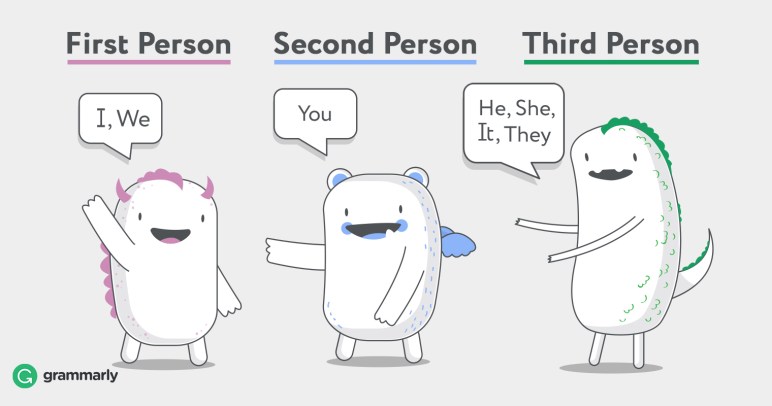
Thank you to the beautiful people at Grammarly for this awesome little image of Point of View.

Whilst (I love using that word) typing up the title today I realized, that all of these blogs on novel writing can also be used in other aspects of your writing. Short stories, flash fiction, non fiction, and even poetry all contain aspects of plot, character, and point of view. In a novel, however, consistency of your point of view is crucial for keeping your reader snuggly in your world. Shifts in POV can cause confusion or jar them out of the story.

So today, we’re going to briefly discuss the typical types of POV as well as which ones are most effective to use.

For the budding writer, I’ll lay down some foundation.

Point of View is basically who is telling the story.

In First-Person POV, then the action is happening to the person telling the story (the narrator is the main character). Here, a writer uses “I/We” mostly while only using “he/she/they” as outward observations. They can tell you what they see, feel, hear, know, etc, but they can’t tell you what anyone else sees, feels, hears, or knows. The best way to show those things are through action and dialogue AND by having faith in the reader to understand by your clues the general idea.

Second-Person is the red-headed step child of writing POV. I’m sorry. I said it. Second person uses “you” and “your” and they narrator speaks directly to the reader. “You were amazed. You’d never seen a chicken with five legs.” They make you part of the story. I suppose some of my blogs have been in 2nd person, non-fiction informative may utilize this POV. I’ve never used this in a short story or my fiction but occasionally it creeps into my poetry. In fiction, it’s very difficult to do well. (“Bright Lights, Big City” by Jay McInerey, “The Sweetheart” by Angelina Mirabella, “The Night Circus” by Erin Morgenstern)

Third-person is an outside narrator telling the story from a distance (she/he/they). When it gets closer in (think into the characters’ heads) it’s called third-person omniscient. Third-person is popular with light fiction, serial romance, cozies, beach reads, sci-fi, fantasy etc. The tricky part of this POV is being able to stay focused on one character at a time. If the story dictates it (two or three main characters) I will switch POV in Third by chapter, possibly by section, but never by paragraph or within the same scene.

We discussed each typical type, but how do you know which one is best for you? Well, part of this comes down to your writing style. When you write, are you the character? Are you in their mind, in the arena, in the pilot’s seat? Or are you observing them, building the world around them and telling them what you see from above? Are you walking them through the story, a sort-of inward conscience to their journey? Which genre is your story? What’s the purpose of the story?

All of these factors can make writing in the right POV harrier than my old math teacher at the swimming pool (Hey! Take the sweater off before you get in–oh…wait…sorry!) Some genres are more lenient as to how much you can change or shift the point of view. Some genres really do best when one specific POV is used.

Take memoir for example. This type of storytelling should be first person, past-tense. Period. That’s your story, it happened to you. You are telling it.

Now, romance novels can dance on the edge of third-person, third-person omniscient, or first-person.

Most contemporary fiction these days is first-person (think Hunger Games) or if you’re feeling fancy, 2-person, first-person (look at Gone Girl–a book told in first by two different main characters–very clever)

I am wont to say that sci-fi and fantasy tend to be third person, due to the world building that has to occur. But it can be done marvelously in first as well (check out “The Martian” which tickles both first and third).

The important part about POV (especially when working with third) is that you stick to a strong, non-passive-voiced point of view that stays in its lane.

Check this out:

“You’re such a selfish prick!” Jill yelled and slammed her fist into the table upsetting the spoons. She’d had enough of his late nights at the track and the dwindling bank account.

Bob jumped back at the sound. His heart fell to his gut and he felt like crying. He couldn’t believe he’d lost their honeymoon money. He was only trying to double up on the winnings so they could have a bigger trip.

Jill paced the room in a fury. How could he? After she had been saving for months and months so they could go away…

Yowza. For one–this is a lot of information dumping out on your reader. You can’t describe your main character’s (Jill) thoughts and feelings about Bob and then in the next paragraph have Bob spring into an inner dialogue on his thoughts and feelings about her. It’s called head hopping and it confuses the readers. Only a few really talented authors can make this happen and not lose the reader (I’m looking at you Nora Roberts).

Don’t cause a ruckus. If the character you are writing for (be it third or first) isn’t a goddamn mind reader then don’t describe things they wouldn’t know.

If you want the reader to have the information, you show through body language and dialogue.

“You’re such a selfish prick!” Jill yelled. “I can’t believe you blew our savings at the tables!” She slammed her fist into the table and knocked over the cup of spoons.

Bob hung his head and swallowed. His voice trembled. “I’m sorry.”

“Sorry? Sorry doesn’t even begin–“
“I was only trying to–” Bob started.

“It doesn’t matter!” she yelled. “You don’t get another chance to make this better!”

Here, the reader has enough information to gather how Bob feels without dropping us into his head.

Ok. Whew! Speaking of info dumps, huh? Take a minute to absorb all of that. Think about your story, what you’re trying to do, who you’re trying to follow, and how you want to bring the reader along. If you’re writing short stories, experiment with all the types of POV. I’ve only written a few things in first and its very powerful, but for some reason, it’s very hard for me. My comfort is in Third-Omniscient, but as in all things in life, we have to push our comfort zones to be better. So…push your zones, get uncomfortable.

Pick a POV per project and stick with it.

Until next week. Happy writing!