Two Ears, One Mouth: The Power of Listening for Writers

I know it’s been a pretty poetry-heavy blog of late and I’m honestly not apologetic about that. Poetry is a grace that fits into my life better these days. It’s more accessible to write, to slip my fingers into it’s lines, and to distill so many of the big and difficult feelings I’m currently holding. If you don’t poetry, you should. (Yes, it’s a verb, and a noun). But for today, I wanted to write about something I think is a skill whose value is immeasurable for writers.

The power to listen. Now, I’ve always been kind of a quiet kid (until I know you better, then good luck getting me to shut up) and was subjected to all kinds of comments. “Doesn’t she know how to talk?”, “I guess she’s just not much of a joiner, huh?”, “She’s so quiet.” All of this and more almost berated me into more silence until I was into my adulthood, and was forced to be more proactive in communicating. Still, to this day, in a large crowd of people, I prefer to be the one slinging one question into the crowd and then softly withdrawing to the sidelines to watch the frenzy.

Because I learn more this way.

First: I learn about character, history (or backstory), as well as flaws and strengths. In the listening to their words, their thoughts, their stories in total, yes, but also… I learn how they speak, I listen for intonations, and body cues. I listen for changes in pitch and pace, I listen for old dialects and idioms sneaking through. I listen with my eyes to watch the way their hands talk, their body nervous or posturing. I listen to the subtext of history behind it all. I learn about humans, and their story when I listen. And learning about humans is such a fundamental skill for writers to have. Not because we want to poach a character straight out of our monthly PTA meeting (well, maybe you do, I’m not here to judge) but so that when we sit down with our characters we can visualize them. As they are, with all of their imperfections and mannerisms, and really start to build a world true to what they’re saying in words, thoughts, and actions.

Second, and perhaps more utilitarian, I learn about the world. Listening to people opens me up to experiences and knowledge that I don’t have, maybe that I may have never even wondered about. And every story that settles into my encyclopedia brain is a new idea, a richer understanding of an old idea, and a bigger picture of this fantastical world. Every human being is a conduit to experience I don’t have enough years to gather myself. What a wonderful way to learn, am I right?

Third, and this is a natural consequence of the last point, listening to someone is a sign of respect, of interest, and on some level, love and acknowledgment of their existence, their struggle, and their worth in the world. More than just getting that character quirk you’ve been struggling with for months, or learning that a group of hippos is called a ‘bloat’, you are validating the experiences and importance of another person’s life. You are willingly giving them your time and attention (finite resources) and being present with them. That matters. More than just as a writer, but as a human being.

So–next time you’re in a crowd, writer… pay attention. Focus in, feel the presence of being in someone’s audience and listen to the story they show and tell you. It may lead to the next grand idea, it may help you unstick your work, or it may just help another human being feel seen.
The Beautiful Stuff Writers Workshop: Novelty #4- Character Part Deux

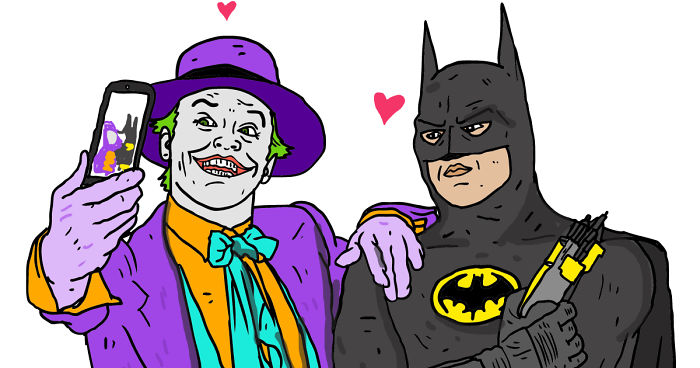
(image respectfully borrowed from Nick Cocozza’s amazing “selfies” series)

F*&k yeah, I just copied and pasted another great blog I wrote on Character (sorry for using F*&k in the first sentence, Mom). But if you haven’t followed me from the start you might have needed a reminder and I needed to work on some other projects. So… Ladies and Gents, enjoy Part Deux of Character.

From the dark, cavernous recesses of the author’s twisted mind springs forward all sorts of nasty and derelict creations.

Okay, that’s a touch overdramatic.

Frankly most writers will begin by creating a story from people they know or have read about. Sometimes we do it without even realizing it. Characters and personality traits that we admire, or equally cringe at, stay with us in that sometimes-twisted-but-always-magical realm of our subconscious. Realism in characters is important because it adds to their believability and with that, their ability to connect with our readers.

Why is it so important to connect your character to your reader?

We are a society of channel flippers, of instant gratification lovin’, drive-thru eatin’, convenience hounds. We have the attention spans of goldfish. If you can’t connect your readers to your character through the common ground of sympathetic and universal traits they will put your book down. And often, when a book lands on the nightstand, it never gets picked up again.

I shudder to think how many amazing stories were lost to the underside of the coffee table.

If your reader can’t identify with your character in even some small way, they will cease to care about that character and will not follow them, no matter how interesting the story is. The human element is very important.

So along with grabbing them from the beginning with an interesting and challenging first scene, you must hold your reader to a character that they care about, either because they relate to them, or because they are fascinated by their darker side. Their traits and foibles make your readers want to know what’s going to happen to them next. And that keeps them reading.

In the ignorance of youth, I used to think that my character could be anything and do anything. They could be perfect because I was building their world and I could make them flawless. They could be smart, and athletic, and beautiful, always saying and doing the right thing, always in control of their situation and aware of their future. (In the business we call these characters “Mary-Sue”s or “Sunshine Sallys”).

Snooze-o-rama and eye-roll Central.

Nobody, and I mean NOBODY, wants to read about some pristine person who’s practically perfect in every way.

For one, we don’t need perfection rubbed in our face. We get enough from the glaring social media machine. Secondly, a character that always says the right things, does the right things, and looks like a supermodel is not challenged and if they are, they do not fail. Characters that never fail are unrealistic, which means they cannot relate to the nerdy girl in her frumpy sweater and ripped jeans, curled up with your book (Yep, that’s me I just described). And what happens when that person doesn’t relate? The book is given a good chuck over the shoulder with a hearty ‘Good riddance’.

So make your characters dirty. Make them tarnished and worn. If they have to be beautiful, make them fundamentally broken somehow inside. If they are self-assured and intelligent, give them an outward physical challenge that hinders them. When a reader sees your character fail, they see the humanity within their own failures. More importantly, when they see them overcome the faults that stall their growth, they feel hopeful for their own path. They follow that character. They root for that character.

*In an amendment to this section, I would like to say, due to the overwhelming lack of Mary-Sue characters these days, they’re actually a bit of a phenomenon. So, if you must create a Mary-Sue, own the hell out of it. Make them so staggeringly perfect that its almost comical…or otherwise interesting. Think of the person with extraordinary good luck, that can’t do wrong, even when they try.*

As a beginner writer it’s tempting to live out the life you wish you had in your pages, and it’s okay to write those ideas down. But keep those rarities for yourself. When it’s time to write an amazing story for the world, give the reader a character they can root for.

This advice is straightforward for developing the protagonist’s character traits. But it’s equally important to give this attention to your antagonist.

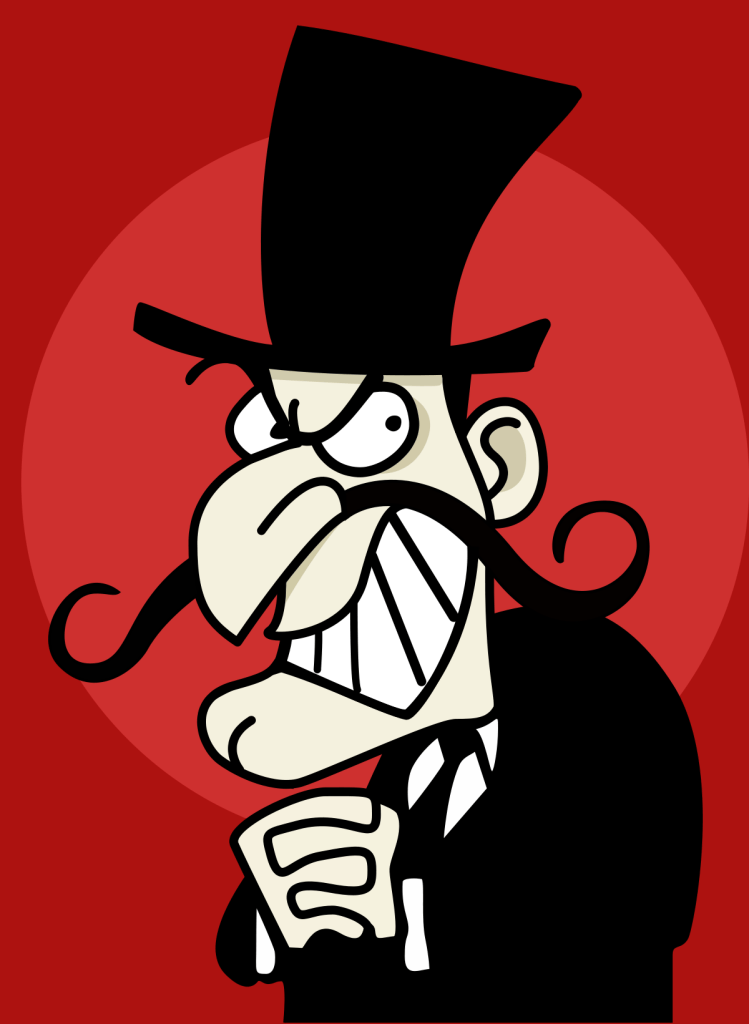
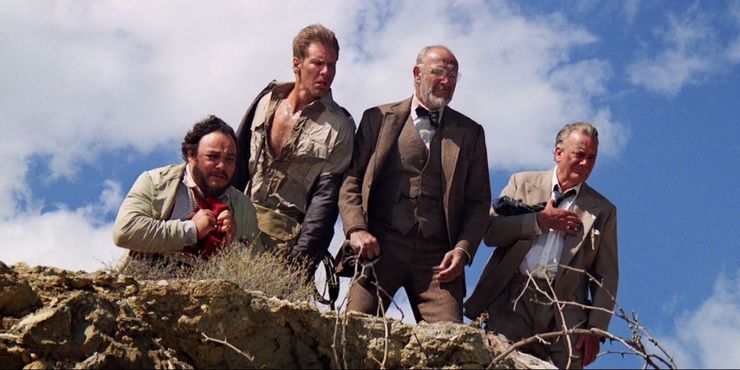
Something tells me this guy has rope, a damsel, and a train to catch

No ‘good guy’ is all good, and no ‘bad guy’ is all bad. Even the worst ‘bad guy’ has to have reasoning in his actions. They must have something that drives them, and it has to be something we can understand on our basic human level, even if we don’t agree with it.

Having even a slight sympathetic response to an antagonist builds tension between the characters and gives your reader the nail-bite reaction. The opposing forces both come from places that can seem justified and ‘right’ in their position, which makes the battle all the more important on both sides and the outcome so much more brutal or celebratory.

This week’s exercise is to take a hard look at your characters. Do they have some baseline, deep-rooted faults? Are these faults causing interesting and plot-driving stumbling blocks? Are they loveable, and a little bit annoying? Are they dangerous, but still broken?

If you find that they’re not engaging enough, throw in a life-changing event into their past and rewrite them based on their new fault. Divorce, fire, murder, car accident, illness, or the loss of loved one can be good ideas to play with. Take away one of their defining traits and replace it with its opposite. Nothing you play with is set in stone, it’s just a way to grow your character’s depth and help you to know them better.

If you’re looking for a good reference, one of my favorite books on the subject is Writer’s Guide to Character Traits by Linda N. Edelstein, PH.D Writer’s Guide to Character Traits.

Good luck out there, kiddos. I’d love to hear if this helped you out and how!

Happy Writing.

The Beautiful Writers Workshop: Novelty #3: Character

Good morning, writers! And a happy morning to you (or afternoon, or evening, whenever you tumbled out of bed–or back into it and are catching up on your bloggers). This week, in exploration of the novel, we’ll be talking characters.

I’m telling you now, because contrary to some reports out there, I’m not a complete idiot. A while back I did a decently in-depth study of character and I’m using a lot of that for this post. After all–the quicker I get the blogging part done, the quicker I can get back to my own novel and the characters I’m currently developing.

So without further ado– recycled Character Development:

Since character development is one of my favorite aspects of writing and I thought I’d pay homage to it’s process in a two part post.

So first, let’s address where characters come from.

I’ve had characters come to me in dreams (day or night), sometimes they’re inspired by true stories from news that I trip across. Sometimes they spring from hazy memories of a childhood friend, or the curious behavior of the neighbor across the street who steals decorative rock from the common area and smuggles it away in her purse. Any one adept at studying human nature and observing their fellow human beings can get inspiration simply from watching what our nutty human brethren do (and don’t do) in the course of their day.

Often, though never in their entirety, I write from people I know. By this I mean people I know both casually and intimately are good places to start for characters.

Although real people can help jumpstart the process, they rarely become the character in the final draft, and here’s why.

For one, it would be creepy (and, depending on the story and topic, possibly slanderous) to write about an actual person from your life, unless it is a memoir of said person and they are asking you for your help. Ethically, a writer looking to publish or share their work with the world must adhere to certain rules of respect and common decency concerning using the likeness of other people. That being said, you can (and should) borrow personality traits, history, and physical attributes that enhance your character’s believability, without putting someone’s life down, verbatim, on your page.

Secondly, even when based on someone you may know, something magical will inevitably happen when you put a ‘real’ person on a page and shove them into a conflict (the driving force of your story). Under the demands of a proper story arc, the character you began with will be forced to shift and evolve into someone else. You don’t know how your character will behave in an apocalyptic dystopia and the situations and decisions that they are faced and make will be a magical combination of what the author dreams up spontaneously, the character’s history and what the author needs them to do to move the story forward.

For example, Joe Smith may start off looking like your high school biology teacher but if you write him exactly as he was, including is normal day to day, your audience will be too bored to stick with his story.

Now, if you put the body of an alien in the school science lab’s freezer next to the dissected frogs, Joe Smith, your old biology teacher will automatically become way more interesting. And as he does, he will move away from the real person you started with and morph into a different character. A man of his own, alien-hiding, design.

They double-dog dared him.

A writer can tweak, correct, enhance and play with personality types, turning one, real-world person into a completely different but still realistic character. But it’s important to keep the relatable aspects of the initial ‘muse’, including the physical attributes that you can describe in realistic detail, or the personality types that can be explored in depth from a place of personal interaction.


What can be left behind are names, exact and undeniable physical description (don’t be a creeper) and any ‘boring’ or typical parts that may be cliché or expected. The character will change to be their own person with the natural progression of their role and development within your story.

The other method of character development is to begin with a story and let your mind follow the natural path of who lives it. This is one part plot-driven creation and one part spontaneous combustion.

An atomic bomb goes off, a virulent disease hits the population, a train switches tracks, a car runs through an intersection, an alien shows up in a freezer.

Start with an event and ask yourself; who would it affect most? Who stands to lose or gain the most? Who is equipped to deal with the situation? More interestingly, who is least able to cope with it and how do they survive?

Characters will find their way into your mind. They may look and act like someone you know or they may have a mind of their own. As a writer you will find that as your plotline advances the character will become less and less your creation and more a product of their history combined with their destiny.

We all have these personalities in our heads that sit dormant on the shelves until something shakes them loose. Most writers, (yes, I’m saying it) are a little bit schizophrenic. We are geniuses of introspection and observation. Humans are interesting and a good writer will watch and learn from their interactions how to build characters that could be a best friend or a worst enemy in their reader’s own world. They talk to us as we write their paths, they argue when we move too far away from their true reactions. They trip us up by throwing random but necessary bits of history our way that we hadn’t considered for the bigger picture. It’s maddening and magical all at once.

Next time we’ll talk about developing intricate characters and some tips I’ve picked up along my journey to make them somebody your reader’s will root for, love, and hate. Until then, take a few minutes today to think about some characteristics that you love and loathe in human beings and think about why they draw your attention.

Make a list of character traits that are interesting in both beneficial and detrimental ways.

Also, feel free to write or comment about your favorite characters, and if you’ve ever found yourself ‘accidently’ writing about someone from real life. Next time we’ll have an exercise on character development and I look forward to your responses!

Happy Writing!

What’s Up This Month?

Wow, I’m so glad you asked. I’d love to say, I’ll be doing a lot of fall gardening, hiking to my heart’s content, writing in hoodies with hot tea and snuggling into the fall. Unfortunately, its still hot as balls here, and a writer’s work is never done. So none of that will transpire (though I may sneak away for a hike). Below are some links on where I’ll be, what I’ll be doing, and some cool books, events and classes I hope you’ll check out. Not to sound altruistic, but its not all about me here…

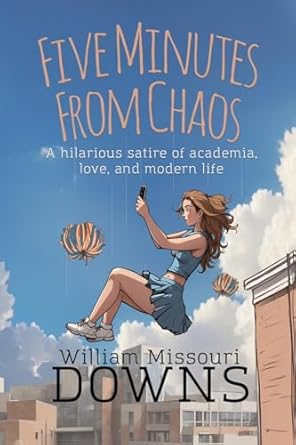
One of my favorite people in the whole world is releasing his first novel today (September 5th). William Missouri Downs is a delightful, ingenious writer. He’s been a play and screen writer for many years and this is his first foray into fiction. And let me tell you…its fucking brilliant. If you like humor, philosophy, and quick, fun, laugh-out-loud scenes, you won’t be disappointed. You can get your own copy of it here: 5 Minutes From Chaos

My first Youth Writer’s meeting happens on September 14th. The group meets once a month but in the next year we’ll be bringing in some stellar guest speakers and doing a lot more to help the members get writing time in and promote their work. If you know of a youth (12-18) who loves to write but who’s creativity is constantly being smooshed flat by diagraming sentences in English class, send them my way. Nothing but uneducated, free-wheeling writing going on here. It’s in person and virtual and FREE. Check it out here: Youth Writing WHWA

I’m taking my oldest daughter on a college visit to New York state. I don’t want to pressure her, but I’m really hoping she likes The University of New York Fredonia, because one of my bestest friends works there in the English department. I’ll actually get to see her while I’m in town, and this lady Rebecca Cuthbert, is a writer you should get to know. Her work is brilliant, dark, smart, delicious and spine tingling. I just love it. Her newest books and releases can be found here: Rebecca Cuthbert

I’ll be helping to host some of the events with Writing Heights Writer’s Association, so if you want more information on a great group that will help you better your writing skill and offer you a wonderful support system of other writers who really get it, check them out here: WHWA

Finally, I’ll be attending the Rocky Mountain Fiction Writer’s Colorado Gold Conference at the end of the month and I’m all atwitter over it. Nervoucited? Excitous? I’ll be teaching the classes shown below at the event and trying to cram going to as many more as I can. The presenters are amazing, the content offered is awesome and I’m just gearing up to writer-geek out. Here’s the link if you want to register, because I would LOVE to see you there: RMFW Gold Conference.

Well, that’s it (as though all of this isn’t going to run me ragged) I hope that you find something cool to do with the month and I hope I get to see you sometime. Take care!

Backstory: The Sum of Our Parts

Hey kids! Today I thought I’d settle back into a little bit of craft. For those of you who are beginning writers, I hope this will be of use. For those of you who are super-sonic, advanced, best-selling writers…what in the hell are you doing reading my blog? Don’t you have launch parties to go to and movie studios to schmooze? As I consider myself a perpetual beginner in all things, I will continue as if this is something you still need work on, because I do.

Backstory…ah yes, all the shit that happened to your character before they land on the page of your novel. All of those pesky details that readers don’t necessarily need to sift through (100000 words or so?) but that are essential to why your character behaves the way they do, why they are where they are, and what fatal flaw we are hoping they fix. So how do we, as writers, weave the important details in without dumping large, boring, sagas of backstory on our readers? Here’s a fine bullet list:

  • WRITE IT OUT, BUT DON’T PUT IT IN: One of the best practices you can do is write out all those long, sweeping, historical scenes in a separate document. It helps you get to know your character better and to be able to write them from a place true to their history. That document doesn’t have to be seen by anyone else, think of it as writing an entry on your character in wikipedia to be able to better write them authentically on the page. Backstory details will have an easier and more organic presence that way.
  • CONSIDER YOUR GENRE: Some genres (Literary, YA, Regency Romance) tend to have more personal historical details, and if the main goal of the genre is a transition from the past to the present or future (coming of age, hero’s journey) then the past will play a bigger role and more time can be devoted to it. Readers in these genres expect as much.
  • MOTIVATION: Everybody has a WHY. If the motivation is obvious (he’s a cop because he believes in justice) it requires no backstory. If, however, they’re in a role or position that seems to clash with their personality or values we need to know a bit about how and why they got there. (She’s a cop because her father was killed on the job by a dirty partner and now she wants to ferret out the current Commissioner).
  • BE SELECTIVE TO ENHANCE THE FLAWS: If your main character arc is about how a closed down hunk learns to love again, then we need to know why they closed down in the first place. You don’t need to know he was the captain of the rugby team unless his heart was broken by a fellow player. Stick to the details that caused their flaw, or reveal something important about their values and personality that are essential for their evolution, or are the defining handicaps that keep them failing.
  • BE BRIEF: In this case, a hint is as good as a paragraph/chapter. Some of the best backstory is the kind that is interwoven, seamlessly within a paragraph. Related to the current events but powerful in its small punch. “When he asked if she wanted a peppermint mocha she scrunched up her nose. She hadn’t liked the scent since her grandmother had insisted she rub peppermint lotion on her feet every night. ‘No thanks, just a latte,” she said.” Here we see that she had to take care of her grandmother and it wasn’t pleasant. Young people in positions like that have a heavy sense of duty and often resentment. We learn this from one line about grandma feet.
    • If you struggle with how to shrink it down, see the above bullets for the most important details and boil those down further. Ultimately it’s about practice and thinking about how your own brain works; how certain smells can bring up memories, or being in a car reminds you of a trauma, etc.
  • IF IT’S GOT TO BE LONG: Okay, I get it, sometimes exposition is too important to the motivation, character flaw, and story to get cut down. So here’s some rules of thumb, if it has to be longer:
    • It better be full of gasp-worthy events
    • Write it in beautiful sweeping prose and be addressing a literary audience that doesn’t mind a good wander.
    • Make it hilariously funny

Well, there you go. I hope this helped give you a little boost on how to interweave backstory into your work. Good luck on your writing and next week I’ll have some announcements about the big ol’ month of September and what fun things are going down.

What’s in a Name?

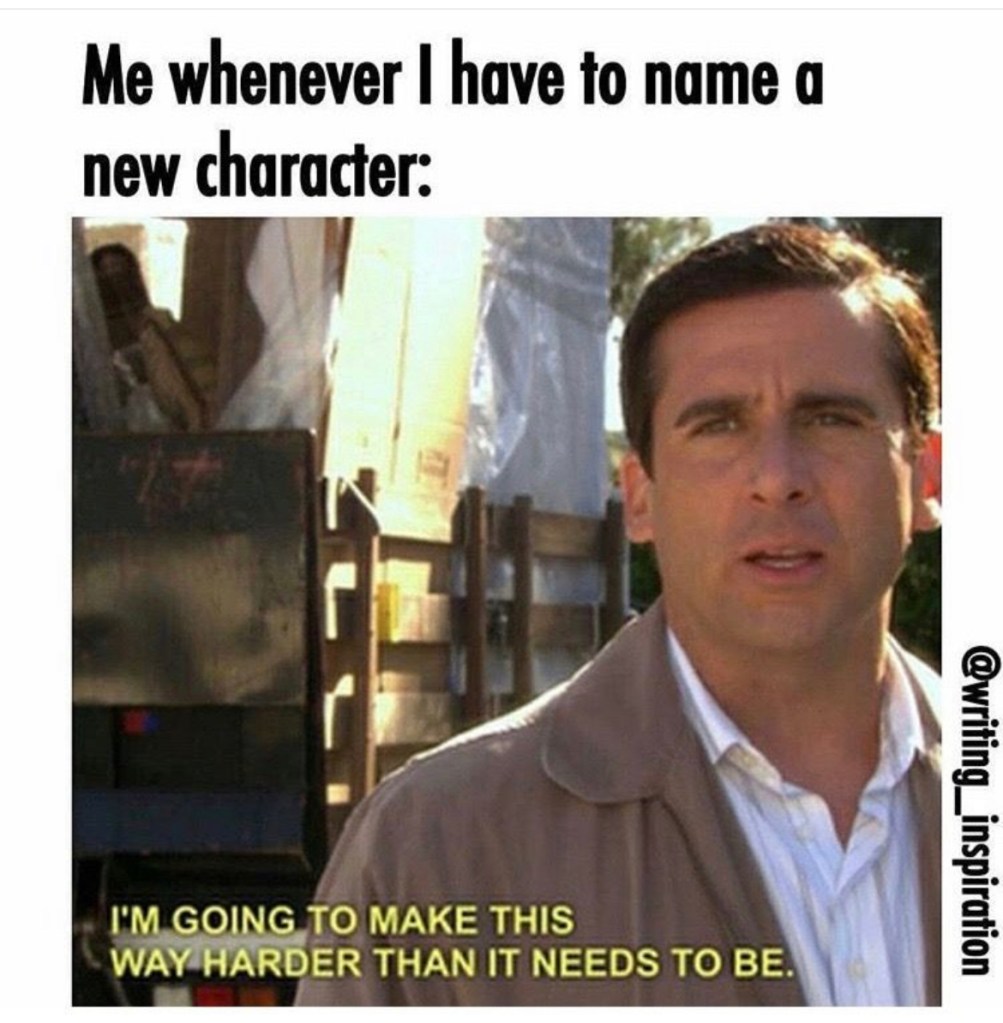
Good morrow sweet readers. Today I’m going to talk about the importance of names in your fictional writing. Every writer has a process, and some of them are very organic while others are tortuous. I have been in both of those phases. Sometimes a character is just who they say they are when they pop into my head. And even if I wanted to change the name, I couldn’t. Sometimes the same character goes through an evolution of two to three (to seven–jesus, Elle Sullivan) names before the right one lands.

So how do we do it? Well… Here’s a bullet list because… we love bullet lists. Keep in mind that a character can be named for one of these reasons or for a combination of them.

  • Naming your character with meaning
    • This is where we get into the baby name sites and books and start with a meaning and back search what names correlate. I’ve done this a lot with my more urban fantasy/paranormal characters. I’m pretty sure none of my readers go around looking up the name and finding the little easter egg of their arc and purpose matching up. I do it more for me.
  • Naming your character Regionally/In Situ
    • Naming your character something that originates from their homeland, family, or region. This is important in some cases, to ‘show’ the reader a little bit about who they are by where they came from (like dialect but in a word).
  • Naming your character with sound
    • I think this is especially important in childrens’ and middle grade books. Lemony Snicket, Severus Snape, Skippyjon Jones. Not only does it make it more fun to read outloud but if you do your job right, you can intonate character with name. Severus Snape, ‘esses’ like a snake on your tongue.
  • Naming your character in tribute
    • There’s absolutely nothing wrong with this when it is done out of love and respect. My grandma Emma became Em. I even inadvertently wrote in a dear friend’s mother, Carmen into Back to the 80s. I know a Jamie, and love the name and fella but since it would be weird to write him as the MC, I made sure it was ‘Jameson’ in Composing Laney. I’ve used friend’s last names or nicknames. Sometimes its a way to pay tribute to them and be a little lazy.
  • Naming your character for foreboding
    • Gage in Pet Cemetery. Hodor from the Game of Thrones. Damien in The Omen. Even Remus Lupin, gave us some insight into the direction of the character. You can either spoil plot twists with this one or make your readers stop mid page to gasp at your cleverness. The trick is subtlety and not thing more than the name away before the twist. It could even be that an evil name (Severus Snape) is actually not attached to a villian.

Well, there you go. A few ways to start thinking (and probably overthinking if you’re like me) about how to name your next character. For a few more resources, check out the list below. Some of these are way more in depth than I like to go, some are fun and you can just keep spinning the wheel until the right one comes up. Good luck out there.

  1. Masterpiece
  2. Fantasy
  3. Listophile
  4. The Story Shack
  5. Reedsy Villains

Listening to Our Characters

Good morning dear readers and writers. First, may I offer a huge thank you for all the comments and encouragement I received from the last post. Writer’s know what it is to get bogged down in the process, and no one is better at pulling you up from that dark, dusting off the weight of the little failures that cling to your shoulders, and giving you a gentle but determined shove back up on the road. So thank you for your advice and encouraging words. They mean a lot.

Between that last blog and this one, I was lucky enough to take Todd Mitchell’s workshop on Creativity. I’d been to a few of his classes but this one seemed serendipitous. I knew I needed to start writing again, a novel. A big project to immerse myself in, and I have a beautiful trio sort of dangling between first draft and not quite done currently on my computer. I love the second book, and that’s obvious by how close to done it is. The third, similarly has pulled me in and I’m enjoying working through the rough patches. But the first. Ah…the first. Kind of the keystone in a series…well…it’s a piece of shit.

And it took me a while to really figure out why during rewrites last year. The main character had somehow taken on the dreaded Susie Sunshine persona (probably because the concept of her was born many years ago.) So, I put her through a character-lift (like a facelift but for imaginary people without faces yet). She got a spanking new name and I roughed up her edges. But nothing in the story seemed to make sense and it felt like trying to force an incorrect puzzle piece into a million different holes that did not fit. What in the hell was wrong with her? I knew what she needed to do and the plot and arc of the book was solid.

But I didn’t believe she was the woman to live it. And I was stuck.

And then Todd said something about struggling with a novel for years until he finally sat down and wrote a letter to his main character and asked him “What is it you want me to know? What’s your story? What am I not seeing?”

For the average human reading this post, I’ve just solidified in your head what absolute insanity writers possess. What do you mean you ask your characters? You created them. You know them. That’s your brain.

But the brain is a tricky place, silly non-writer. It’s vast, and expansive and it has a million rooms we’ve never even found the doors to, let alone explored. And sometimes, characters and answers lay behind those doors. And the only way to access them is to stop trying to force the answer. (I’m planning a post on Alpha State writing so hanging in for that one). Answers com only when we calm the hell down, and sit quietly outside the door, letting go of our ego and our need to tell the story, and just listen to their story.

Sounds crazy. Absolutely, bat-shit, bonkers.

And it totally works.

I put on a meditative playlist, took some deep breaths and focused on her name. Her new name. Her newly rough edges. And I sat, with my back to her door and took some deep breaths. I closed my eyes and started typing. And I didn’t question or stop, or allow myself to think of what she was saying. I just listened to her.

Here’s what it looked like:

Hey Dani,

Hey Sarah.

So, I’ve been struggling with you.

Yeah, I know.

I want to create you

You can’t create me. I just am.

So who are you?

Wrong question

What is it you want me to know? What am I missing about you?

I’m dark.

You began so light and perfect

That’s not how the world works. Not for babies abandoned, babies with parents like mine.

What does that mean? Who are you?

I am Danika Brennen. I was left at a fire station as a baby. An orphan.

Who left you there?

A pregnant vagabond, disowned. My mom

Who was she?

An member of the High Guard,

kicked out

Are you ***’s daughter?

No, I’m Loki’s.

holy shit.

Now, I’m not going to give everything away, but that last thing she said…that was an answer I didn’t know until I let her talk to me. And it’s an answer that I can write a book from. That will help me, help her navigate through this story…to a better place. To a life she deserves. As dark as she thinks she is.

It’s crazy right? But talk to any fiction writer and I guarantee they’ve had some kind of experience with their characters talking to them, to each other, offering unwanted suggestions or criticism along the way. And yes, they’re all in our heads. But I think as humans we underestimate the expansive reach of our brains and neural capacity.

I mean what if they’re not just our consciousness, what if they’re wavelengths in a much bigger plane of existence that we’ve only just started to understand. The wavelengths and dimensions that only open to us, When we listen.

Feel Like Makin’ Love

You’re welcome for getting that song stuck in your head.

Last week I talked about heat index and how to define your novels for submission or how to search for the right Goldilocks-level of heat for your preference. This week, I want to talk about writing engaging love scenes in your books.

No matter the level of heat you’re writing in, the sexiness of a scene doesn’t just depend on how many engorged members you’re throwing in there.

Photo by Pixabay on Pexels.com

Wow, what a visual. Yeah, that actually makes it less sexy thinking of it…penises getting thrown into bedrooms willy-nilly. Ha, willy-nilly…ugh. Ahem, let’s move on.

Let’s get something straight right away, sexiness isn’t about sex. Heat and desire, aren’t about sex. At least not for the majority of women. (Men, if you’re reading this, get a notebook.) Sexiness is about connection. Two strangers can have sex, and people will read it. Penthouse has proven this. But if you really want someone to read a whole book about two characters, follow them through the quagmire of plot arcs and dialogue, sex is the perfectly balanced frosting on the cake of it all. Two characters that are emotionally connected interacting in a physical way, drives up the excitement and anticipation in the reader tenfold.

It’s all about chemistry. It is vital when aiming to curl the toes of your readers, that you give your characters a connection that feels genuine, deeper than surface level, and tied to their emotional well-being. Then, when you get to the point of all that delicious teasing, it makes the ‘climax’ all the better. Because it isn’t just about physical satisfaction, it’s about connecting in the most intimate way with someone who really gets you. Who loves you. Who sees your scars and your war wounds, and kisses every one of them with acceptance and care.

So if you want to up the sexiness of your scenes, establish a good connection, (even if its enemies to lovers). Find a common ground between them, a exposition of trust that opens hearts, and a deeper understanding of one another that makes the sex even better because there will be less reserve, fear, or doubt involved.

And this brings me to another point, writing good connection between characters is a subtle art that you can employ in your dialogues, body language cues, and inner dialogue (if you write that POV).

Next, depending on your comfort level, what you crave in romance, the nature of your book, or the heat index you’re working on, be honest about the sex. It doesn’t always have to be pretty. Heads get bumped, knees get scraped, giggling ensues. Don’t shy away from the human experience and the parts that make it truly beautiful. With that remember that there are a lot of senses involved in the act. Sight, sounds, smells, touch, taste. Don’t be afraid to play around with them as a way to bring readers in. How far in you bring them is up to you, but even the best closed-door scenes have an awesome build up to the point the door slams shut.

Attraction, chemistry, and desire are the tenements of any good romance, but remember that it starts with connection. Human connection, in all its glorious messiness. Putting in those beautiful messy moments will help bring your characters in a place where the love they make is a natural and much anticipated progression in your book.

Writing to Frighten: The Art of Suspense and Tension

Photo by Monstera on Pexels.com

Good morning, writer. As we approach Samhain and the dark, twisty corners of the season I thought it would be a great time to bring up suspense in your writing. I’m not a horror writer and I’m not going to pretend to be just to fit in to the theme of the month but I do believe that being able to create suspense in any genre is key to keeping your readers engaged and turning the pages.

Suspense can help build emotion in your reader up to your critical moments of change (the top of your acts–the big doors–crisis of faith moments—etc.) And that helps them become more invested in your character and the outcome of the scene. Because it’s been awhile, I’m going to give you a good-ol’ bullet list. Everybody likes a bullet list. Here are some top tips to factor in while working the element of suspense into your novel/Work-In-Progress. Keep in mind, these are general so they can be applied to most genres, but within each tip, there are a hundred different directions you can go–from the benign to the macabre.

  • Tap Into Universal Fears: We all have some pretty basic fears that drive us. They are usually based in survival. Fear of death, loss of child/loved one, fear of physical pain, starvation, exposure–anything that can take away the basic needs for survival. Fear of the unknown–can mean anything from not knowing what’s making that bumping noise in the closet, to not have existential knowledge of where you’ll end up after death. Fear of emotional pain, fear of social stigma. We’re scared little apes, so there’s an endless well to tap into here.
  • Create the Right Atmosphere: Depending on your genre and the style you like to write in, you could use your scenes to strike psychological terror (inner thoughts, rampant and illogical emotions, mind-games, gaslighting, etc) physical/gross terror (think limbs stripped of their muscle fibers, blood spurting, eyeballs popped out, or any other gory, pain-inducing action), or subtle/unseen terror (the ever present feeling of dread–small sounds getting closer, lights flickering down long hallways, those two notes on the piano when Jaws was nearby)
  • Make The Stakes High: It’s not going to ruffle your readers feathers if your character meets the friendly neighborhood cat at night if they love cats and brought yum-yums to share. Make it ten mange-riddled cats with broken, sharp teeth, stalking down a feline-hater, from all directions on a deserted city street and then you have a show. Losing a job sucks–but make it the job with the benefits that her sick daughter needs the insurance for, and its a different game (let us pause for a moment when discussing terror and how the American medical system has actually become something that induces terror…think about that for a moment)
  • Consider Your Point of View: There isn’t a wrong POV for horror, it just depends on how you want the reader to feel. Are you aiming to put them in a shed with the axe murderer outside, holding their dying cell phone? (FIRST PERSON)Or are you sitting beside them in the shed with eyes on how close the bloodied axe is to the door, yelling out in the middle of the library “Make the call, you idiot!!! He’s coming for you!!” (THIRD PERSON)
  • Don’t Forget the Character: Listen, it all comes down to the basics, if the reader isn’t invested in your character, they aren’t going to feel the empathy needed to induce terror no matter what horrifying situation you put them into. Make your character someone worth following into the dark and twisted. If your character is the dark and twisted, give it/them the solid justification that makes the reader question who the bad guy really is.

OK! Well, that’s all you get today. Good luck out there creating some suspense. Use it as you need to in your own work and if you feel the Hallow’s Eve vibe, try your hand at a little horror. I always encourage dabbling outside your genre to help make your work stronger.

Happy Writing!

Romancing The Story

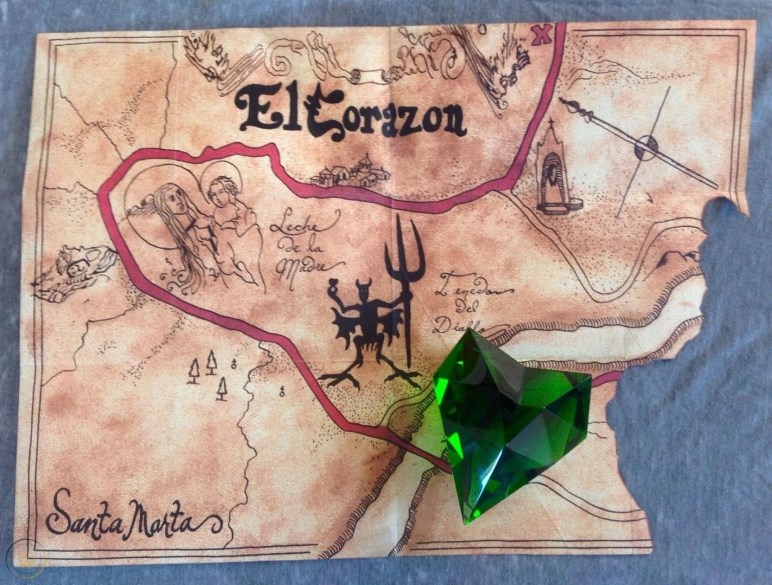
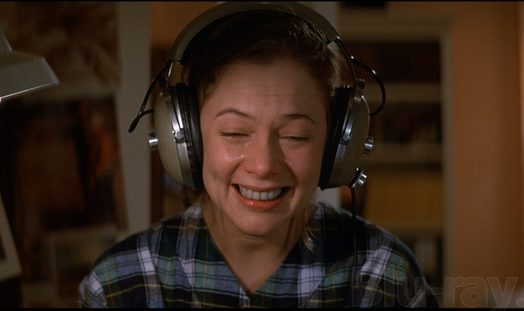
Please tell me I’m not the only one who remembers these movies. I think, they may be partly to blame for my current profession (not the karate instructor—the other one, that pays even less). I loved the quirky, unrealistic way that the original frumpy romance novelist came upon adventure and began living the kinds of stories she only wrote about before. I also loved that by the second film we see her living this exotic and adventurous life and still suffering writers block brought on by lack of romance in her characters.

How I imagine I look as a tough-ass romance novelist
What I actually look like, flannel pjs and all.

Because no matter how much adventure, vine-swinging, sheik angering, and Jewel finding you do, if you’re not in love with your novel, no one else will be either.

Bam. Mic drop. Blog finished, I can go take a nap….

*sigh* ok, I’ll elaborate.

Romance isn’t just about what happens between the sheets in a typical Harlequin. Romance is about creating a smolder, a heat, an intrigue between your characters, and between your story and your readers.

When I titled this blog, I worried I would lose those writers who focus on different genres and have little need for ‘romance’. Suck that (respectfully), we all need romance. Humans are born to seek out connection. Now, the phases of it and levels of requirement are different. But the truth remains that if there isn’t chemistry between your characters…be it platonic, hate, or lust…the story will fall flat.

Well, gee whiz, Sarah, what do I do about my Scifi Cowboy Inter-dimensional six book series where no speaking women exist because I’m THAT kind of author.

how much talent, great story writing, and acting did we lose in this era from all the stereotypical, misogynistic bullshit? The world may never know.

First of all—ugh, way to cut out 50% of the entire thinking, capable, and amazing population and demote us to some hot object in a skimpy space suit, so 1960’s of you. Secondly, your ‘lone star’ lead has to have some connection to someone or something. A loyal side kick, his long-lost brother, his space ship, or *puke* if you must, even some hot object in a space suit.

Otherwise, he lacks a pathway for your reader to connect to him. Characters that ‘don’t need anybody’ are fine, but you may find that attitude extends to your readers. They won’t need him either. Characters, even the lone wolf, are better if they really do need people and are just too afraid to say something, until somewhere in act three.

“Hurrumph—well, I write non-fiction only. There is no romance. Its fact and common knowledge. I do not deal in fluff.”

Lady, (or mister?) listen. The numbers of readers you will get from a book that is all fact and no heart (i.e. romance) will be disappointing. I can’t think of a single person who goes back to their high school American history book and eats up 100 pages on the American Revolution (I’m sure they exist okay, there’s nothing wrong with a good ol’ informative book). I can, however, name numerous people all salivating over Hamilton tickets. Why? Because THAT story, makes us fall in love with the characters. The writer found romance in the people, situation, and actions of the time. It created a bond by connecting us to common feelings, needs, and emotions. And that’s what romance is really about in writing. Appealing to the human divine in all of us.

So, in this made-up month of love, explore your current work in progress and ask yourself if you are in love with these characters, their story. Ask if your character is hell-bent and heart centered on someone or something three-dimensional to ground themselves to. Is it throwing spice into the reading? Or is the plot fizzling? Where and how can you use romance to draw in and maintain your reader’s attention?

After all, romance is not romance, if it doesn’t have an anchor of reality at its heart.