Poetry and Poetic Books

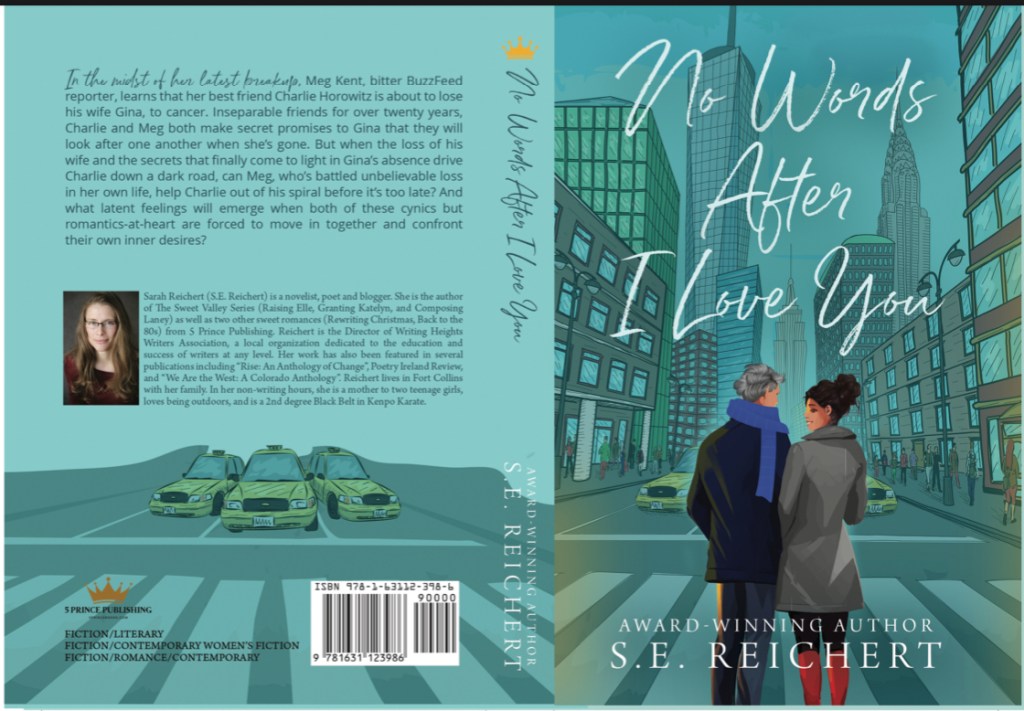
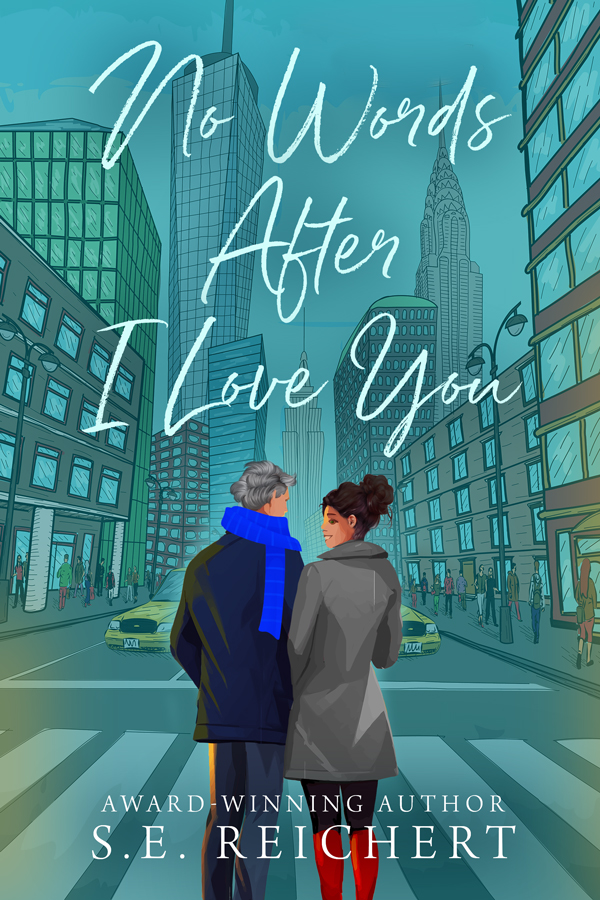
I’m going to drive ya’ll nuts, but there’s a link below, if you’re interested in buying my latest book; “No Words After I Love You”.

This stand alone novel is a journey through grief, friendship, creativity and love. It’s about how the heart heals, (or doesn’t) and all the ways humans punish themselves in an effort to be ‘strong’. It’s about deep-seated friends, the kind you’d answer the phone for, even if you don’t answer the phone. It’s about choosing your own family, and learning how to let go the wounds from the real one. Its about trying not to fall in love, even when your heart is already decided. It’s about soup, and rain on dirt roads, its about knowing how they take their coffee and a campaign for bushier, wilder eyebrows. It’s about denouncing god and still finding divinity. Check it out: BUY NO WORDS AFTER I LOVE YOU

And now, a short poem:

Daredevil

My heart does all her own stunts
Never one to sit back from the danger
or sip Rosé while someone else
takes the fall

Oh no, she's always been
all in

She sees the perilous ledge
the death defying leap
the broken bone canyon
and nods with bravado
flicks her Marlborough into the abyss
exhales the clouds of calm
and dives in

My heart does all her own stunts
but the scars are starting to show
and the puckered skin
and toughened hide
cannot beat as strongly
as her younger self once did
The bullets she's taken, stab wounds
and excisions
the irreparable losses that linger
in phantom limb syndrome
beat ragged and untimed

My heart does all her own stunts
but I cannot convince her to stop

Making the Most Out of Your Retreat

Hey writer and fellow creative friends. Wherever you are on your artistic journey, I hope you’ve considered the benefits of joining or participating in a retreat. Now, retreats can range from the ridiculously expensive, to renting a room at the shady looking motel three miles away. Some have classes or workshops, some have yoga or hiking mixed in, some are just straight up writing time.The point is to get out of your normal space, away from your normal routine, and spend that time focusing on your work. So whether you’ve broken the bank to jet set off to the French Riviera or you’re on your way to a twin room at the Motel 6, these tips can help you get the most out of that time. I even put it in a nifty little bullet list.

  • Be Prepared (Mentally):
    • One of the best tips I have, is to make yourself a list, before you go, detailing what you want to do, or get out of the retreat. Are you hoping to network and make connections? Are you aiming for a certain word count, or project completion? List out the major goals, then leave space (I’ll tell you why later on)
    • Be realistic but also a shade optimistic. Know your average, everyday word count and think about doubling or tripling it. You’ll have more time and less outward distractions and setting that goal will keep you on track. By making it a little challenging you’ll push yourself just enough. Even if you don’t hit the goal, you will get farther than if you’d been too ‘reasonable’.
    • Bring multiple or at least a couple different things to work on. The hours can become tedious and you might want to switch it up to stay fresh and motivated.
    • As a mom, and working mom, a strange thing happens the first few hours of being alone at a retreat. I get this thing I call “care-giver paralysis”. In the absence of doing for others, I can’t remember what to do with just myself. Understanding that this feeling will come, and I’ll have some listlessness helps me to remember to ease into the weekend with some journaling, or shorter projects.
  • Be Prepared (Physically):
    • The practical side of things is that you’re going to be away from home. But not on a typical vacation. So remember to bring your goal list, paper, pens, notebooks, journals, your laptop and charger…the basic tools of your trade. Make them your favorites or the one’s you’ve been ‘saving’ for something special. This is something special.
    • Plan for the environment: If you’re poolside or in the mountains, bring the proper clothing and footwear. You won’t be holed up in your room the whole time (I’ll explain more on that later). If there are dinners or classes, if it could be cold, or hot, try to think in layers. If its just writing, pack lots of comfortable clothing. Sunblock, hats and mittens. Bear spray or Mosquito spray?
    • Sleep aids- especially if sharing a room. I’m talking about eye covers, ear plugs, and headphones (not a rubber mallet if your roommate snores). Anything you need to get a good night’s rest.
    • Any special dietary needs/wants that the place won’t be able to provide.
    • Water bottle, medication, and bathroom necessities. Nothing is worse than being dehydrated and/or not having a toothbrush. Big and little comforts will make a huge difference.
    • Business cards. Holy shit, I can’t tell you how many times I’ve forgotten this one. Even if you’re just there to write, exchanging info with your fellow retreat members is great. You’ll be surprised how much you learn from one another in that time.
    • Tech that you need, none that you don’t. You’ll need brain breaks, you’ll probably want to check in with family once or twice, you may need a laptop. You probably don’t need your gaming system, and be careful of your social apps. This is a time for connecting with yourself and your art, not the 7 billion people of the world.
  • Be Flexible:
    • You’re going to have a goal list. You’re probably going to stray from it. That’s alright
    • There may be days when the word count fizzles or the scene doesn’t play out like you want. That’s okay.
    • There may be a project you exceed expectations on, and another you barely touch. That’s alright.
    • You may accidentally sleep in, or need a nap, or get caught up in conversations. These are good things.
    • Retreats are a balance of getting your work done, and taking care of yourself, which leads me to…
  • Schedule in Self-Care:
    • Bring along comfort. Your favorite pillow, blanket, clothing, music. Whatever it is that helps you feel relaxed and at home.
    • Take naps. You’re little brain is going to be working extra hard. It’s going to be focusing for hours and working through the plot holes and dialogues you’ve been avoiding. Schedule in time for naps, early bed times, or meditation on your goal list.
    • Take advantage of the outdoors. (Unless your Motel 6 is in a shady part of the city–then try to grab a Lyft to a safer part) Go for a hike or walk every couple of hours. Sit outside stare off into the far away for awhile. Your eyes and brain will thank you. Also schedule in brain breaks on your list.
    • Bring any nutritional or necessary snacks. I need coffee in the morning. I need tea before bed. I need fresh fruit and veg. I like hydration mix and the occasional bourbon on ice (not together, that would be gross) I want my Little Debbie brownies and my twizzlers. These little joys will keep your spirits up in the middle of the tough work.
    • Exercise, Mediate, Drink lots of Water, and take warm showers. All good things and breaks away from the intensity.
    • Skimping on self care will make you less productive and more likely to burn out. Nobody wants a mushy brain half way through.
  • Assess and Recalibrate:
    • After its all over, if you’ve got a drive home, or a flight…take some time to reflect. What went well? What was a challenge? What did you wish you had? What did you bring that you could have left home?
    • How did your goal list go? Did you overshoot? Did you get distracted, and by what?
    • How do you feel physically and mentally and how can you make sure that the next retreat leaves you feeling accomplished without being overwhlemed.

Well, there you go. I’m open to hearing if you have any other advice in the comments below. I’ll be heading a retreat next week, so if you’ll be there, I hope we can make it a great experience. If you can’t be there, I’ll be hosting another one in the fall with the Writing Heights Writers Association and I’ll let you know the details as they’re finalized. Until then, Happy Writing.

The Beautiful Stuff Writers Workshop: Novelty #4- Character Part Deux

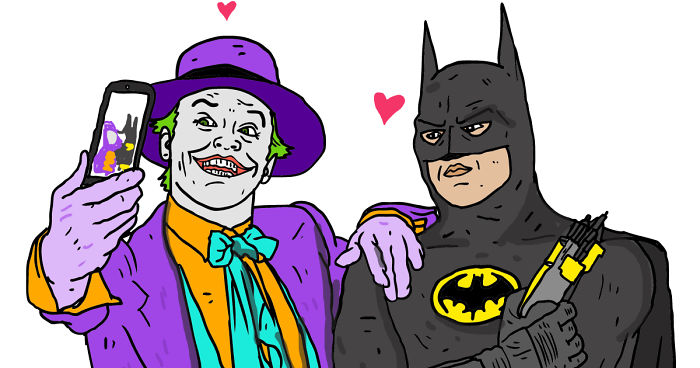
(image respectfully borrowed from Nick Cocozza’s amazing “selfies” series)

F*&k yeah, I just copied and pasted another great blog I wrote on Character (sorry for using F*&k in the first sentence, Mom). But if you haven’t followed me from the start you might have needed a reminder and I needed to work on some other projects. So… Ladies and Gents, enjoy Part Deux of Character.

From the dark, cavernous recesses of the author’s twisted mind springs forward all sorts of nasty and derelict creations.

Okay, that’s a touch overdramatic.

Frankly most writers will begin by creating a story from people they know or have read about. Sometimes we do it without even realizing it. Characters and personality traits that we admire, or equally cringe at, stay with us in that sometimes-twisted-but-always-magical realm of our subconscious. Realism in characters is important because it adds to their believability and with that, their ability to connect with our readers.

Why is it so important to connect your character to your reader?

We are a society of channel flippers, of instant gratification lovin’, drive-thru eatin’, convenience hounds. We have the attention spans of goldfish. If you can’t connect your readers to your character through the common ground of sympathetic and universal traits they will put your book down. And often, when a book lands on the nightstand, it never gets picked up again.

I shudder to think how many amazing stories were lost to the underside of the coffee table.

If your reader can’t identify with your character in even some small way, they will cease to care about that character and will not follow them, no matter how interesting the story is. The human element is very important.

So along with grabbing them from the beginning with an interesting and challenging first scene, you must hold your reader to a character that they care about, either because they relate to them, or because they are fascinated by their darker side. Their traits and foibles make your readers want to know what’s going to happen to them next. And that keeps them reading.

In the ignorance of youth, I used to think that my character could be anything and do anything. They could be perfect because I was building their world and I could make them flawless. They could be smart, and athletic, and beautiful, always saying and doing the right thing, always in control of their situation and aware of their future. (In the business we call these characters “Mary-Sue”s or “Sunshine Sallys”).

Snooze-o-rama and eye-roll Central.

Nobody, and I mean NOBODY, wants to read about some pristine person who’s practically perfect in every way.

For one, we don’t need perfection rubbed in our face. We get enough from the glaring social media machine. Secondly, a character that always says the right things, does the right things, and looks like a supermodel is not challenged and if they are, they do not fail. Characters that never fail are unrealistic, which means they cannot relate to the nerdy girl in her frumpy sweater and ripped jeans, curled up with your book (Yep, that’s me I just described). And what happens when that person doesn’t relate? The book is given a good chuck over the shoulder with a hearty ‘Good riddance’.

So make your characters dirty. Make them tarnished and worn. If they have to be beautiful, make them fundamentally broken somehow inside. If they are self-assured and intelligent, give them an outward physical challenge that hinders them. When a reader sees your character fail, they see the humanity within their own failures. More importantly, when they see them overcome the faults that stall their growth, they feel hopeful for their own path. They follow that character. They root for that character.

*In an amendment to this section, I would like to say, due to the overwhelming lack of Mary-Sue characters these days, they’re actually a bit of a phenomenon. So, if you must create a Mary-Sue, own the hell out of it. Make them so staggeringly perfect that its almost comical…or otherwise interesting. Think of the person with extraordinary good luck, that can’t do wrong, even when they try.*

As a beginner writer it’s tempting to live out the life you wish you had in your pages, and it’s okay to write those ideas down. But keep those rarities for yourself. When it’s time to write an amazing story for the world, give the reader a character they can root for.

This advice is straightforward for developing the protagonist’s character traits. But it’s equally important to give this attention to your antagonist.

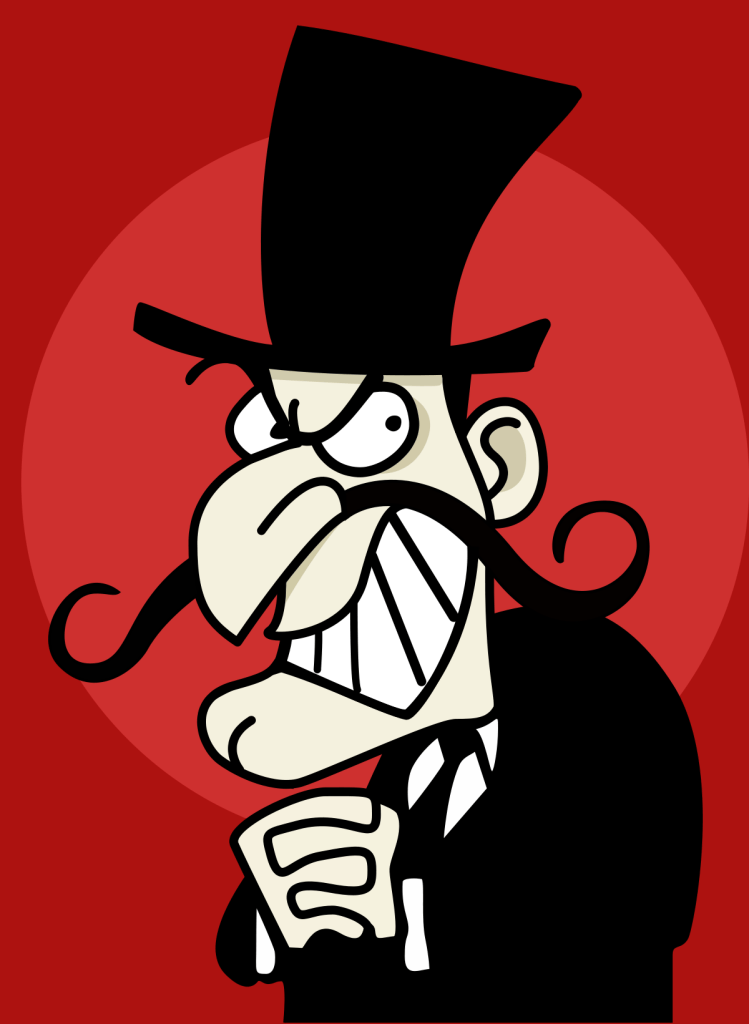
Something tells me this guy has rope, a damsel, and a train to catch

No ‘good guy’ is all good, and no ‘bad guy’ is all bad. Even the worst ‘bad guy’ has to have reasoning in his actions. They must have something that drives them, and it has to be something we can understand on our basic human level, even if we don’t agree with it.

Having even a slight sympathetic response to an antagonist builds tension between the characters and gives your reader the nail-bite reaction. The opposing forces both come from places that can seem justified and ‘right’ in their position, which makes the battle all the more important on both sides and the outcome so much more brutal or celebratory.

This week’s exercise is to take a hard look at your characters. Do they have some baseline, deep-rooted faults? Are these faults causing interesting and plot-driving stumbling blocks? Are they loveable, and a little bit annoying? Are they dangerous, but still broken?

If you find that they’re not engaging enough, throw in a life-changing event into their past and rewrite them based on their new fault. Divorce, fire, murder, car accident, illness, or the loss of loved one can be good ideas to play with. Take away one of their defining traits and replace it with its opposite. Nothing you play with is set in stone, it’s just a way to grow your character’s depth and help you to know them better.

If you’re looking for a good reference, one of my favorite books on the subject is Writer’s Guide to Character Traits by Linda N. Edelstein, PH.D Writer’s Guide to Character Traits.

Good luck out there, kiddos. I’d love to hear if this helped you out and how!

Happy Writing.

One Month Away! Book Launch and Deals

Ya’ll, I haven’t been so excited about a book coming out since…well ever. I started this book a couple of years ago at a writing conference. It was a rare and beautiful madness, where the characters would regularly interrupt me on my morning commute to the kids’ camps, my Peloton rides, my hikes, in line at the grocery store, with little snippets of their life. Like I was a radio that would pass by their frequencies and catch conversations. Notes were drawn up on my phone, scraps of paper and notebooks. Eventually landing on my screen. Only I didn’t write it as one novel. This book started out as two separate novels, one from each perspective that I then had to go back and merge into the finished project. It was messy and strange, (and an absolute headache for my editor I’m sure) but through it all, I’ve never gotten to know two characters more intimately.

It’s safe to say, I’m in love with them both. I need a Charlie in my life. I think we all do. I think we all need a Meg too. Someone to remind us what’s worth living for. To kick us in the pants when we feel too sorry for ourselves. To be in our corner, no matter what.

So, I hope that you’ll preorder it. Preordered sales count in the total number and it can really help an author to be seen in some of the bigger markets. Its not so much me that wants to be seen. It’s Charlie and Meg. I want the world to know them. So pre-order if you can! But if you want a little something more, I’m running a special book package for No Words.

If you chose to buy the book this way, you’ll be sent a signed copy of the book and some goodies, hand selected by me. The price will include the shipping cost. More details will be released in a couple of weeks, but if you’re interested now (I like to start making my list) shoot me an email (with the subject line No Words Special) or DM me on my socials.

I will also be crowing about the book launch and book signings that are currently getting hashed out, so please stay tuned for those and if you’re in the area, stop on by! I’d love to talk books and writing with you, and sign some copies. Dates and places to be announced soon.

Here’s a little excerpt:

Charlie asks me to meet for coffee the morning after Bradley’s departure. I, of course, comply. Coffee with Charlie always breaks me out of my mood. If there’s anyone crabbier at the world than me, it’s him. Plus, I love to hear him talk. About anything and nothing. I love the way he sits back and listens, discerning brows pulled together, as though he’s contemplating my words. As if I matter. I’m curious as to why he asked me and didn’t mention Gina coming along. Her birthday is coming up soon, and I’m sure Charlie, in his old-school romantic way, has devised a plan he needs help with.
What a man to find, I think as I put on my worn red boots to navigate the slush-deep sidewalks. It’s ten blocks but I don’t have enough for fare today. When I arrive, Charlie is there, already seated, readers on and mouthing answers to the crossword. I watch his lips count through the window. The spaces, the letters, making it all fit. He looks up, a graying curl on his forehead. He waves me in.
He looks pale. Paler than I’ve seen him in a long while and his bright blue eyes pop against his skin. His mouth is downturned, like he doesn’t want to talk first. He rarely does.
“Hey!” I puff out and the breath feels hot on my cheeks.
“Did you walk all the way?” he scowls.
“It’s a lovely fall day.”
“It’s twenty degrees out, Meg.”
I shrug and take off my coat, I settle in, nod for coffee and don’t allow even a moment before I dive into the dramatic end scene of Bradley. Charlie remains a statue as I recount the far-too familiar episode.
“And that’s how I ended up with all the rent and none of the sex.”
Charlie’s scowl deepens. “Well, thank God. The guy was a grade-A moron.”
“He got into Cats.” I say over the menu.
Charlie rolls his bright eyes over his readers and levels them on me.
“He couldn’t get into a bag of chips with scissors. The man was a talentless hack and you shouldn’t have paid his rent as long as you did.”
“You’re just saying that to be sweet.” I sip my coffee and looked out over the busy city street outside. The cloudy morning spits gray flakes against people’s faces as they walk by. I set aside the menu. I can’t afford toast, let alone breakfast.
“When have you ever known me to be sweet? Go to hell.” Charlie studies his puzzle again. I watch him from across the table. I love looking at Charlie. His wild and curly hair, unkempt and disrespectful. His face a map of a million laughs, handsome but in total, unrefined.
“Thanks,” I whisper. For the moment of stability, for reaffirming my faith in men. He reaches out, without looking up from his puzzle, and places his warm hand over mine with a squeeze.
“How is Gina?”
Charlie pauses, and with him, my heart. He never pauses when talking about Gina, he’s over the moon in love with her. There is always some news, some show, some smash hit that she’s working on mastering, filling up their brownstone with repeated notes and lines, and the sparkle that is Gina. There is no pause to a life so full. Charlie clears his throat.
“It’s back.”
The words are like a double hit to my chest. I don’t have to ask what ‘it’ is. It’s only be five years since it took root in her the first time. Now it takes root in me, with the kind of despair that steals words.
“Charlie, no.”
“Yes… It’s bad, Meg.”
I ache with anger. I want to throw my fist into something, but I’m stupid and weepy instead, so I take his warm hand in mine.
“What can I do?”
“Be here,” he says.
I sniff and look up to staunch the deluge. My crying doesn’t help any of us, and he certainly doesn’t need to feel worse for my tears.
“Ok. How is she?”
“Tired,” he shakes his head, tucking the paper beneath his plate. I watch him take off the readers and rub his eyes. “This time is already worse.”
I’m at a loss. What the hell do you say to that? I’m a fuck up, not a doctor. I have nothing to give him, even after they’ve given me so much. My heart aches and I’m desperate to do something.

The Beautiful Writers Workshop: Novelty #3: Character

Good morning, writers! And a happy morning to you (or afternoon, or evening, whenever you tumbled out of bed–or back into it and are catching up on your bloggers). This week, in exploration of the novel, we’ll be talking characters.

I’m telling you now, because contrary to some reports out there, I’m not a complete idiot. A while back I did a decently in-depth study of character and I’m using a lot of that for this post. After all–the quicker I get the blogging part done, the quicker I can get back to my own novel and the characters I’m currently developing.

So without further ado– recycled Character Development:

Since character development is one of my favorite aspects of writing and I thought I’d pay homage to it’s process in a two part post.

So first, let’s address where characters come from.

I’ve had characters come to me in dreams (day or night), sometimes they’re inspired by true stories from news that I trip across. Sometimes they spring from hazy memories of a childhood friend, or the curious behavior of the neighbor across the street who steals decorative rock from the common area and smuggles it away in her purse. Any one adept at studying human nature and observing their fellow human beings can get inspiration simply from watching what our nutty human brethren do (and don’t do) in the course of their day.

Often, though never in their entirety, I write from people I know. By this I mean people I know both casually and intimately are good places to start for characters.

Although real people can help jumpstart the process, they rarely become the character in the final draft, and here’s why.

For one, it would be creepy (and, depending on the story and topic, possibly slanderous) to write about an actual person from your life, unless it is a memoir of said person and they are asking you for your help. Ethically, a writer looking to publish or share their work with the world must adhere to certain rules of respect and common decency concerning using the likeness of other people. That being said, you can (and should) borrow personality traits, history, and physical attributes that enhance your character’s believability, without putting someone’s life down, verbatim, on your page.

Secondly, even when based on someone you may know, something magical will inevitably happen when you put a ‘real’ person on a page and shove them into a conflict (the driving force of your story). Under the demands of a proper story arc, the character you began with will be forced to shift and evolve into someone else. You don’t know how your character will behave in an apocalyptic dystopia and the situations and decisions that they are faced and make will be a magical combination of what the author dreams up spontaneously, the character’s history and what the author needs them to do to move the story forward.

For example, Joe Smith may start off looking like your high school biology teacher but if you write him exactly as he was, including is normal day to day, your audience will be too bored to stick with his story.

Now, if you put the body of an alien in the school science lab’s freezer next to the dissected frogs, Joe Smith, your old biology teacher will automatically become way more interesting. And as he does, he will move away from the real person you started with and morph into a different character. A man of his own, alien-hiding, design.

They double-dog dared him.

A writer can tweak, correct, enhance and play with personality types, turning one, real-world person into a completely different but still realistic character. But it’s important to keep the relatable aspects of the initial ‘muse’, including the physical attributes that you can describe in realistic detail, or the personality types that can be explored in depth from a place of personal interaction.


What can be left behind are names, exact and undeniable physical description (don’t be a creeper) and any ‘boring’ or typical parts that may be cliché or expected. The character will change to be their own person with the natural progression of their role and development within your story.

The other method of character development is to begin with a story and let your mind follow the natural path of who lives it. This is one part plot-driven creation and one part spontaneous combustion.

An atomic bomb goes off, a virulent disease hits the population, a train switches tracks, a car runs through an intersection, an alien shows up in a freezer.

Start with an event and ask yourself; who would it affect most? Who stands to lose or gain the most? Who is equipped to deal with the situation? More interestingly, who is least able to cope with it and how do they survive?

Characters will find their way into your mind. They may look and act like someone you know or they may have a mind of their own. As a writer you will find that as your plotline advances the character will become less and less your creation and more a product of their history combined with their destiny.

We all have these personalities in our heads that sit dormant on the shelves until something shakes them loose. Most writers, (yes, I’m saying it) are a little bit schizophrenic. We are geniuses of introspection and observation. Humans are interesting and a good writer will watch and learn from their interactions how to build characters that could be a best friend or a worst enemy in their reader’s own world. They talk to us as we write their paths, they argue when we move too far away from their true reactions. They trip us up by throwing random but necessary bits of history our way that we hadn’t considered for the bigger picture. It’s maddening and magical all at once.

Next time we’ll talk about developing intricate characters and some tips I’ve picked up along my journey to make them somebody your reader’s will root for, love, and hate. Until then, take a few minutes today to think about some characteristics that you love and loathe in human beings and think about why they draw your attention.

Make a list of character traits that are interesting in both beneficial and detrimental ways.

Also, feel free to write or comment about your favorite characters, and if you’ve ever found yourself ‘accidently’ writing about someone from real life. Next time we’ll have an exercise on character development and I look forward to your responses!

Happy Writing!

What’s Coming Up This Month

Hey kids, it’s your monthly reminder of some cool stuff happening in my world and for writers everywhere.

First, this month on the 29th, Writing Heights Writers Association will be hosting its monthly classes. For the morning class, I’ll be teaching a super fun workshop on how to apply Gothic style and themes to every genre. We’ll be talking about the history of the style as well as how it applies to character, social commentary, and the prevailing themes that can enhance every genre. The afternoon class will be “Hiding the Bodies: Enliven Your Writing with Exquisite Corpse and Ekphrastic Poetry” with Chris Guppy and it should be a really fun and interesting day of class. I hope you are all able to come.

Remember, these are virtual so you can attend from anywhere (keep in mind its 10 and 12 MST). You don’t have to be a member to join and they’re inexpensive for quality classes. You can register here: MARCH CLASSES.

Remember, if you are a writer, of any level, and you have information to share with your writing community, send us in a proposal. It doesn’t have to be writing specific, and we’re always looking for ways to expand our knowledge and make cool connections with the arts and the business side of writing. You can send in your proposals HERE.

Next up…let’s see. I’ll be rearranging the Youth class this next month to accommodate Passover, more on that in my social feeds and on the website. I will also be looking for a new person to run the Youth Class for Writing Heights as I’m currently kicking my own ass with being over scheduled.

Speaking of that, I have a book coming out in May! And pre sales really matter. So if you wanted to get a copy, you can preorder it HERE. I’ll also be running a special pre-order package where I’ll send you the book, signed, and some goodies to go along with it, exclusive to those preorder packages only. I’ll keep you up to date on that as I have more details from my publisher.

I’m running a writing retreat in May (the 11th through the 14th) in Allenspark, Colorado. It will feature a flexible schedule of two different tracks. One for Memoir, one for Craft/Creativity. There will be time for critique as well as time to get some of your own writing done. Private rooms are a little expensive, but all prices include your food and room as well as the high-quality instruction, morning yoga, and some some of the coolest people I know.

I’ll be at the Mesa Verde Literary Festival (and writers conference) on July 9th-12th and also at Rocky Mountain Fiction Writers Conference in September. More on the classes I’ll be teaching and workshops I’ll be running later.

Other than that, I’m working on finishing up a Christmas-but-not-Hallmark holiday novel and hoping to start edits on my next series soon with 5 Prince Publishing.

My oldest is getting ready to graduate so May will be full with three major things happening all at once (I did it all to myself so there’s no real way to complain about it) If you have a hard time getting a hold of me, trust that I’m just trying to keep my head above water.

Hope to see you in some classes and some book signings soon!

Poetry 3-13-25

HEART

She is a bore
and a lofty braggart
claiming forever
but following the newest smell
away from her leash

She is tender and full
a bag tensed, to burst
at the slightest slight
heavy with blood and the suffering of want

She is the doorway
to a thousand churches
and the carnal sacrilege
of all good, and wild things

She is latin
for courageous
and holds my breath and my breathlessness
in space between her beats

She is a pauper
always begging
and a selfless saint
giving away all of her compassion in bills
like she could not take it with her

She dances in the kitchen
with a baby on her hip
even when that baby is
long, gone
grown

She lights up like Christmas
and echoes in dark gothic hallways

She shudders and trips
beats steady and sound
she's the only one I can ever claim
is mine
And yet, so often
I still think her,
a stranger
in my chest

We couldn't live without each other.
I hope
whatever the next life brings
I can take her with me.

Influenza, A Conversation

I caught the flu. I was vaccinated last November but, I also know those things don’t always last. Also, I’ve been a little worn down so it should come as no surprise that my immune system let one slip through. I could get political about this. What with RFK in office and the refusal to allow the yearly meeting of flu vaccine doctors/experts to determine next year’s best guess at protecting the herd that is the United States population… but right now my little electric meatloaf is a little fried. So fried that I wrote a post about it. The only thing I’ve accomplished today, actually. Besides sleep and pumping in a lot of fluids. Enjoy?

(Please be aware, all of this was written mid 103 temperature. What seemed really funny to me at the time, probably doesn’t translate the same)

Am I struggling with the words and the thinking? As my Minnesotan conclave would say, “oh yea, sure, you betcha”. So I thought I might document the exchange inside my overheated brain while I was living it. For posterity. And a laugh. I mean, I think it’s funny as hell. But it’s also…not. Is this how schizophrenia starts?

Me: Okay brain, Listen. I know you’re having a rough time of it right now. Lot of pain, lot of general unpleasantness. The thing is, I really need you to work on this presentation and speech we have to give next week.

Brain: No prob, my main man. I got this. You just point me in the direction of…

Me: Brain?

Brain: Hmm? Sorry, why does my left big toe hurt, like really bad?

Me: It’s the flu. Its normal. You’re not going to die.

Brain: Oh, really? Tell that to my phalange! Fuck should I try to pop it?

Me: No brain, just…hang in there, it will go away.

Brain: Oh—oh you’re right. Huh. Whew, that’s so much—Sweet baby Jesus, my back!

Me: Brain! Can you try to focus, Here. Here’s a heating pad and your favorite jammies and lots of pillows. Let’s just bang out a quick…

Brain: Jammmmmmiiiiieeessss…nap time we must.

Me: No! Brain—Come on man, focus. Just the outline. Let’s just get the outline written.

Brain: Right, right. Work, big talk. Lots of people. We hate lots of people though, right? Staring at us?

Me: They asked us to be there. We submitted the proposal, they accepted it.

Brain: jammmmmiiiieesss.

Me: Brain!

Brain: Why can’t I keep my right eye open? Oh look, I can switch them off. But I don’t get the two at once.

Me: *sigh* Can we just focus? Ten minutes.

Brain: Yes. Absolutely.

Me: Wait, is that Instagram? Are you opening Instagram?

Brain: I just need a little treat, thinking about work and being berated is so stressful.

Me: I didn’t—

Brain: Look at the miniature donkeys!

Me: Yes, yes, very cute. They will be there after you finish the outline.

Brain: Oh the outline, that’s right…we have work to do…So I shouldn’t…swiiiiippe!?

Me: Goddamn it, Brain,

Brain: What is it about Scottish toddlers cursing that makes my whole heart believe in the goodness of humanity.

Me: No—no don’t laugh!

*coughing fit ensues, pain shoots everywhere, gunk comes out of my mouth. Me and my brain stare at it in fascination and horror*

Brain: I don’t like this. This is dumb. I’m tired now.

Me: How about just three bullet points.

Brain: Fuck you, do you know how hot it is in here? Can’t you open a window or something? I’m baking.

Me: Open a—what like trepanation?

Brain: pfff! HA, that’s not a word.

Me: Look it up, hot stuff.

Brain: *types several renditions of trepanation until spell check has mercy on us* Jesus christ you want to cut a hole into me? What are you a barbarian? Fucking anthropologist. Why do you remember that of all the things? Of all the classes?

Me: It’s supposed to ease the pressure!

Brain: Ever heard of a decongestant you fucking savage?

Me: *Quietly sobs from couch* Can we please just get a little work done?

Brain: *gives haughty look over the phone at me* No. You wanted to perform ancient brain surgery on us. Look at this.

Me: *sighs* what?

We stare at the screen together at a poem by Mary Oliver

I do know how to pay attention,
how to fall down, into the grass, how to kneel down in the grass.
How to be idle and blessed.
How to stroll through the fields which is what I have been doing all day.
Tell me what else I should have done?
Doesn’t everything die at last and too soon?
Tell me what it is you plan to do with your one wild and precious life.

pause

We look into the screen that’s gone blank and dark. Into our flushed complexion and glassy eyes. Begging for rest. To kneel down in the grass. To pray to this body that is, right now, fighting battles we cannot know the extent of. While I stand on the sidelines of the fray and shout… ‘but my outline!’

ME: Hey, Brain. Wanna take a nap?

Brain: Fuck yes I do….jammmmiiieesss…
The Beautiful Writers Workshop: Novelty #2: The Story Arc

Good Thursday to you, Writers. I hope you have a brand-spankin’ new plot started in your head from Tuesday. Moving from that amazing raw material I’m going to tickle your inner plotting nerd and give you a ‘graph’ of sorts to help you with organize a killer storyline.

-I love tickling nerds

Last time we discussed ways to help create a basic plot for your novel idea, today we’re going to outline the beats, or arcs, of that story. If you remember from my handy-dandy, bulleted list on Novels, I list Arcs as being an important element. While this blog does cover some of the theory, I will do a more in depth look at crafting an arc that creates the perfect amount of tension.

Back to plot. Some of the best stories follow a pattern, or what I like to think of as a rollercoaster of ever-rising stakes.

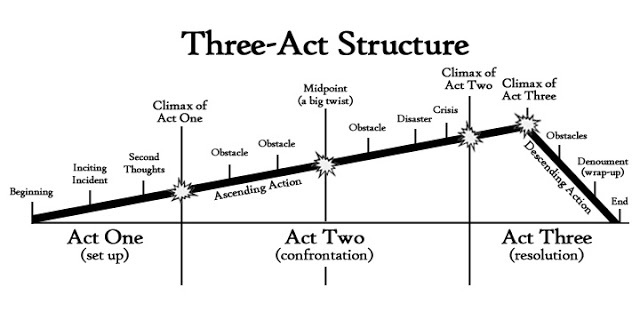
Most plots can be split into three acts. The Set Up (beginning), The Conflict (middle), and The Resolution (ending). Each of these acts should have some defined crisis or event which is like a doorway your character passes through and must either change, fight, or overcome more trials until they find resolution. I found this nifty diagram from David Harris Kline’s “Structure Lesson #2: The Three Act Structure” ( http://www.writers-for-writers.com/2017/11/08/structure-lesson-2-three-act-structure/)

As you can see the beginning has to hook the reader into a specific event, starting point, or character problem. Here’s where you introduce your character and show us who they are, what they want, what they are facing. Throw in some foreshadowing and Bam! You just met a small-town farmer from Tatooine.

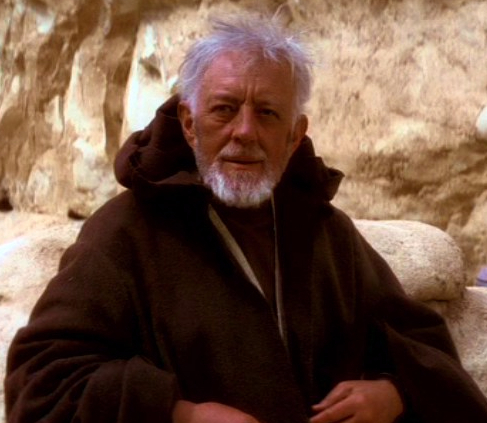
Act II comes with something that disrupts their normal day to day. (Holy shit, this droid has an important message from the Rebellion!) The character is forced to make a choice (wipe the droid’s memory or try to get the message to old Ben).

Real, live image of me during quarantine.

The middle, as most of us know, can be a bitch to write. This is where the dreaded doldrums hit. The quagmire. The swamp of eternal despair. I’m not going to get too deep into that swamp today except to say that this is where plotting can really help build a bridge across the muck and help your character get to that final, defining climax. This bridge is paved with different obstacles and trials that keep the action and the tension going through out. (Scruffy looking nerfherders and tough-ass princesses, oh my!)

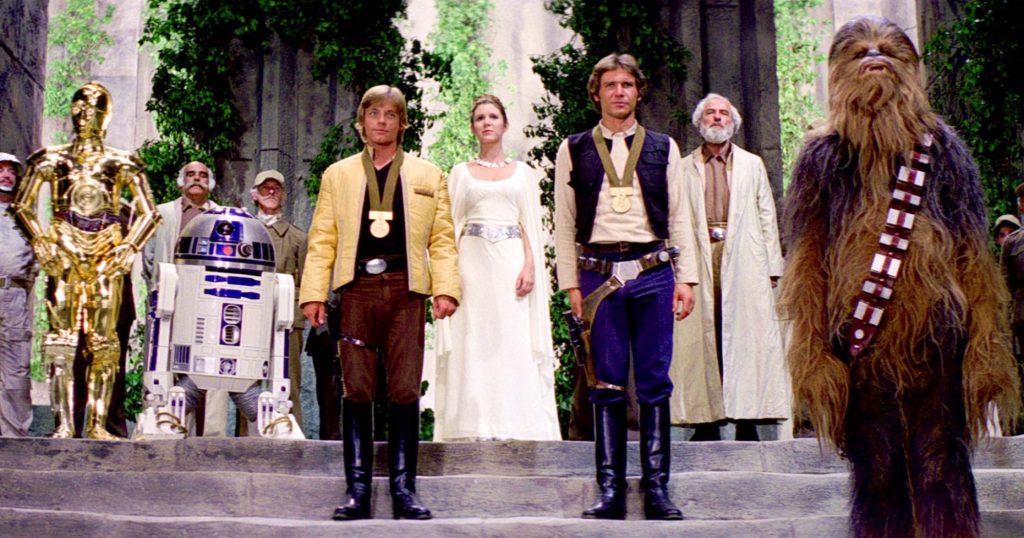
Then, finally, as our hero/ine comes through that final climax (for better or worse) we witness their transformation or acceptance of who they are or what they need to do . The final act is where you tie up your loose ends and give the audience the resolution they’re seeking. Like giving a Wookie a medal.

Wait a goddamn minute…where’s Chewie’s medal?

Well, that’s pretty much all I wanted to cover on plot for this time around. Next week we’ll be talking about one of my absolute favorite aspects of writing: Characters.

Until next week, diagram your plot, think about what events, scenes or characters you can inject to get those bursts of conflict. Think about what your character wants and what obstacles stand in the way of that. How does overcoming them move them/change them for the next bump in the road?

Good luck out there, and may the Force be with you.

The Beautiful Writers Workshop: Novelty #1: Why in the Hell do I Need to Worry about Plot?

Can you believe I couldn’t think of a more creative title? Me neither. Some days are like that. Remember, this is geared towards beginning writers, so most of you long-in-the-tooth novelists may not get the same bang for your buck. But…there are a lot of sexual innuendoes. You’re welcome, or Sorry.

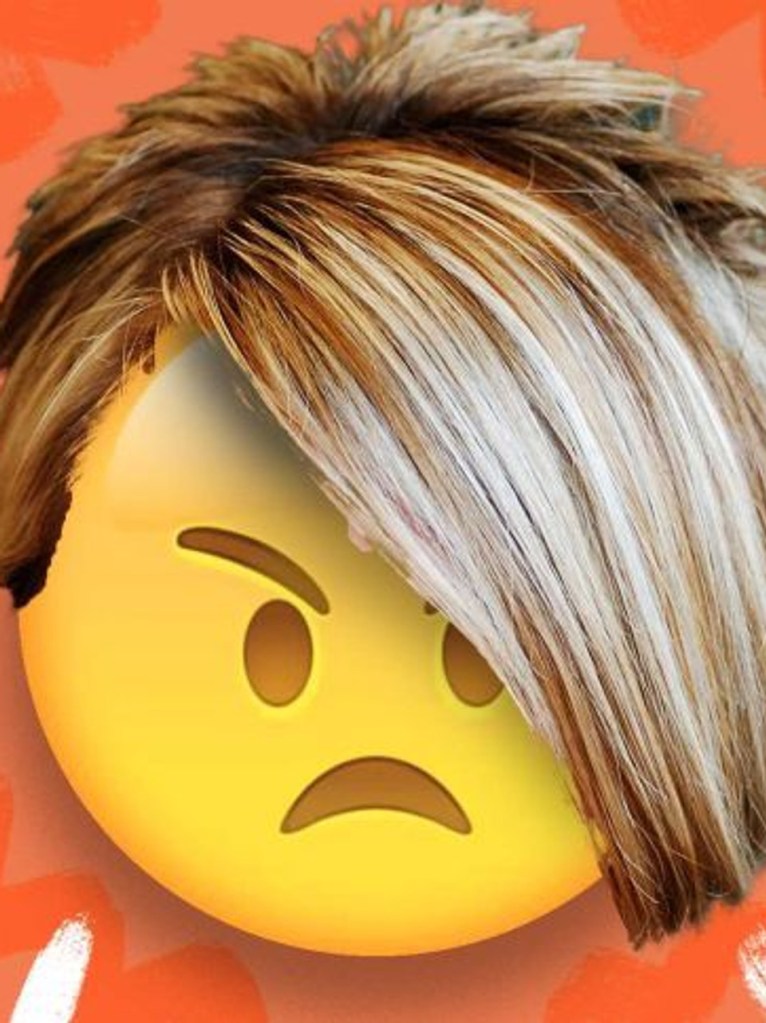
Today, I’m pushing through and rehashing an old, but viable post. Remember? Before the fucking world turned upside down and Elon Musk became president with Absolute Power? Yeah…those were good times. Let’s not dwell, you can call your congress person again (you’re calling right?) and attend those protests (you’re attending right? This IS the time to be the MOST KAREN you can KAREN–see below for my favorite emoji of the species) after this short and entertaining jaunt into PLOT. We’re getting into the meat and potatoes of writing a novel, and this kind of thing needs space. So, without further ado…

What is Plot and Why is it Important?

All right, I get it, it’s a dumb question, we’re all writers and we all KNOW that plot is the basic structure and story of your novel. It is the idea. The “what happened”, and why, and “what’s going to happen next” of any decent story. I’m not trying to dumb it down for you. But the true test of a good plot lies in the simplicity of answering those questions.

Now, you can have books that are character driven (an event happening TO a person, or BECAUSE OF a person). And you can have books that are historical non-fiction, based on one specific moment in time or occurrence. The PLOT of your book expands more than just beyond an event (otherwise The Hunger Games would have been maybe 50 pages long). The plot is the premise or sequence of events. Some novels will follow a very specific order of events that are common to their genre, or as we like to call them tropes. Tropes comes from the Greek Tropos define as “turn, direction, way” and refers to common, recognizable elements or sequences of events.

Many genre specific tropes (I almost prefer ‘formulas’) are embraced by the audience and even expected. Examples include: “the hero’s journey”, “enemies to lovers”, “small towns”, “cold cases”, “missing persons”, “AI gone wrong”, “fairy tale retelling”. But if almost every novel follows a plot formula how is it #1, that readers don’t get bored and #2 that you tell an original story that hasn’t been done before.

It’s an interesting dilemma on the part of a writer. We know which formulas work in fiction and straying from them often makes a plot fall apart or leaves a reader angry or unsatisfied at the end.

(She’s gonna want to talk to your manager)

But how do we follow commonalities in plot structure and still make it a fun, captivating, and surprising journey for our readers? The answer my friends, lies your ability as a writer to do five things: (Fuck Yeah! A bullet list!)

  • Begin with a unique event or crisis. This comes back to the “scan the headlines” exercise I’ve had you do before. A lot of weird shit goes down in the world. A lot of undercover, shady AF stuff too. Use it as a springboard, to your “what happens then/if” story building.
  • Tie the reader to your character (through love or hate) and make their reactions to events unique or contrary to the norm. (ie a cheerleader who fights vampires. A small town farm boy who becomes a powerful Jedi. A teenager who comes into supernatural powers without the maturity to handle them and doesn’t use them to download free porn–come on….or *snicker* cum on? Oof, sorry. Uncalled for. Please keep reading, I’ll behave.) Character building will come later in this series but if you create unique ones, their actions will create new takes on formulas.
  • Use honed writing technique to build tension for climaxes. Yikes, that sounds dirty and here I promised to be good. Tension is one key to making a story more than just series of events. So much of this depends on your voice and writing style. But the big take away here is about risk. Making the risks personally huge for your character, and even the world at large, will keep the plot fresh and drive it forward.
  • Play with the number and intensity of climaxes (story arcs). I think I’ll start using story arcs (some prefer ‘beats’) because every time I type climaxes I can’t stop giggling. Ok. Story arcs are BIG deals in your plot. Think of these as door ways, crisis-points at the top of your arc, that your character has to move through in order to get closer to what it is they want/need. Once they hit that doorway, or crisis point, they can’t go back. A serious change has occurred either in the setting or with-in the character and they must move forward. Next blog will be all about these arcs so I won’t go into much more detail here.
  • Consider using unexpected but intelligent twists. The best movies and books I can think of that do this are: “The Sixth Sense”, “Fight Club”, “Gone Girl”, “Mind Hunters”. What better way to shake up an audience than by having them accept one reality for the entirety of the story, only to show them the true reality at the end.

All right, so there are some tips for building an effective plot that carries readers throughout the book. My advice to you this week, is to explore various tropes and patterns, especially those in your genre. Turn a piece of paper (landscape-style) and write out the typical pattern of your story, then overlay events and characters of your proposed idea. See how they match up, see if you have enough tension building scenes, just play around with it. I’m not much of a plotter myself, but even I will do a general outline to keep myself on track and make sure I’m building a solid plot.

Next time, more on story arc, how to climax well (*snork*), and end satisfied (*hahahahaha). Until Thursday, happy writing.