She breaks the silence with the crack of a match strike instant whirl of smoke and snap open jumps the flame
She’s Magic on dark nights when I need reprieve from myself when I yearn to slip into someone else’s skin and be the one my parents warned me about
The kind who lives truth through match strikes and bared teeth and hard, dirty alleys rough brick scraping backs of thighs and halting breath that never begs
Unleashed from boredom She carries the burning ember of strife at the end of her cigarette and coaxes the glowing cinder with deep inhalations Blowing out sinuous tails through lips split by love
Back again for more? Quirked eyebrow, pierced and dauntless
yes, again pray unbroken lips with underground currents of tightly wound desire.
Good morning, writers! And a happy morning to you (or afternoon, or evening, whenever you tumbled out of bed–or back into it and are catching up on your bloggers). This week, in exploration of the novel, we’ll be talking characters.
I’m telling you now, because contrary to some reports out there, I’m not a complete idiot. A while back I did a decently in-depth study of character and I’m using a lot of that for this post. After all–the quicker I get the blogging part done, the quicker I can get back to my own novel and the characters I’m currently developing.
So without further ado– recycled Character Development:
Since character development is one of my favorite aspects of writing and I thought I’d pay homage to it’s process in a two part post.
So first, let’s address where characters come from.
I’ve had characters come to me in dreams (day or night), sometimes they’re inspired by true stories from news that I trip across. Sometimes they spring from hazy memories of a childhood friend, or the curious behavior of the neighbor across the street who steals decorative rock from the common area and smuggles it away in her purse. Any one adept at studying human nature and observing their fellow human beings can get inspiration simply from watching what our nutty human brethren do (and don’t do) in the course of their day.
Often, though never in their entirety, I write from people I know. By this I mean people I know both casually and intimately are good places to start for characters.
Although real people can help jumpstart the process, they rarely become the character in the final draft, and here’s why.
For one, it would be creepy (and, depending on the story and topic, possibly slanderous) to write about an actual person from your life, unless it is a memoir of said person and they are asking you for your help. Ethically, a writer looking to publish or share their work with the world must adhere to certain rules of respect and common decency concerning using the likeness of other people. That being said, you can (and should) borrow personality traits, history, and physical attributes that enhance your character’s believability, without putting someone’s life down, verbatim, on your page.
Secondly, even when based on someone you may know, something magical will inevitably happen when you put a ‘real’ person on a page and shove them into a conflict (the driving force of your story). Under the demands of a proper story arc, the character you began with will be forced to shift and evolve into someone else. You don’t know how your character will behave in an apocalyptic dystopia and the situations and decisions that they are faced and make will be a magical combination of what the author dreams up spontaneously, the character’s history and what the author needs them to do to move the story forward.
For example, Joe Smith may start off looking like your high school biology teacher but if you write him exactly as he was, including is normal day to day, your audience will be too bored to stick with his story.
Now, if you put the body of an alien in the school science lab’s freezer next to the dissected frogs, Joe Smith, your old biology teacher will automatically become way more interesting. And as he does, he will move away from the real person you started with and morph into a different character. A man of his own, alien-hiding, design.
They double-dog dared him.
A writer can tweak, correct, enhance and play with personality types, turning one, real-world person into a completely different but still realistic character. But it’s important to keep the relatable aspects of the initial ‘muse’, including the physical attributes that you can describe in realistic detail, or the personality types that can be explored in depth from a place of personal interaction.
What can be left behind are names, exact and undeniable physical description (don’t be a creeper) and any ‘boring’ or typical parts that may be cliché or expected. The character will change to be their own person with the natural progression of their role and development within your story.
The other method of character development is to begin with a story and let your mind follow the natural path of who lives it. This is one part plot-driven creation and one part spontaneous combustion.
An atomic bomb goes off, a virulent disease hits the population, a train switches tracks, a car runs through an intersection, an alien shows up in a freezer.
Start with an event and ask yourself; who would it affect most? Who stands to lose or gain the most? Who is equipped to deal with the situation? More interestingly, who is least able to cope with it and how do they survive?
Characters will find their way into your mind. They may look and act like someone you know or they may have a mind of their own. As a writer you will find that as your plotline advances the character will become less and less your creation and more a product of their history combined with their destiny.
We all have these personalities in our heads that sit dormant on the shelves until something shakes them loose. Most writers, (yes, I’m saying it) are a little bit schizophrenic. We are geniuses of introspection and observation. Humans are interesting and a good writer will watch and learn from their interactions how to build characters that could be a best friend or a worst enemy in their reader’s own world. They talk to us as we write their paths, they argue when we move too far away from their true reactions. They trip us up by throwing random but necessary bits of history our way that we hadn’t considered for the bigger picture. It’s maddening and magical all at once.
Next time we’ll talk about developing intricate characters and some tips I’ve picked up along my journey to make them somebody your reader’s will root for, love, and hate. Until then, take a few minutes today to think about some characteristics that you love and loathe in human beings and think about why they draw your attention.
Make a list of character traits that are interesting in both beneficial and detrimental ways.
Also, feel free to write or comment about your favorite characters, and if you’ve ever found yourself ‘accidently’ writing about someone from real life. Next time we’ll have an exercise on character development and I look forward to your responses!
Good Thursday to you, Writers. I hope you have a brand-spankin’ new plot started in your head from Tuesday. Moving from that amazing raw material I’m going to tickle your inner plotting nerd and give you a ‘graph’ of sorts to help you with organize a killer storyline.
-I love tickling nerds–
Last time we discussed ways to help create a basic plot for your novel idea, today we’re going to outline the beats, or arcs, of that story. If you remember from my handy-dandy, bulleted list on Novels, I list Arcs as being an important element. While this blog does cover some of the theory, I will do a more in depth look at crafting an arc that creates the perfect amount of tension.
Back to plot. Some of the best stories follow a pattern, or what I like to think of as a rollercoaster of ever-rising stakes.
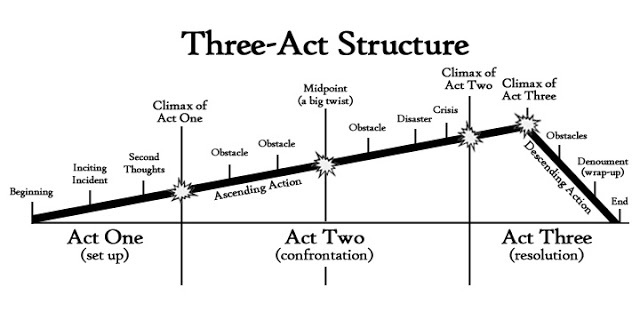
Most plots can be split into three acts. The Set Up (beginning), The Conflict (middle), and The Resolution (ending). Each of these acts should have some defined crisis or event which is like a doorway your character passes through and must either change, fight, or overcome more trials until they find resolution. I found this nifty diagram from David Harris Kline’s “Structure Lesson #2: The Three Act Structure” ( http://www.writers-for-writers.com/2017/11/08/structure-lesson-2-three-act-structure/)
As you can see the beginning has to hook the reader into a specific event, starting point, or character problem. Here’s where you introduce your character and show us who they are, what they want, what they are facing. Throw in some foreshadowing and Bam! You just met a small-town farmer from Tatooine.
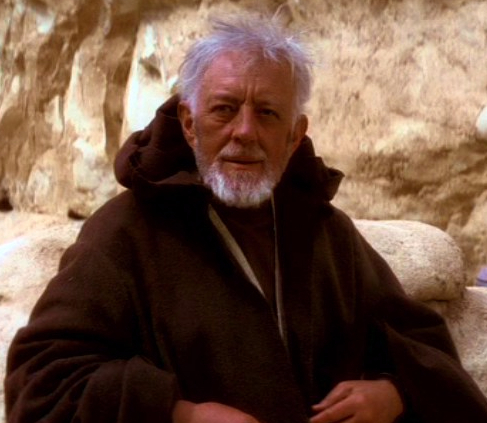
Act II comes with something that disrupts their normal day to day. (Holy shit, this droid has an important message from the Rebellion!) The character is forced to make a choice (wipe the droid’s memory or try to get the message to old Ben).
Real, live image of me during quarantine.
The middle, as most of us know, can be a bitch to write. This is where the dreaded doldrums hit. The quagmire. The swamp of eternal despair. I’m not going to get too deep into that swamp today except to say that this is where plotting can really help build a bridge across the muck and help your character get to that final, defining climax. This bridge is paved with different obstacles and trials that keep the action and the tension going through out. (Scruffy looking nerfherders and tough-ass princesses, oh my!)
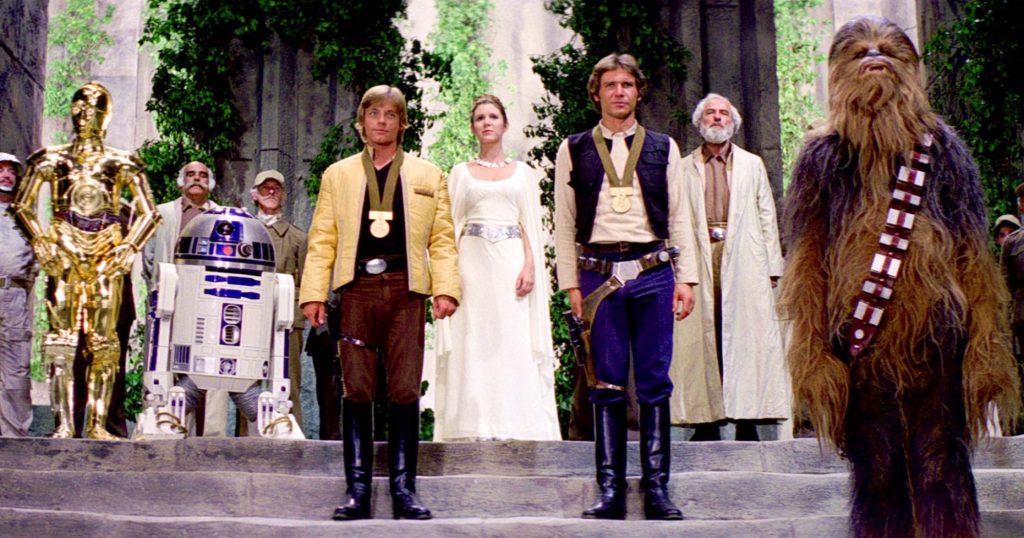
Then, finally, as our hero/ine comes through that final climax (for better or worse) we witness their transformation or acceptance of who they are or what they need to do . The final act is where you tie up your loose ends and give the audience the resolution they’re seeking. Like giving a Wookie a medal.
Wait a goddamn minute…where’s Chewie’s medal?
Well, that’s pretty much all I wanted to cover on plot for this time around. Next week we’ll be talking about one of my absolute favorite aspects of writing: Characters.
Until next week, diagram your plot, think about what events, scenes or characters you can inject to get those bursts of conflict. Think about what your character wants and what obstacles stand in the way of that. How does overcoming them move them/change them for the next bump in the road?
Good luck out there, and may the Force be with you.
Well, well, well, if it isn’t a day away from that ridiculous, capitalist exchange day. You know, the one where we exchange affection for $8 cards and a box of (probably last year’s) chocolates to prove we are enamored with one another. Valentine’s Day has become a symbol for showy displays and, in some part, single shaming. I’m always heartened when I hear of people celebrating in counter culture ways, because if anyone needs a big middle finger to the face, it’s capitalism and ‘traditional’ heterosexual misogyny.
So, I’m against love, right? Not in the slightest. Hell most of my writing career exists because I believe in and ache for, and get excited by love. But that doesn’t have anything to do with fancy jewelry or a hearty case of diabetes in a heart shaped box. Love is about connection. It’s about support and reliability. It’s about physical affection (not necessarily sex) and putting forth the effort to remember what they take in their coffee. It’s about hearing the exhaustion in their voice and ordering dinner in. It’s about sending silly memes that remind them of you. It’s a million different things that don’t necessarily have to put money into the corporate cesspool. If you’ve never read one of my books, the ongoing theme of them is that Love is something to be worked on and perfected. Love makes you want to be a better person. Love carries you past the hardships and centers you in the storm.
I’m not against love. I’m against my feelings being taken hostage and only released if I pay their fee. I’m against having to ‘prove’ affection with overpriced flowers or the anxiety of ‘choosing’ the right gift. Let me sleep in on a Saturday and bring me coffee in bed…that’s love. When I’m cranky and raging, kiss my forehead, tell me I’m right and the world is a fucking mess, and go take a warm bath, that you’ll clean up dinner. Be open and honest about your emotions and trust me enough to love you no matter what.
I urge you on the upcoming holiday to think differently about how you express your love. Write a poem, or if you’re not a poet-y type, find a poem and send it. Pick them up a coffee or tea on your way. Support a local book store and take them there for a date. Put on their favorite movie and sling a frozen pizza in the oven. Hold them when they cry. Turn off their light for them when they fall asleep reading. Give them the first cookie out of the oven. Clean up the cat vomit so they don’t have to…these are the things that make up love.
On a larger scale, I urge you to think more expansively about love. Stand up for others. Use your privilege and any means necessary to protect human rights, and the constitution. Protect science, and education. Fight for living wage, and lower cost medical services, adopt a rescue pet, donate to the food bank, donate blood, hell-donate a kidney, don’t allow disadvantaged voices to be silenced in any room you’re in. Fight for equal pay and stand between bullies without warrants and people just trying to live a better life. Join the resistance, support the National Park Service, and keep reminding Google that it’s “The Gulf of Mexico”. There are a million ways to show your love, that don’t need to put money into the pockets of corporations who’ve sided with a traitor to democracy. That makes up the larger love that we all need so desperately right now.
Can you believe I couldn’t think of a more creative title? Me neither. Some days are like that. Remember, this is geared towards beginning writers, so most of you long-in-the-tooth novelists may not get the same bang for your buck. But…there are a lot of sexual innuendoes. You’re welcome, or Sorry.
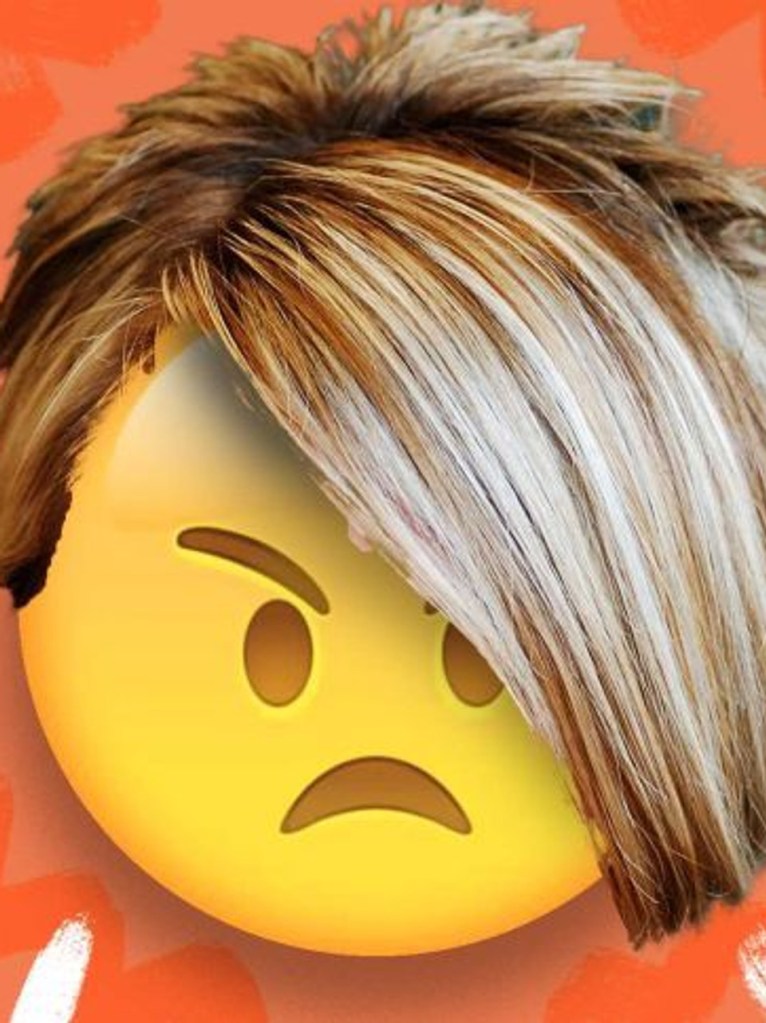
Today, I’m pushing through and rehashing an old, but viable post. Remember? Before the fucking world turned upside down and Elon Musk became president with Absolute Power? Yeah…those were good times. Let’s not dwell, you can call your congress person again (you’re calling right?) and attend those protests (you’re attending right? This IS the time to be the MOST KAREN you can KAREN–see below for my favorite emoji of the species) after this short and entertaining jaunt into PLOT. We’re getting into the meat and potatoes of writing a novel, and this kind of thing needs space. So, without further ado…
What is Plot and Why is it Important?
All right, I get it, it’s a dumb question, we’re all writers and we all KNOW that plot is the basic structure and story of your novel. It is the idea. The “what happened”, and why, and “what’s going to happen next” of any decent story. I’m not trying to dumb it down for you. But the true test of a good plot lies in the simplicity of answering those questions.
Now, you can have books that are character driven (an event happening TO a person, or BECAUSE OF a person). And you can have books that are historical non-fiction, based on one specific moment in time or occurrence. The PLOT of your book expands more than just beyond an event (otherwise The Hunger Games would have been maybe 50 pages long). The plot is the premise or sequence of events. Some novels will follow a very specific order of events that are common to their genre, or as we like to call them tropes. Tropes comes from the Greek Tropos define as “turn, direction, way” and refers to common, recognizable elements or sequences of events.
Many genre specific tropes (I almost prefer ‘formulas’) are embraced by the audience and even expected. Examples include: “the hero’s journey”, “enemies to lovers”, “small towns”, “cold cases”, “missing persons”, “AI gone wrong”, “fairy tale retelling”. But if almost every novel follows a plot formula how is it #1, that readers don’t get bored and #2 that you tell an original story that hasn’t been done before.
It’s an interesting dilemma on the part of a writer. We know which formulas work in fiction and straying from them often makes a plot fall apart or leaves a reader angry or unsatisfied at the end.
(She’s gonna want to talk to your manager)
But how do we follow commonalities in plot structure and still make it a fun, captivating, and surprising journey for our readers? The answer my friends, lies your ability as a writer to do five things: (Fuck Yeah! A bullet list!)
Begin with a unique event or crisis. This comes back to the “scan the headlines” exercise I’ve had you do before. A lot of weird shit goes down in the world. A lot of undercover, shady AF stuff too. Use it as a springboard, to your “what happens then/if” story building.
Tie the reader to your character (through love or hate) and make their reactions to events unique or contrary to the norm. (ie a cheerleader who fights vampires. A small town farm boy who becomes a powerful Jedi. A teenager who comes into supernatural powers without the maturity to handle them and doesn’t use them to download free porn–come on….or *snicker* cum on? Oof, sorry. Uncalled for. Please keep reading, I’ll behave.) Character building will come later in this series but if you create unique ones, their actions will create new takes on formulas.
Use honed writing technique to build tension for climaxes. Yikes, that sounds dirty and here I promised to be good. Tension is one key to making a story more than just series of events. So much of this depends on your voice and writing style. But the big take away here is about risk. Making the risks personally huge for your character, and even the world at large, will keep the plot fresh and drive it forward.
Play with the number and intensity of climaxes (story arcs). I think I’ll start using story arcs (some prefer ‘beats’) because every time I type climaxes I can’t stop giggling. Ok. Story arcs are BIG deals in your plot. Think of these as door ways, crisis-points at the top of your arc, that your character has to move through in order to get closer to what it is they want/need. Once they hit that doorway, or crisis point, they can’t go back. A serious change has occurred either in the setting or with-in the character and they must move forward. Next blog will be all about these arcs so I won’t go into much more detail here.
Consider using unexpected but intelligent twists. The best movies and books I can think of that do this are: “The Sixth Sense”, “Fight Club”, “Gone Girl”, “Mind Hunters”. What better way to shake up an audience than by having them accept one reality for the entirety of the story, only to show them the true reality at the end.
All right, so there are some tips for building an effective plot that carries readers throughout the book. My advice to you this week, is to explore various tropes and patterns, especially those in your genre. Turn a piece of paper (landscape-style) and write out the typical pattern of your story, then overlay events and characters of your proposed idea. See how they match up, see if you have enough tension building scenes, just play around with it. I’m not much of a plotter myself, but even I will do a general outline to keep myself on track and make sure I’m building a solid plot.
Next time, more on story arc, how to climax well (*snork*), and end satisfied (*hahahahaha). Until Thursday, happy writing.
Sort of hard to think about a future right now, to be honest. But resistance and rebellions were not built on giving up ground. So, I keep getting up. I keep supporting the people I love and the people who are in the most need, and I keep practicing my art. I’m writing representatives and flooding ICE hotlines with tips to look into the financial contributions of an illegal immigrant named Musk. I’m donating money to Planned Parenthood and frequenting the library. I’m making sure that my organization (Writing Heights Writers Association) will always honor Diversity, Equity And Inclusion. That I understand privilege poisons the well of our society and I am a part of that, so it’s my duty and my honor to use what little power I have to uplift everyone in my community, support them, listen to them, and advocate in ways that help them most, not my ego.
On top of that, here are some things I’ll be doing. If you’re in the area, or are interested in supporting my writing organization or my career, you can. For the record, WHWA is not a non-profit, but its not a money maker either. It’s a zero-sum game after I pay the bills and the teachers so, know that if you sign up for a class, or register as a member, your fees go to teaching and supporting writers. It is a labor of love and I hope I can do it for a very long time.
Here’s a Bullet List:
Starting in February, I’ll be looking for Beta readers and reviewers for my newest book, “No Words After I Love You” is a beautiful homage to love, grief, and how we, as humans cope with the shifting changes, losses, and heartaches in life while still being open to love and joy. It follows two older friends on a journey of rediscovering their fire and making peace with the past. I’d call it contemporary/literary fiction with a romantic/philosophical twist. Let me know and I’ll send you a copy.
WHWA is hosting classes at the end of the month in February and we’ll be talking about Plotting (Cristina Tripani-Scott) and How to Write Emotion in Fiction (me) You don’t have to be a member to attend and it’s all virtual so you can come in your pjs. Here’s the link to register: WHWA CLASSES
Registration is opening up in February for WHWA’s Spring Workshop and Retreat. This year we’ll have two tracks: Memoir and Creative Craft. There will be morning yoga, evening readings and socializing and plenty of time to write if that’s how the time serves you best. All up in beautiful Allenspark with views of Longs Peak and Rocky Mountain National Forest.
In March (the 12th) I’ll be giving a talk at Founded in Fort Collins, sort of a community organizer/entrepreneur conference, aimed to help small businesses, nonprofits, and aspiring hopefuls navigate the world. My talk will be about the importance of writing, and getting your voice heard. Here’s the dets:
They have socializing/networking hours as well as class time
I’m pitching two new novels to 5 Prince Publishing. Each is the first novel in a three-part series and I’m excited to get back into some fun, escapist romance. One is a time-traveling, historical romance, and the other is an odd hodgepodge of paranormal romance. Both have higher spice factors so…yum. I’m hopeful to get them out towards the end of the year, depending on how badly written they are and how much work my poor editor has to do.
Well, that’s all the news from my corner of the world. I hope you are doing good and just things from where you’re at. Be kind, work hard, don’t falter. Change happens with consistency and determination. We’ve got those things, so don’t lose hope.
I’d been trying to think of something writer-like to put on the blog this week. I am, after all, a writer and my blog is about more than just book signings and the random outburst of poetry. It’s a space for aspiring and seasoned writers to not feel so damn alone. To know that we exist in a universe together, with other, weird little writers. We inspire and uplift each other. Sometimes we are cautionary tales, or serve as examples good and bad to one another. We critique and offer hands up, teach and learn, all together, knowing that the heart of an artist is surrounded in a soul more sensitive than most.
We see the world differently. We hear it and smell it, and absorb it. We make connections and notice the little things that many don’t. Its often why we suffer so much more greatly. But this week. This week I watched and read as whispers of misconduct became horrible, horrific truths. About someone I used to admire very deeply. Someone I thought understood and abhorred causing unnecessary suffering. I read his books. I read my children his books. I bought his graphic novels, I enjoyed his writing advice. He was incredible and creating characters and monsters.
Then the truth came out that he was one. A true-to-life monster.
For years, and in very dark and disgusting ways, he committed monstrosities. Ways that I cannot as a feminist, as a human, as an artist, or as a soul made of stardust, reconcile with. It took every one of his books off my shelf, and put it in the recycling bin.
But you can hate the artist but love the art, right? All of those terrible acts don’t negate that he’s a good writer… Here’s where I brush aside that morally gray line.
NO. I can’t love the art of someone who’s soul is so rotten and sick that he’d do that to another person.. Yes, those terrible things DO negate that he’s a good writer. Because the brain that created those words, also created and excised pain and terror on actual human beings.
Here’s the bottom line. I’m fed up with a world offering excuses to people who behave this way. Weighing a ledger between talent and atrocity. Where its ‘kinda okay’ because I don’t want to give up my special editions? No. It matters. It matters who we support and what we allow, and I’m done allowing it.
I took his books off my shelf, for those girls and women. For my daughters, for anyone who’s ever fallen victim to a hero, and every hero who’s ever taken advantage. That’s not heroism.
He’s not allowed in my house anymore. I’ll never willingly read his words again or buy any more of his books. I hope he turns the monstrosities and horrors he put out into the world, back in on himself where they belong.
Good morning writers, authors, editors or accidental guests.
I’m trying to find more efficient ways to work this year and I found this old series in my back catalog. Now, I teach writing and support writers for a living but I think these little nuggets of advice (free) are actually still pretty good and relevant. So starting today, and for every Second Thursday on my Blog, I’ll be offering a little writing advice.
I call it the The Beautiful Writers Workshop, based on the quote from Ray Bradbury about filling your cup and letting all of the beautiful stuff pour out. This year-long journey is about developing your craft through exercises in creativity, editing techniques, inspirational prompts, and building the framework for your writing career.
Some of the blogs will inspire. Some blogs will lean more to the technical side of writing. But whatever the monthly topic, you can be assured of two things:
You’ll have a prompt or exercise to help develop your writing (and the opportunity to share it)
I’ll try to keep it spicy enough to be enjoyable.
So let’s get rolling! I searched through nearly all of my favorite books on writing for a perfect topic for our first lesson together but the truth is, there are just too many (good and bad) ideas out there.
So I’m going to start simple and ease you in gently to this process.
If you’re here you are either interested in writing, or are already doing it and are looking for something to add to your tool box. In order to appeal to all levels today’s workshop is centered on the basic purpose of your writing.
Below are a few questions that I’d like you to read, think about, and journal down your answers to. You can share them, you can keep them secret, but DO WRITE THEM DOWN.
Something amazing happens when we write down goals and steps to reaching them. The process becomes manageable; the goals become real. It’s one of the many beautiful and powerful attributes of writing.
Without judgement or discouragement, and being as direct as possible: what is the ultimate, lifetime goal you have for your writing?
What can you do to kick start this goal in the next 12 months? (hint: where do you need to start, where do you need to grow most for the big picture)
Is this yearly goal attainable? WHY OR WHY NOT?
Of your reasons from #3, think about the fears, limitations or concerns that formed these reasons. Name them. What do you foresee keeping you from moving forward on this yearly goal?
Of the fears, limitations and concerns, what are the possible solutions or actions you can take to eliminate them? (hint: each limitation/fear/concern gets its at least one action you can take to overcome it)
If you have a planner or calendar, write down one weekly goal (eliminating distractions, word count requirement, number of submissions out, editing, classes etc) that will help overcome the hurdles you have to your writing.
Looking at these weekly goals, find specific and measured times you have to dedicate to their success and write them down.
Okay, that’s it! I know, it’s a little dry but when building a house you have to have a solid foundation first or none of the pretty architecture above it will survive. So build your foundation, know where you’re coming from and next week we’re going to talk about:
Mission Possible: Drafting your Writing Mission Statement
(that sounds super boring but it will help writer’s across the spectrum. I promise!)
Hey there, consider this a ‘newsletter’ of sorts. I’m sure you’re all DYING to know what’s going on in my life, and have nothing between Thanksgiving and the Winter Holidays to keep you busy, so here’s a short run down of what I’m doing.
First, there’s going to be a little party, the last in the physical office of Writing Heights Writers Association, December 7th from 1-4. There will be food, books, good conversation and a teary (probably, I know I’ll be crying) send-off to our amazing director, Amy Rivers. She’s had a lot of battles this year and her bravery and fortitude has been inspiring. With so much weight to carry, it hasn’t been easy. But, in doing only a small part, I’ll be taking over for her as the director. And though we’re unfortunately losing her as the leader and our office (I wish I had the funds to keep it but rents are high) we will still be providing support, inspiration and services to writers in the community and beyond. In January I’ll be announcing some exciting opportunities and some return to activities that COVID had put a pause on.
Second, If there are classes or topics you’d like to see more of through WHWA, please let me know. If you’re struggling with a certain skill or marketing aspect, I want to know so even if I don’t know the best answers, I can find a super smart person to help you with it. Also, we’ll be bringing some longer, more in depth workshops for our members so if there’s something you want to deep dive into (memoir, screenwriting, character development, book launching) let me know and I’ll try to get it put on the schedule this year.
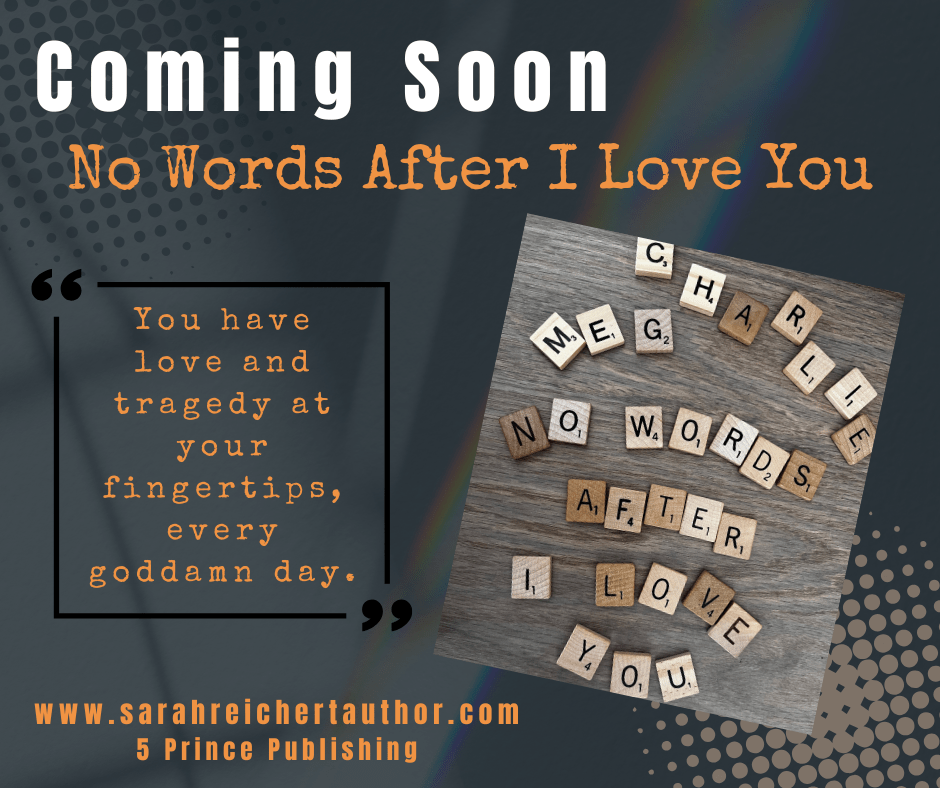
Third, I have a new book coming out with 5 Prince Publishing! It will be released May, and y’all, this is my favorite yet. I know we’re not supposed to have favorites, but…No Words After I Love You is an expansive and beautiful trek through grief, creativity, loss, acceptance and love. Its funny and poetic and…there aren’t any steamy scenes but it’s one of the best kisses I’ve ever written so… Gosh, I really hope it does well. More details to come.
Finally, my sweet kiddo will be going in for surgery mid month. A pretty scary, big surgery and I hope you’ll excuse me from being absent from the world for a few weeks. Wish us luck, send us all your good thoughts, and hug your babies tight (even if they’re teenagers and hate it). So much of our lives are wrapped up in their survival, thriving, and living a loved life, so I know you’ll extend me grace if I can’t get to emails and requests as quickly.
That’s about all the news that’s news. I know I’m supposed to include some links to my books or something? So…here’s where you can buy my stuff. Also, I appreciate it if you do, I don’t make much as a writer but there will be some hefty bills coming up and every bit helps.
I can’t tell you how much of my life I overthink. From what a friend has said, to what the scowl my daughter is giving me means, to the side eye my dog throws at me and the head shaking the man in the car next to me offers when I’m belting out Blink-182 lyrics… I overthink it all. I overthink every decision (but if I have a bagel without the egg I’m going to be hungry, if I brush my teeth now they’ll just get dirty because I want one more cup of coffee, but if I don’t brush them now, it might not happen today…) You see what I mean?
So when I’m given (or read, or listen to) writing advice, I tend to do the same. I over calculate how many chapters I should be writing a month to finish a book in a quarter. I’m diagraming the hell out of my character’s backstory (after a pantster first draft that feels too tepid). I’m getting lost looking at internet trends, publishing tips, and marketing plans… And so much of these grand ideas, sparked by advice to help in the long run (some don’t) but what they for sure do, is take up time. And invested time like that isn’t just the physical hours but the mental energy that it takes to process it all. Less mental energy means…less writing (or less quality in the writing?)
Recently, I read this great article on the timeless tidbit of: “just write”.
I mean, admittedly, it’s kind of a breath of fresh air. Simple. Not complicated. Correct. To be a writer, to finish your novel/story/project, you must actually write it. So…just write.
But it’s also oversimplified. If writing were just that easy, every person who’s ever come up to me and said “I’ve always wanted to write a book” or “I’ve started a novel but I can’t seem to finish it” would have oodles of books written. Wants made into dids. I mean, “just write” makes it sound like all we really have to do is sit down, the words will come, the knowledge will be there and the novel will march through beginning, middle, and end without fail or hiccup.
But writing isn’t simple. It’s akin to playing an instrument, and doing it well. Anyone can pluck the strings of a guitar. Anyone can thunk on the piano keys, but it takes more dedication, thought, and skill to actually play a song, none the less write one. But the practice is the road towards a better song.
So, as this pretty smart writer guy said, we should instead “Practice Writing.”
Practice Writing. It is better, no? You’re still doing the writing thing, but it comes with the lightened atmosphere of it being something continually tried and worked for, something offered, reworked, and perfected, but never perfect. Something we find joy in, while still being committed to the process of it.
And it helps me not over think it. Because every sentence, scene, poem, blog, or chapter I indulge in, is a practice, and a learning opportunity, but not a commitment to perfection. And just like an instrument, through trial and error, and time spent, we writers will get better and better. So, I beg you to go forth, and practice your writing today. Whether it’s 2000 words, or 20. Every plunking of the keys counts towards learning the complete song. Every word, every thought, every rambling blog post, is a writer in the making.












 Sarah Reichert Author