Making the Most Out of Your Retreat

Hey writer and fellow creative friends. Wherever you are on your artistic journey, I hope you’ve considered the benefits of joining or participating in a retreat. Now, retreats can range from the ridiculously expensive, to renting a room at the shady looking motel three miles away. Some have classes or workshops, some have yoga or hiking mixed in, some are just straight up writing time.The point is to get out of your normal space, away from your normal routine, and spend that time focusing on your work. So whether you’ve broken the bank to jet set off to the French Riviera or you’re on your way to a twin room at the Motel 6, these tips can help you get the most out of that time. I even put it in a nifty little bullet list.

  • Be Prepared (Mentally):
    • One of the best tips I have, is to make yourself a list, before you go, detailing what you want to do, or get out of the retreat. Are you hoping to network and make connections? Are you aiming for a certain word count, or project completion? List out the major goals, then leave space (I’ll tell you why later on)
    • Be realistic but also a shade optimistic. Know your average, everyday word count and think about doubling or tripling it. You’ll have more time and less outward distractions and setting that goal will keep you on track. By making it a little challenging you’ll push yourself just enough. Even if you don’t hit the goal, you will get farther than if you’d been too ‘reasonable’.
    • Bring multiple or at least a couple different things to work on. The hours can become tedious and you might want to switch it up to stay fresh and motivated.
    • As a mom, and working mom, a strange thing happens the first few hours of being alone at a retreat. I get this thing I call “care-giver paralysis”. In the absence of doing for others, I can’t remember what to do with just myself. Understanding that this feeling will come, and I’ll have some listlessness helps me to remember to ease into the weekend with some journaling, or shorter projects.
  • Be Prepared (Physically):
    • The practical side of things is that you’re going to be away from home. But not on a typical vacation. So remember to bring your goal list, paper, pens, notebooks, journals, your laptop and charger…the basic tools of your trade. Make them your favorites or the one’s you’ve been ‘saving’ for something special. This is something special.
    • Plan for the environment: If you’re poolside or in the mountains, bring the proper clothing and footwear. You won’t be holed up in your room the whole time (I’ll explain more on that later). If there are dinners or classes, if it could be cold, or hot, try to think in layers. If its just writing, pack lots of comfortable clothing. Sunblock, hats and mittens. Bear spray or Mosquito spray?
    • Sleep aids- especially if sharing a room. I’m talking about eye covers, ear plugs, and headphones (not a rubber mallet if your roommate snores). Anything you need to get a good night’s rest.
    • Any special dietary needs/wants that the place won’t be able to provide.
    • Water bottle, medication, and bathroom necessities. Nothing is worse than being dehydrated and/or not having a toothbrush. Big and little comforts will make a huge difference.
    • Business cards. Holy shit, I can’t tell you how many times I’ve forgotten this one. Even if you’re just there to write, exchanging info with your fellow retreat members is great. You’ll be surprised how much you learn from one another in that time.
    • Tech that you need, none that you don’t. You’ll need brain breaks, you’ll probably want to check in with family once or twice, you may need a laptop. You probably don’t need your gaming system, and be careful of your social apps. This is a time for connecting with yourself and your art, not the 7 billion people of the world.
  • Be Flexible:
    • You’re going to have a goal list. You’re probably going to stray from it. That’s alright
    • There may be days when the word count fizzles or the scene doesn’t play out like you want. That’s okay.
    • There may be a project you exceed expectations on, and another you barely touch. That’s alright.
    • You may accidentally sleep in, or need a nap, or get caught up in conversations. These are good things.
    • Retreats are a balance of getting your work done, and taking care of yourself, which leads me to…
  • Schedule in Self-Care:
    • Bring along comfort. Your favorite pillow, blanket, clothing, music. Whatever it is that helps you feel relaxed and at home.
    • Take naps. You’re little brain is going to be working extra hard. It’s going to be focusing for hours and working through the plot holes and dialogues you’ve been avoiding. Schedule in time for naps, early bed times, or meditation on your goal list.
    • Take advantage of the outdoors. (Unless your Motel 6 is in a shady part of the city–then try to grab a Lyft to a safer part) Go for a hike or walk every couple of hours. Sit outside stare off into the far away for awhile. Your eyes and brain will thank you. Also schedule in brain breaks on your list.
    • Bring any nutritional or necessary snacks. I need coffee in the morning. I need tea before bed. I need fresh fruit and veg. I like hydration mix and the occasional bourbon on ice (not together, that would be gross) I want my Little Debbie brownies and my twizzlers. These little joys will keep your spirits up in the middle of the tough work.
    • Exercise, Mediate, Drink lots of Water, and take warm showers. All good things and breaks away from the intensity.
    • Skimping on self care will make you less productive and more likely to burn out. Nobody wants a mushy brain half way through.
  • Assess and Recalibrate:
    • After its all over, if you’ve got a drive home, or a flight…take some time to reflect. What went well? What was a challenge? What did you wish you had? What did you bring that you could have left home?
    • How did your goal list go? Did you overshoot? Did you get distracted, and by what?
    • How do you feel physically and mentally and how can you make sure that the next retreat leaves you feeling accomplished without being overwhlemed.

Well, there you go. I’m open to hearing if you have any other advice in the comments below. I’ll be heading a retreat next week, so if you’ll be there, I hope we can make it a great experience. If you can’t be there, I’ll be hosting another one in the fall with the Writing Heights Writers Association and I’ll let you know the details as they’re finalized. Until then, Happy Writing.

Begin Again

So here we are, at the precipice of a new year and probably, in some part, still reeling from the last two. I recall, vaguely, that at this time last year I was filled with hope that things were about to get better. Then, events in the first week of the year reminded me that the calendar rolling over didn’t wipe the slate clean on the world’s troubles. It’s just a date. Not a miracle.

The only comfort I had, and still have, as we again sit at the top of 2022, is that I have control over at least one thing in the world, and that’s how I live in it. So no matter where you are, in physical or mental space, take an opportunity to day to think about what you would do if you could begin again. The date may be arbitrary, but the idea is sound.

Everything you’ve lived through up to this point has prepared you for the challenges ahead. Everything that you’ve seen, learned, failed at, succeeded at, has built in you a resilience for the journey ahead. So while we shouldn’t dwell on our pasts (whether it be to regret–terrible thing, or to relive glory days–also unhelpful) we should remember the value they have given us. Every experience, hardship, joy, failure, and triumph has added to your soul-resume and will give you what you need for this next year. I believe that whatever it is you set your sights on, whether its finishing a book, starting a new job, getting out of an abusive relationship, or giving yourself more grace, you will find success. But don’t just throw vague intentions out. Make a map.

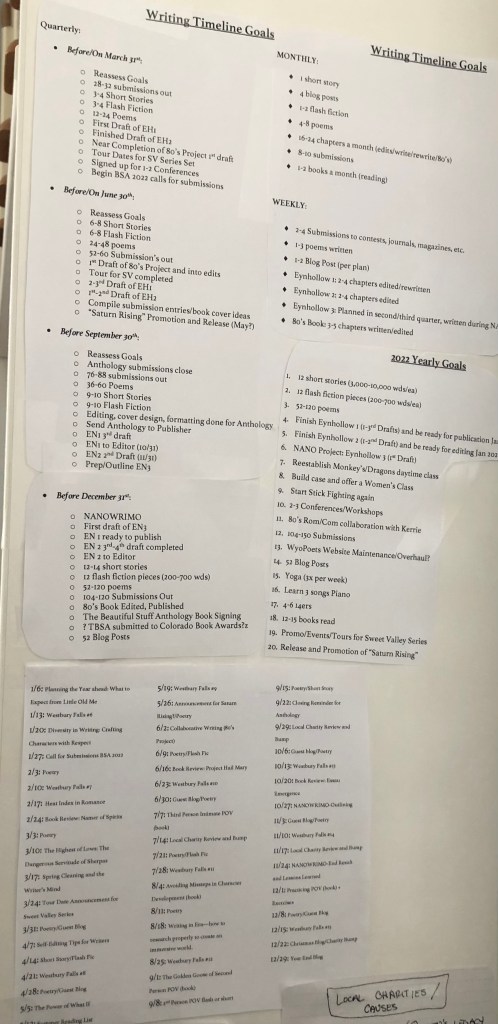
Now how detailed you want to get depends on your level of focus, your own acknowledgement for order, and what works for you. I like to start with a general goal list, break it down by quarter, month, and week, and hang it up where I can see it. So when I find myself caught up in pitbull puppy videos, its looming over me, reminding me to focus.

That’s a shit-ton of bullets…*sigh*

At the beginning of the year, it looks daunting. So I have to remind myself, even if it’s on paper, it’s still fluid. Just because it’s all there, listed out, doesn’t mean it all gets done today. Like any journey, goals are a series of steps, one after another.

This year, I’ll be trying a few different things, and I only squawk about them here as a measure of accountability.

In the spring (March-ish) I’ll be releasing my Western Romance Series and planning some tour dates in my home state of Wyoming to promote it. This will include book signings, readings, and Q and A sessions. I’m aspiring to submit short stories, poetry, and flash fiction to at least 100 different publications (aiming for 100 rejections but my hope is they aren’t ALL rejected). In May, I’m hoping to finish up a collaboration with a local press for my Sci/Fi novella “Saturn Rising”. The blog will continue with weekly writing advice, poetry, guest blogs, and a special series on local charities, the work they’re doing, and how we can help keep them running. This year’s Anthology is not yet themed but I’m shifting over to include short stories, essays, and excerpts. Stay tuned for more details. This year, winning entries will be published and receive a monetary prize.

I’ve got my first co-authoring project in the works (a fun romp and homage to my love of 80’s pop culture) and will be working on my next series (I’m getting all Urban fantasy this time).

Outside of writing, I’ll be teaching a few more classes, continue advancing towards my next degree (Sensei Sarah has a nice ring to it), reading more, I’ll climb a few more 14ers, and work this old body into more flexibility through yoga. It all feels like a lot, but days are made of minutes and you can do a lot in those minutes….once you choose to begin.

Good luck out there. Come back and visit to keep updated on the anthology submissions and so we can check in with each other on our new starts. Above all, let’s just be better people this year. The best versions of ourselves we can be.

Reflections on Goal Setting

When I first took a class on goal planning for writers last year, the intention was to create an environment and a year where I carved out space for my writing as I would a career. Now, as we reach the end of another year (yeah, I hate to tell you, but its only a few hours away) I wanted to take the time to look back and let you know what worked, what didn’t, and what I could do better next time. Not so much a bragging post, this is more to offer you ideas of your own on how to pursue your writing career without feeling too overwhelmed.

Every great endeavor seems impossible while you’re standing at the base of it, wondering how best to begin. But journeys are not made in great leaps and bounds, they are made by singular footfalls, one in front of another. Maybe your goal is to finish your novel, memoir, poetry book, cookbook and have it ready for publication by December next year. That’s a huge leap when you’re staring at an empty page.

I’ll be the first to admit, I’m not a planner when it comes to the creative process of my writing. I don’t outline in detail, I don’t diagram, and I sure as hell don’t employ computer programs to chart the course of my books…but–being the little virgo-seque, organizational lovin’ nerd I am, I do like a set plan for how I get from blank page to finished book.

So rather than try to eat this whole goal at once, try taking little bites. I realize it seems over simplified, but what what worked best for me was breaking down my goals by first naming the end result I wanted, then thinking about the benchmarks I needed to meet every three months to make it happen. Then I broke it down further, to what I needed to do every month to meet those benchmarks, and finally what I needed to do every week so that it was manageable within my life.

In example, I wanted to submit at least 55 pieces of work this year. That meant that every month I needed 4 to 5 submissions, or one + a week. It’s hard to think of 55 poems out for submission all at once. I don’t think I would have been able to feel capable. But one submission, every week was something I couldn’t find an excuse not to do.

I wanted to finish editng three novels and have them ready for publication. I didn’t try to cram them all into a month. I broke it down to 3-6 chapters a week, which gave me about four rounds of in-depth editing for each, including a Beta reading round.

Having defined goals in mind is essential, allowing yourself room to wiggle when life gets complicated (because life always does) is just as important. That’s why at every quarter, in my planner, I would write down a day to reassess. What was working? What wasn’t? What could I let go of? What was I ahead on? It helped me understand my work habits and held me accountable to myself more than just a post-it of ideas on the first of January.

When life got complicated, overwhelming, and sometimes down right depressing, I gave myself room to let go of what I no longer deemed as important (I didn’t read 100 books this year, but made it through about 15–plus 12 read-throughs of my own novels). I reprioritized the schedule so that the things most important to me (family) would have first dibs on my time and used what I had left to do my best.

Even while giving yourself grace, don’t give yourself the excuse to quit. I find, no matter what the task, if I’ve set a deadline on a particular project, I will almost always finish it on time or before. Having a date to work with helps boost the sense of urgency and makes you delete social media from your phone so you aren’t wasting even one minute that you could be writing/practicing/editing/researching/submitting.

So that’s pretty much it. Because I love you (of course I do!) here’s an easy bullet list reference:

  • Set defined, obtainable goals. Pick anywhere from 1-5, but don’t go crazy. You’re only human.
  • Break them down by quarter, month, week, even day if need be.
  • Schedule rewards for meeting your goals on these timelines.
  • Allow yourself room to drop/add/readjust if something isn’t working. The journey won’t go anywhere if you’re passed out on the side of the trail with exhaustion.
  • Set defined dates for benchmarks and completion of the steps toward your goal. In other words: Give yourself ‘Due Dates’.
  • Make sure you understand your “WHY”. Why are you doing this? What are you seeking? Is it fame? Closure? Justification? The “Why” is never wrong, and you will need to return to it when things get tough.
  • Set your goals and break down the schedule you’ll need a week to two before the start of the New Year. Nobody wants to wake up New Year’s Day and try to muddle through big plans. Start thinking about it now and give yourself time to figure out what’s obtainable and most desired.

Well, I’m done talking. I appreciate you giving this blog a look over and hopefully getting the gears turning about your goals for this new year ahead. Drop me a line and let me know what you’re planning to do (this is a good exercise in accountability–if you’ve told someone you’re gonna, its an extra source of drive when you don’t feel up to it.)

Happy Writing.