A Super Secret Guide to Finishing Your Damn Book. Part Deux: Seeing The Bigger Picture

Bonjour!

I’m so glad you decided to come back.

How was last week?

Did you separate the amoebic tendrils of your technological parasites long enough to remember how to write, free-style? Did you get hand cramps? Keep it up, before you know it, you’ll be cleaning and jerking 7,000 words a week, vocabularian veins popping out all over the place.

For this week we’re going to zoom ahead to the future; to the cumulation of all your writing efforts and the massive chunk of story sitting in front of you. All of those beautiful words you’ve poured into a pile are just waiting for the dexterous hand of a good story teller.

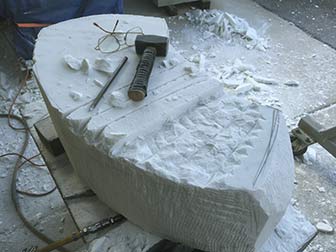
Your rough draft is like a thousand pound hunk of stone. If you want to get all “Americana” on it, you could even say its akin to a 100 pound ‘pat’ of butter. Yeah, let’s go with butter.

The rough material has potential. Your story has energy and power. But if you were to send in a stick of butter to the Iowa State Fair judging committee, they’d probably to one of three things: write you a scathing review for wasting their time; send it back and write a scathing review for wasting their time; or batter it, deep fat fry it, and send their thanks for the mid-morning snack.
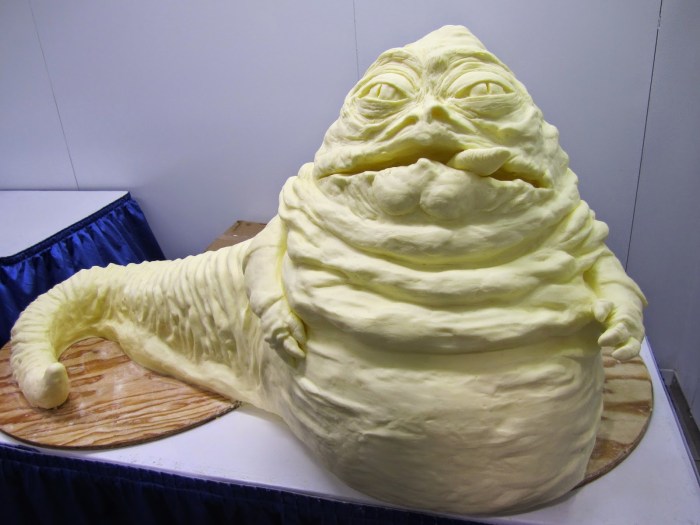
jabba butter
Jabba the Butt(er). No? Come on. You have no idea how many hours I spent looking at butter sculpture.

Your book, your words, your ideas deserve better. If you loved it enough to write it, then love it enough to shape it into the best it can be. And by that I mean…learn to edit your work properly. This week’s true secret to finishing your damn book is something you won’t hear from a lot of writers and here it is:

Being a great writer is 20% writing. and 267% editing. Shut up, I’m not good a public math. Seriously though, when you get your ass in that chair and throw all the good and bad down, and your mind learns to work in the space and time you give it to create, you can really accumulate a massive amount in a short period of time. But the art of writing, the finesse, the je ne sais quoi, if you will, lies in the ability to edit that beautiful mess into a story that captivates.

Que voulez-vous dire?

How does this magic happen, you might ask? If you’ve been around in the writing game for any amount of time, you’ve had the old adage banged into your skull over and over “Kill your darlings, Kill your darlings…” Yes…yes Maestro Faulkner, whatever you ask!

What does that really mean? Well–*le sigh*–it means you as a dreamer, a wordsmith, a lover of story and character…you, creator…must become a destroyer. A hard, eagle-eyed machine; disconnected from the rapport you’ve built over the years with your characters. You must let go of the personal angst, pain, and joy you’ve brought into the world enough to see its true potential. You have to take that beautiful hunk of marble (or butter) and break the rough and useless parts away to reveal the true work of art beneath.
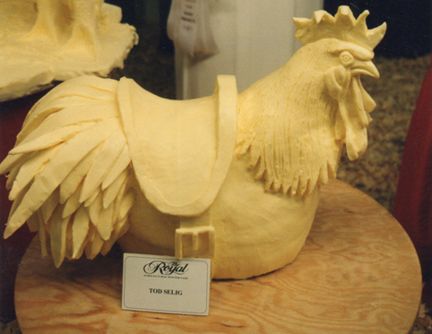
buttered saddled cock
Yep…that’s a giant butter cock with a saddle. You. Are. Welcome. (By the way, ‘giant butter cock’ is now trademarked. By me.)

Oh, Mon Dieu!  (which literally translates to OMD—OMD Becky, regarde ses derrière!)

The practice of “Killing your Darlings” is meant to make you understand that editing is hard. That letting go of the phrases and pieces of your novel that you love, when they are distractions to the story and its flow, can be the best thing you do. Cut. Cut deep. Cut the subconscious catch phrases and passivity. Give your readers a stronger character by making them the center of the action; by putting the reader in their shoes. Stop telling us everything. Cull the useless, the distracting, the stuffy, the monologues and head hopping. Give us the moonlight glinting off of window panes.

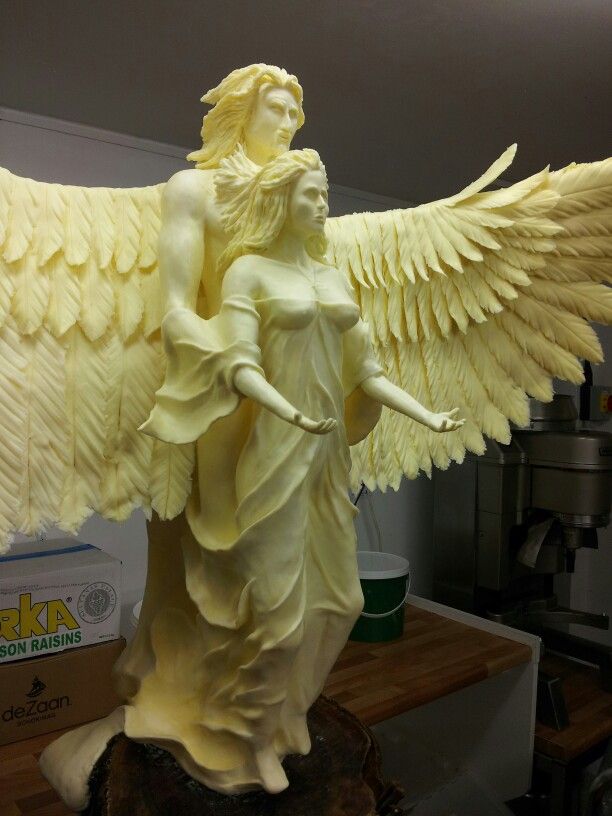
Take that lump and make it into something where details pull double-duty and every word counts. Line by line, strike out that which does not serve purpose or cause emotion to rise in the chest. Because even the most indescript lump of butter can turn into something quite magnificent when given the time and attention it deserves.
angelic butter
Sweet, Angelic Milk Fat.

Next week…after all of you hoodlums have taken a hard look at your work and gutted it to buttery perfection, we’ll take a look at what you can do next to get that silky minx out into the world.

Until then, keep writing. Drop me a line. Tell me how you’re doing.

Does anyone really want a giant baguette right now?



All Editing and No Writing Makes Sarah a Dull Creator

Before you get on some high horse about how editing is a part of writing, allow me to unbuckle your saddle while you’re still on it. I know that the process of being a novelist is a journey of different landscapes. The initial sunrise of bursting light (inspiration) is followed by rocky paths (writing and plotting) and raging storms (character development and killing darlings) to the darkest nights (getting stuck) and comforting moonrise (resolution the big story arcs). Then there’s editing. And it’s important, amazingly important. A piece of shit first draft only becomes a good book because of proper and often harsh rewrites.

But lately… Oh lately… I’ve been spending the majority of my time in edits for 4 different novels coming out this year.

And because it is a constant parade of fixing and rewriting, and cutting, and facing my inadequacies on the daily, editing to me feels like the endless beach scenes in The Drawing of the Three. Or slogging through an infinite desert on your way to somewhere but with no clear end in site. And though it’s repetitive you can never just let your feet (or your eyes in this case) zone out as you plod ahead. Because you’re traversing that same wondrous journey from an outside and judgmental perspective, and at least for the hundredth time and all the rocks seem to look the same, and the plot holes are huge, and there’s that lovely garden that serves no purpose so it must be felled. And when you reach the end, that moonrise? Well, it just skips forward again to the start. And you take smaller steps, sentence by sentence steps, every comma, period, flagrant and free-range POV that escaped the first dozen times. And you know this story and you’re sick of the characters and every step, every sentence feels heavier and heavier and…

You start to wonder why you’d ever want to write down another journey again.

Add to that, when you do sit down to write, you’re brain is in so much of a “Pick this shit apart and find what’s wrong with it” mode that you barely get two sentences in before you’re going back to the start of them to preemptively rewrite. The free flow of the sun coming up over the mountains looks more like a giant yellow strobe light over hills that you can no longer describe off the tip of your fingers like before.

What I’m saying is, I’ve been neck deep in editing now for months, and I’m grateful that I have so many projects coming out this year. I truly am. But if I don’t start limiting those hours of cuts and rewrites, I’m worried I’ll lose my joy in telling a story in the first place. I worry that the editor in me will take over the controls and I will be stuck in self-editing mode long enough, that I no longer am capable of telling a story. Just judging one. That I’ll be stuck in that deserted wasteland where no words are allowed out, because they don’t come out in 20th draft form.

What’s the point of this rant? I’m not sure, except that if you’re a writer, I’d love to hear how you balance out your creativity with the necessary clean up of editing. Right now, I am struggling and it’s left me frustrated, uninspired, and if I may say, more than a little disheartened. And a writer with no heart…

Self-Editing (It’s Not Just for Polite Conversation)

I’ve read a lot of books on this topic, scoured blogs, took any and every class I could at conferences and workshops on the matter, but I always still feel like there’s vast room for improvement when it comes to editing your own work.

Part of the reason is that it’s incredibly hard after writing, rewriting, and rewriting again (times a thousand) to edit all of those words. Not because we’re narcissistic megalomaniacs and don’t think there’s anything wrong with our novel, but because there’s a true phenomenon that happens in our brains as we read (and re read, and re read again) our own work.

The human brain is complex and the way it takes in and interprets stimuli from outside is a complicated and delicate dance. If we were to notice every single thing in our world, we wouldn’t be able to exist in it. The noise, the colors, the sound, the smells are so varied and ever present that our brains would be in a constant state of interpretation that would cause us to vomit, or pass out. Or both. (Which is one of the reasons so many people on the spectrum can have a difficult time coping with crowded, noisy, overstimulating places). As a result, we tend to soften the edges of a lot of information, block it out, or keep it in the peripheral of our consciousness, allowing our brains to make up a great deal of what we take in, through context.

It can be the same as when we edit. We tend to be in a taking-things-for-granted-because-I-read-it-so-many-times-before haze. We coast over the words and retell ourselves the story we already know in our heads, rather than focusing on what is actually on the page.

You, the author who created this magnificent book, know what it’s supposed to say, you know what you meant when you wrote it. So in your brain, when your eyes pass over the words, it will fill in the missed words, ignore the double ones, and forgive the dangling participles because in your brain, it’s reading correct. Very rarely do we ever approach our own work as a completely new reader. It’s practically impossible to do.

Does that mean we shouldn’t edit? Fuck no. Unless you’re incredibly rich and can afford an editor to take your first draft to your final over the course of 9 rewrites. And if you are that author, why the hell are you reading this blog? This is for the poor, struggling authors who are trying to procrastinate their own editing by reading my blog. Not for big money-bag writers who bang out twenty political spy thrillers a year because they have a nanny, and a cook, and a dog walker, and a personal shopper, and a house cleaner…

Where were we—ah yes, self-editing. Here are some of the biggest tips that have helped me produce a much better final version (before I send it in to an editor for the one or two rounds I can afford).

  • Take it line by line, sentence by sentence. Is the structure sound? Does it make sense? Is it passive? Is it clear who is doing the action, who is in control of the perspective? Is there a random “pineapple” thrown in at the end of a paragraph?
  • Read it out loud. When all else fails, read it cover to cover, out loud. That’s when I find most of my mistakes. Or, if you’re not into that (or you live with people who aren’t into listening to you and by people, I mean cats) at least read aloud the passages, paragraphs and parts that feel awkward or over the top.
  • It’s not too late to kill some darlings. I have been known to cut out scenes/sentences/dialogue, in my final rounds that I knew didn’t belong but I clung to them like a freezing poor boy on the wreckage of the Titanic. Save them in a different file, but if you know in your heart it’s there to stroke your ego at your brilliant wordage but it’s not doing the story any good then show some humility and axe it.
  • Check your tense, check your POV, be consistent in those little things because they make a HUGE difference on whether or not your reader can follow the story and isn’t frustrated trying to do so.
  • Print it out. You can get a good deal at local or national printing companies (my local FedEx cashier knows me and it is so heartening every time she asks “new book?” and hands me the brown box of hope). Double sided, nothing fancy, cheapest version possible will still only set you back about $30 for a 250 page book. You will see things in ink that you cannot see on the screen, guaranteed.
  • Get a Beta reader or twelve. Yeah, it’s not really self-editing, but it’s part of the process that will help bring new eyes to your work. And usually it’s a low cost way to get a ‘real readers’ perspective on your work.

All right, that’s all I’ve got. Good luck out there. Don’t think this bullet list will take the place of a good professional round of editing, but it should help in your process. And maybe it can even help turn your first drafts into better drafts.